.avif)
.png)
.avif)


Content
CGC vs PSA Which Is Better for Pokémon Cards?

Short answer: for modern cards, go CGC, far cheaper, no membership, and the resale gap is now small enough that the fee savings often erase it. For vintage cards, go PSA, the ~15–20% premium and buyer expectation are still clearly in PSA's corner.
CGC vs PSA: Which is Better for Pokémon Cards?
The figures below reflect current 2026 pricing and market trends, but they can change.
- Cheapest fee: PSA: $79.99/card plus a $149/yr membership to submit directly. CGC: $17/card (25+) or $20 (no minimum), with no membership.
- Turnaround (cheapest tier): PSA: about 40–50 business days. CGC: about 65 days (Economy) or 120 days (Bulk).
- Top grade: PSA: PSA 10 (Gem Mint). CGC: Pristine 10, a step above Gem Mint 10 and harder to earn.
- Modern resale: PSA: still slightly ahead, about 5–10% (2026 est.). CGC: nearly even, and a Pristine 10 can match or beat a PSA 10.
- Vintage resale: PSA: dominant, about a 15–20% premium (2026 est., the "Red Label"). CGC: weaker for vintage.
- Best for: PSA: vintage cards, and squeezing the most modern resale. CGC: modern cards, cost savings, and no membership.
Beckett (BGS) is a third option, best known for its Black Label on premium cards, but for most Pokémon collectors the real choice is CGC vs PSA.
New to buying graded cards? Polkastarter has a new marketplace where you can buy them!
Is CGC Cheaper Than PSA? The Cost Breakdown
This is the clearest difference. As of June 2026:
- PSA charges $79.99 per card at its cheapest open tier (the low-cost Value tiers are paused), and you need a $149/year Collectors Club membership to submit directly. So your first PSA card carries the fee, shipping, and the membership.
- CGC charges about $17 per card at its Bulk tier (25+ cards) or $20 at Economy (no minimum), with no annual membership. Optional sub-grades are no longer offered.
For someone grading a handful of modern cards, CGC's all-in cost can be a fraction of PSA's once the membership is counted. That cost gap is a big part of why the resale math has shifted.
Verdict: CGC is far cheaper to enter, especially for a few cards. PSA's fee plus membership only pays off when the PSA resale premium clearly outweighs it.
CGC vs PSA Resale Value: The Gap Has Narrowed
For years, the case for PSA was simple: a PSA 10 sold for far more than a CGC equivalent, so the higher fee paid for itself. That's changed for modern cards.
Historically a PSA 10 commanded roughly a 25–30% premium over a comparable CGC grade. After CGC's 2023 move to a Gem Mint 10 base (its old Gem Mint 9.5 grade was folded into Gem Mint 10) and growing community trust in CGC slabs, that gap had narrowed to about 5–10% for modern cards by 2026. Some 2026 listings even show a CGC Pristine 10 matching or beating a PSA 10 on certain modern cards, because a Pristine 10 the chase grade CGC added above Gem Mint 10 is statistically harder to earn than a PSA 10.
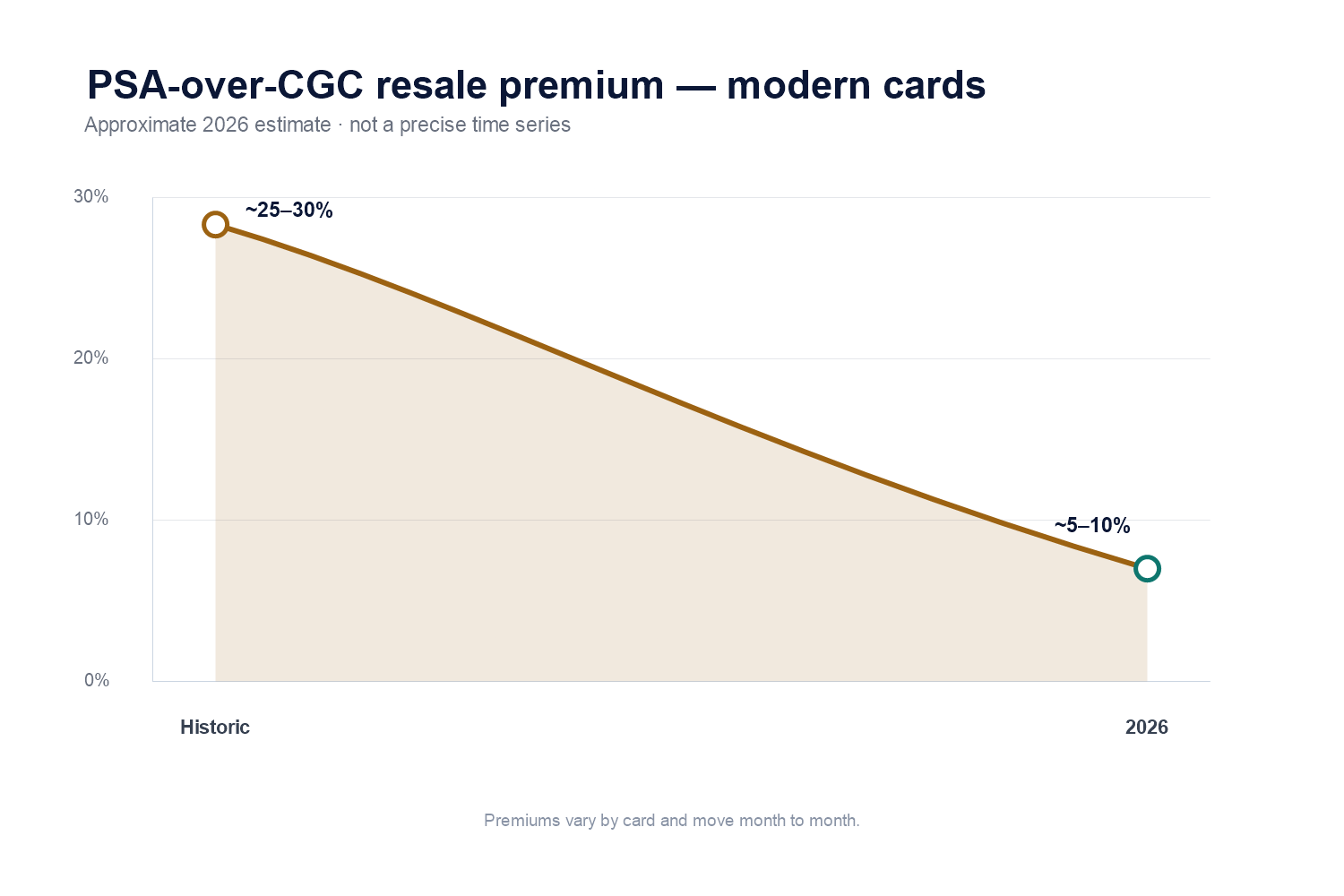
For example, the 2025 Mega Lucario ex Special Illustration Rare has seen its PSA 10 and CGC Gem Mint 10 sales run within roughly 10% of each other nowhere near the old 25–30% gap. On some hyped modern chase cards, top CGC grades have even listed above their PSA 10 equivalents. Prices move constantly, so check recent sold comps (PriceCharting, eBay sold listings) for the exact card before you trust a spread.
For vintage, the story is different and PSA still wins. A Base Set Charizard in a PSA 10 consistently sells well above CGC equivalents (often 15–20% more), and serious vintage and high-end buyers still treat the PSA label as the default for older Pokémon. CGC has not displaced PSA at the vintage top end.
Part of why that premium sticks is structural, not just sentiment. PSA's long-running Set Registry lets collectors build ranked, competitive sets, and the rankings reward PSA-graded cards so dedicated set-builders keep buying PSA labels, which sustains demand, especially on vintage. CGC runs its own registry, but PSA's is the established one collectors compete in.
These premiums move over time and vary by card. Collectible prices are volatile, they vary by exact card, and a number that's true this month can move next month.
Verdict: on modern cards the resale gap is now small (about 5–10%) and CGC's lower fee often erases it. On vintage, PSA still wins clearly (about 15–20%).
CGC vs PSA: Turnaround and Grading Standards
Counterintuitively, PSA is currently faster at the cheap end. As of mid-2026 PSA's Regular runs about 40–50 business days, while CGC's Economy is around 65 and its Bulk tier around 120. CGC was historically the speed leader, but the 2025–26 demand surge flipped that at the lowest tiers CGC still wins if you pay up to a faster tier. Either way, plan for weeks to months unless you buy rush service.
On standards, the two scales differ at the top:
- PSA tops out at PSA 10 (Gem Mint) the long-standing benchmark grade collectors recognize instantly.
- CGC offers Gem Mint 10 and, above it, Pristine 10 (a perfect card with no flaws under magnification). Because Pristine 10 is harder to hit, it carries its own premium. CGC no longer offers optional sub-grades.
Neither company's grade is a guarantee of value demand, the specific card, and condition still decide the price.
Verdict: at the cheapest tiers PSA is currently faster. CGC only wins on speed if you pay up to a faster tier.
PSA vs CGC Slabs: Holder and Population Data
Two things collectors weigh beyond price and speed:
- The holder. CGC's case is a clear, rigid shell that many collectors prefer for display and scratch resistance. PSA's holder is the iconic, trusted standard, though some collectors note frosted edges or the occasional interior "Newton ring." Neither is fragile the look and feel just differ.
- Population data and liquidity. PSA's population report is the deepest in the hobby, which gives buyers better scarcity data and, just as importantly, a larger pool of buyers. Even where the price gap is small, a PSA slab often sells faster, because more collectors are hunting PSA labels. That liquidity edge is a big part of why PSA stays the default for serious sellers.
It's also why some collectors crossover a CGC card cracking the slab to resubmit to PSA when they expect a PSA label to sell faster or higher. It's a real tactic, but it costs another grading fee and risks a lower grade, so it only pays when the PSA premium clearly justifies it.
Verdict: CGC's clear case wins on display. PSA's deeper population data and bigger buyer pool win on liquidity.
Modern vs Vintage: The Real Decision
Skip the tribal "which is better" debate. The right grader depends on what you're grading.
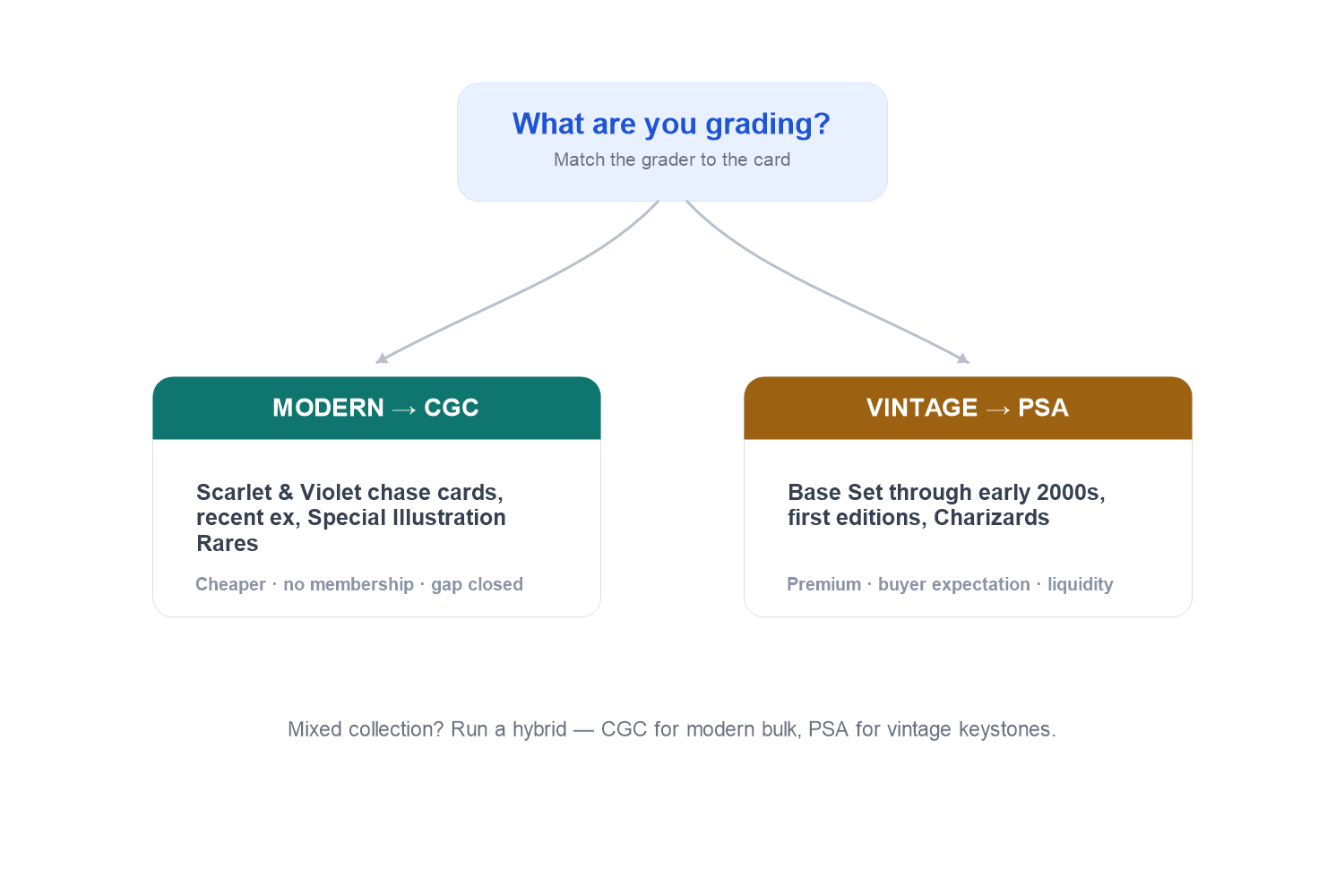
- Grading modern cards (Scarlet & Violet era chase cards, recent ex and Special Illustration Rares)? CGC is usually the better value. It's far cheaper with no membership, grades consistently, and the resale gap is now small enough that the fee savings often erase it. A CGC Pristine 10 can even out-earn a PSA 10.
- Grading vintage (Base Set through the early 2000s, first editions, Charizards)? PSA. The premium and buyer expectation are still clearly in PSA's corner for older cards.
- A mixed collection? Many submitters now run a hybrid: CGC for modern bulk, PSA for vintage keystones. That optimizes cost and resale at the same time.
Which Should You Pick?
- Grading modern cards on a budget? CGC is lower cost, no membership, and the resale gap is small.
- Vintage, first editions, or a Charizard? PSA, clearly. The premium and buyer expectation are still there.
- If an annual membership is a dealbreaker, that alone points you to CGC.
- Selling to vintage-focused or institutional buyers means PSA, full stop.
- Want the hardest modern grade to earn? A CGC Pristine 10 sits above Gem Mint 10 and can out-earn a PSA 10.
Whatever you pick, run the cost against the likely resale before you submit.
Why This Matters for Marketplace Buyers
When you buy a graded Pokémon card, the slab on it changes what you should pay. A PSA 10 and a CGC Gem Mint 10 of the same card are not always priced the same, and a CGC Pristine 10 is its own tier. Knowing which label commands what and that it shifts over time is basic marketplace literacy, whether you buy on eBay, at a card shop, or on newer marketplaces like Polkastarter. Check the grader, the grade, and recent sold comps before you trust a price.
Current as of June 2026, PSA Regular $79.99/card plus a $149/year Collectors Club membership to submit directly. CGC Bulk $17 (25+) / Economy $20, no membership. Resale premiums cited here about 5–10% for modern and 15–20% for vintage in PSA's favor, with CGC Pristine 10s sometimes exceeding PSA 10s are approximate 2026 market estimates that change. Confirm current fees on each company's official page and check recent sold comps for the specific card before grading.
Frequently Asked Questions
1. Is CGC as good as PSA for Pokémon cards?
For modern Pokémon cards in 2026, close. CGC grades consistently, costs far less (about $17 to $20 per card versus PSA's $79.99), and charges no annual membership, and the resale gap behind PSA has narrowed to roughly 5 to 10 percent. A CGC Pristine 10, a tier above Gem Mint 10, can even match or beat a PSA 10 on some modern cards. For vintage cards PSA still leads clearly on resale and buyer preference, so the honest answer is split: CGC for modern, PSA for vintage.
2. Does a CGC card sell for less than a PSA card?
Usually a little less for modern cards, often within about 5 to 10 percent, though a CGC Pristine 10 can match or beat a PSA 10 on some modern cards because it is statistically harder to earn. For vintage cards the PSA premium is larger, around 15 to 20 percent, and PSA's deeper population data and larger buyer pool mean its slabs often sell faster even when the price gap is small. Prices vary by card and change over time, so check recent sold comps before you trust a spread.
3. Is CGC cheaper than PSA?
Yes, clearly. As of June 2026 CGC's cheapest tiers run about $17 per card (Bulk, 25 or more cards) to $20 (Economy, no minimum), with no annual membership. PSA's cheapest open tier is $79.99 per card, since its low-cost Value tiers are paused, plus a $149 per year Collectors Club membership to submit directly. For a handful of modern cards, CGC's all-in cost can be a fraction of PSA's once the membership is counted. Confirm current fees on each company's official page before submitting.
4. Should I grade modern Pokémon with CGC or PSA?
For most modern cards, such as recent Scarlet and Violet chase cards, ex cards, and Special Illustration Rares, CGC is the better value: far lower cost, no membership, consistent grading, and a resale gap that has shrunk to single digits, small enough that CGC's fee savings often erase it. Choose PSA when the specific card has a clear PSA resale premium that outweighs the higher cost, or when you want the deeper buyer pool. Many submitters now run a hybrid: CGC for modern bulk, PSA for vintage keystones.
5. Is a CGC Pristine 10 worth more than a PSA 10?
On some modern cards, yes. CGC's Pristine 10 sits a step above Gem Mint 10 and is statistically harder to earn than a PSA 10, and 2026 listings show top CGC grades matching or even beating PSA 10 prices on certain hyped modern chase cards. But it is card-specific: PSA 10 remains the benchmark grade with the deepest buyer demand, and on vintage the PSA premium still dominates. Check recent sold comps for the exact card before assuming either way.
6. Is CGC faster than PSA?
Not at the cheapest tiers right now. As of mid-2026, PSA's Regular service runs about 40 to 50 business days, while CGC's Economy is around 65 and its Bulk tier around 120, because the 2025 to 2026 demand surge flipped CGC's historic speed advantage at the low end. CGC still wins if you pay up to a faster tier. Either way, plan for weeks to months at the cheapest tiers unless you buy rush service.
Where to Go From Here
The PSA-vs-CGC question no longer has one answer. CGC has closed most of the modern-card gap on price and resale, while PSA still owns vintage. Match the grader to the card: CGC for modern, PSA for vintage, and run the cost against the likely sale before you mail anything. Confirm current fees and recent comps first both the prices and the premiums in this guide move.
Educational content only. Collectible prices are volatile, the premiums above are approximate market snapshots that change, and grading does not guarantee profit.
Sources

Yaryna Dobrianska is a Dubai-based business and technology writer with a background in fintech and digital services. She covers cryptocurrency adoption, cross-border payments, and the practical realities of spending digital assets across emerging markets.
Her work at Polkastarter focuses on making Web3 accessible, breaking down how crypto moves through real-world financial systems, from payments infrastructure to on-chain adoption trends.