


Content
Is PSA Grading Worth It? Costs, Resale Value, and Profit in 2026

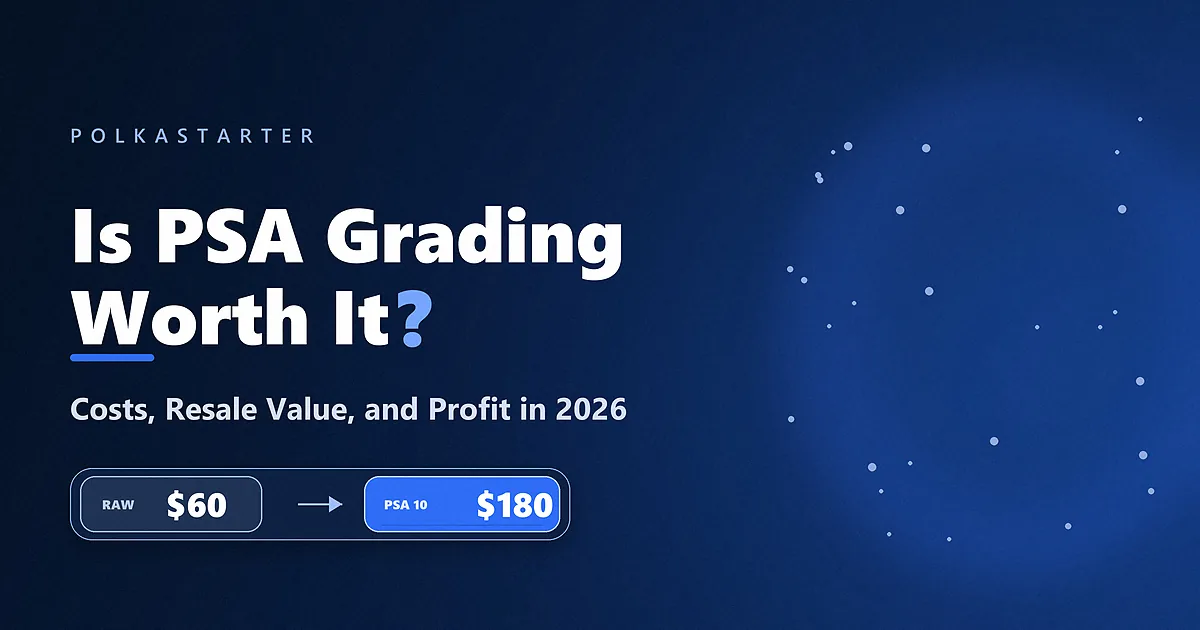
PSA grading is worth it when a card's expected value as a slab, after fees, clearly beats what you would net selling it raw. That is usually true for high-demand cards in strong condition, and usually false for common, high-supply modern or flawed cards. PSA's cheapest open tier is now Value at $39.99 per card, reopened on October 29, 2026. That is up from $32.99 before the June pause, but the math is friendlier than it was over the summer. The fee is the easy part. The grade is the unknown.
Current as of October 30, 2026. PSA's prices and turnaround estimates change often.
Three things need to line up at once: the card has real buyer demand, it is clean enough to earn a high grade, and the graded price comfortably clears your total cost. Miss one and grading tends to lose money. A common card stays common in plastic. A flawed card grades low. A slab can't add demand the card doesn't have.
What PSA Grading Actually Costs in 2026
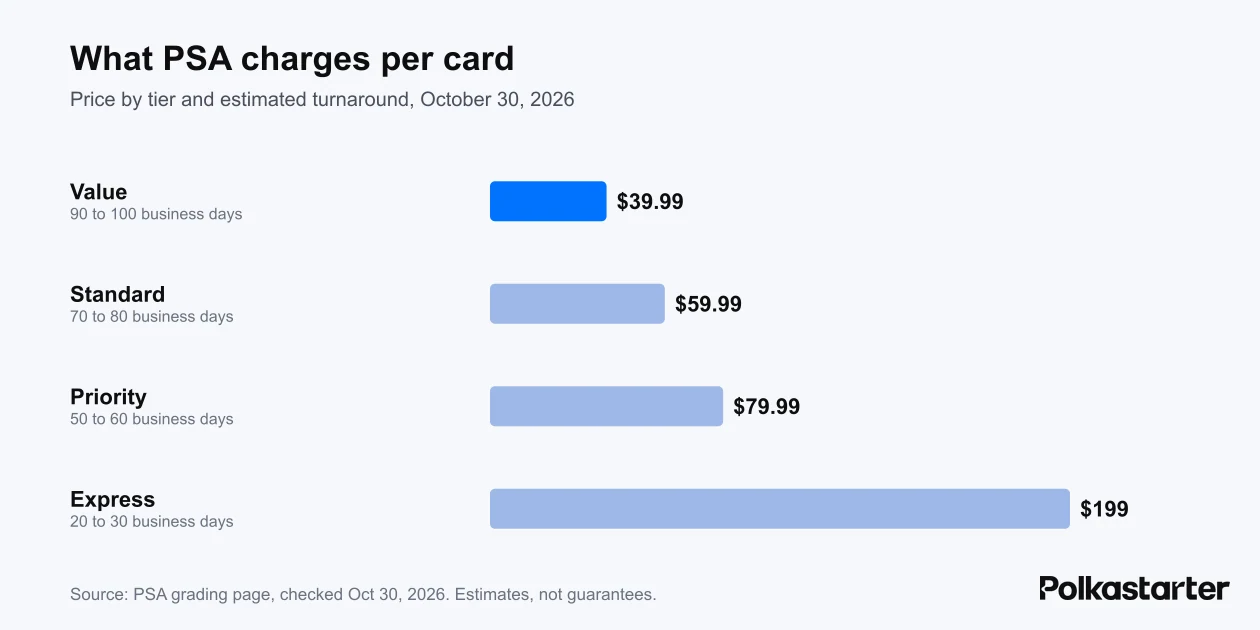
PSA's grading page listed these lower tiers on October 30, 2026, with pricier tiers above Express:
- Value: $39.99, $500 max insured value, an estimated 90 to 100 business days
- Standard: $59.99, $1,000 max insured value, an estimated 70 to 80 business days
- Priority: $79.99, $1,500 max insured value, an estimated 50 to 60 business days
- Express: $199, $2,500 max insured value, an estimated 20 to 30 business days
Value Bulk is still paused, and PSA's October 28 announcement did not mention Value Plus or Value Max. PSA's Collectors Club starts at $149 a year (Premium is $199), and its Bulk Access was marked temporarily paused on October 30, so a membership does not currently open a cheaper grading tier. Paid membership is not required for an ordinary submission, per PSA's FAQ. PSA says turnaround times are estimates, not guarantees.
Then budget for the costs that stack on top:
- Shipping both ways, plus sleeves, semi-rigids and packing supplies
- Insurance on the way in. PSA does not insure inbound packages, per its coverage page
- Tier upcharges. If PSA decides a card's graded value is above your tier's limit, it moves that card up a tier and charges the extra fees
- Selling fees, usually a percentage of the final sale price
The Break-Even Test
Compare two numbers before you submit: what you would net selling the card raw, and what you expect to net after grading it. Here is an example with illustrative numbers, not real prices, for a modern card worth $60 raw:
- Sell it raw: $60 minus about 13% in selling fees nets about $52
- Estimate the grades honestly: say that out of 10 copies, 3 would grade PSA 10 at $180, 5 would grade PSA 9 at $75 and 2 would grade PSA 8 at $50
- Average sale price: $54 + $37.50 + $10 = $101.50
- After 13% selling fees: about $88
- Subtract grading: $39.99 for Value plus about $10 per card, in a small batch, for shipping and supplies leaves about $38
That is about $14 worse than selling raw, even though the PSA 10 is worth three times the raw price. On these numbers, the average sale would need to reach about $117 just to match raw. Change that to 6 PSA 10s, 3 PSA 9s and 1 PSA 8 out of 10, and the same sum gives about $68, which beats raw by about $16 on average. A single card lands on one grade, though: here a 10 nets about $107, a 9 about $15 and an 8 loses about $6. Only the 10 beats raw, so the average alone is not enough. The test comes down to how honest your grade estimate is.
Why a PSA 10 Is Not the Default
Most worth-it math goes wrong because people assume the PSA 10. It is the grade that pays, and the one you are least likely to get. A pack-fresh card is not a sure 10. Factory defects exist before the wrapper comes off: off-centering, print lines, edge whitening, soft corners and roller marks. The gap between a 9 and a 10 is often a border most people cannot see by eye, and PSA's grading standards set out how strict the top grades are.
Before you submit, inspect like a grader, not like an owner. Use a 10x loupe and angle the card under a bright light. Assume it is a 9 and look for the one flaw that proves it.
Cards Usually Worth Grading
- High-demand chase cards where a PSA 10 sells for a large multiple of the raw price, and even a PSA 9 clears your costs
- Genuinely clean copies that survive a loupe-and-light inspection, with strong centering on both sides
- Vintage keystones with proven sold comps, where a slab also adds authentication that buyers pay for
- Cards with a wide graded-to-raw spread, so a grade below your best case still leaves you ahead
The cleanest signal: the math works even if the card comes back a 9. If it only works at a perfect 10, keep it raw.
Cards Usually Not Worth Grading
- Common or high-supply modern cards with no real PSA 10 premium. A $39.99 fee on a $20 card almost never comes back
- Visibly flawed cards. Whitening, scratches, dents or off-centering you can already see will grade low
- Low-demand cards, no matter how clean
- Bulk graded just in case. Grade with a reason for each card, not by the box
- Cards worth less than the all-in cost of grading them
When in doubt, keep a marginal card raw. Raw is liquid, adds no grading bill and carries no grade risk.
Pokémon Cards: Modern Chase vs Vintage Holos
For Pokémon, the line splits by era. Modern Scarlet and Violet and Mega Evolution chase cards can be worth grading when the PSA 10 premium is large and the card inspects clean, but supply is high and a 9 often earns little over raw. Vintage holos and first editions are where grading tends to earn its keep, because demand is deep and the slab also authenticates a card people fake.
Is GameStop PSA Grading Worth It?
Sometimes, for cheaper cards. GameStop runs an in-store PSA drop-off, so you hand the cards over at a store instead of shipping them yourself. Third-party fee reports conflict, so check the current fee in store. Its insured cap dropped to $1,000 per card for submissions created from September 9, 2026, per CardGrade, so it is a poor fit for expensive cards.
PSA vs the Alternatives
PSA is not automatically the right grader, particularly for modern cards on a budget:
- CGC: listed Bulk at $17 a card (25-card minimum, 150 working days) and Economy at $20 (90 working days) on its fees page, checked October 7, 2026. Our CGC vs PSA guide compares them
- TAG: opened a $29.95 Value tier, which had a 10-card minimum as of October 23, 2026, and TAG says it is available only as capacity allows
- Beckett (BGS): known for its Black Label on premium cards and for subgrades
- SGC: has a strong reputation in vintage sports
For vintage, and for maximum resale, PSA is the usual choice. For modern cards on a budget, run the break-even test with each grader's fee, because a lower fee can flip the answer.
Why This Matters When You Buy
The same logic protects you as a buyer. A grade on a label is not a guarantee of value. When you buy graded, check the grader, verify the cert, compare recent sold prices rather than asking prices, and ask whether the premium is justified for that card. Our guide on how PSA grading works covers the process, and our PSA backlog report tracks the queue.
Our take: Value at $39.99 brings more cards into range than the summer's options did, but a new order joins the back of the queue. Grade the specific cards where the math says yes, and keep the rest raw.
Frequently Asked Questions
Is PSA grading worth it?
It is worth it when a card's expected graded value, after fees, clearly beats what you would net selling it raw. That usually means a high-demand card in clean condition where a PSA 10 carries a large premium and even a PSA 9 covers your costs. Run the break-even test on the specific card before you submit.
How much does PSA grading cost in 2026?
As of October 30, 2026, PSA lists Value at $39.99 per card, Standard at $59.99 and Priority at $79.99. Budget beyond that for shipping, supplies, a possible tier upcharge and selling fees.
Do you need a Collectors Club membership to use PSA?
No. Paid membership is not required for an ordinary submission, per PSA's FAQ. The Collectors Club starts at $149 a year, and on October 30, 2026 its page marked Bulk Access as temporarily paused, so membership does not currently open a cheaper tier.
Is it worth PSA grading Pokémon cards?
It depends on the era and the card. Vintage holos and first editions usually justify it because demand is deep and the slab authenticates a frequently faked card. Modern chase cards can be worth it when they inspect clean and the PSA 10 premium is large. Common modern cards are usually not worth grading.
What cards are not worth grading?
Common or high-supply modern cards with no real PSA 10 premium, visibly flawed cards, low-demand cards and any card worth less than the all-in cost of grading it. If a card only makes sense at a perfect PSA 10, keep it raw.
Where to Go From Here
For the right card, PSA grading can pay. For most cards, it does not, so run the test first. If you would rather skip the wait, the Polkastarter marketplace gives you a free mystery pack when you sign up, and every Lootbox lists its contents, values, and chances before you open.
Details checked October 30, 2026. Fees are the graders' published prices on the dates shown and change often. The break-even example uses illustrative numbers. Nothing here is financial advice. Polkastarter is not affiliated with PSA, Collectors, CGC Cards, GameStop, TAG, Beckett, SGC or the other companies named.
Sources
- PSA: Trading card grading services and prices, checked October 30, 2026, accessed October 30, 2026
- PSA: PSA Reopens Value Service and Reduces Estimated Turnaround Times for Standard and Priority, published October 28, 2026, accessed October 30, 2026
- PSA: Collectors Club memberships, checked October 30, 2026, accessed October 30, 2026
- PSA: FAQ, accessed September 29, 2026
- PreGradeCards: PSA Value service reopens, checked October 30, 2026, accessed October 30, 2026
- PSA: Coverage, checked October 30, 2026, accessed October 30, 2026
- PSA: Grading standards, checked October 30, 2026, accessed October 30, 2026
- CardGrade: GameStop cuts its PSA insured cap to $1,000 per card, published September 10, 2026, accessed October 30, 2026
- CGC Cards: Services and fees, accessed October 7, 2026


Ilknur Gubel is a social media manager at Polkastarter. Ilknur has spent the past four years working as a project manager, marketing manager, and social media strategist across Web3. She has held marketing and project management positions at several crypto companies, including Polygen, Nitro League, Kaizen.Finance, and ChainPort.
At Polkastarter she has covered trading card releases, collectible market pricing, and how token holders can spend crypto on real cards and videogames.
Based in Istanbul, Ilknur earned a bachelor's degree in sociology from Istanbul Aydın University.
You can connect with her on LinkedIn for more information.