.avif)
.png)
.avif)


Content
How to Tell If a Pokémon Card Is Fake: Real vs Fake Checks That Work

What's The Fastest Way to Tell If a Pokémon Card Is Fake?
If you only have a minute, run these in order and compare to a real card you already trust from the same set.
- Feel it. A real card is firm with a slightly textured back. A fake often feels papery, a little plasticky, or slick like a playing card.
- Read the back swirl. Genuine backs show a dappled mix of light and dark blue with a crisp boundary between the swirl and the outer frame. Many fakes wash out to one flat, almost purple blue.
- Loupe a solid color. Under a 10x loupe, real cards show a regular dot rosette in the yellow border. Flat color, random dots, or a coarse grid points to a fake.
- Check the cut edge. A real card has a dark inner layer sandwiched between two white layers, visible at the edge under magnification.
- Look for an error. A misspelling, a missing accent on the é in Pokémon, a malformed set symbol, or a misshapen energy symbol is a near-certain fail.
No single one of these is the whole answer. The next section explains why.
The One Rule That Matters Most
Authenticity checks are one-way. A failed check is strong evidence a card is fake. Passing a check is not proof it is real. A missing é, a rosette that does not match, a missing black core, or a spelling error tells you a card is fake. But high-quality fakes now copy the accent, the dots, the dark layer, and the text, so a clean result only means "not yet failed." Two habits make every check below far more reliable.
- Compare to a known-genuine card from the same set and region. Print, color, fonts, and foil all changed over the years and differ between English and Japanese, so a universal mental image leads you wrong. A cheap basic card from the same set is the perfect reference.
- Stack the tells. One oddity can be a print quirk. Three or four together is a fake. Do not condemn or clear a card on a single signal.
Check the Card Back (the Blue Swirl)
The back is often the quickest read. A genuine back uses three readable blues: a light and a dark blue that interweave into a dappled swirl, plus a medium blue for the outer frame. Look at the diagonal sweep of light blue just above and right of the red Poké Ball. On a real card it is dappled with darker blue underneath, and the line between the swirl and the outer frame is crisp. On many fakes that area washes out to one flat, lighter, almost purple blue, and the frame-to-swirl boundary blurs. Judge this only against a known-real back from the same era, since "too purple" is a tendency, not a fixed shade.
Check the Front Print
The front hides several reliable tells. Work through them with a reference card and a loupe.
- Font and kerning. Real text is evenly spaced in the correct typeface. Fakes often use a similar-but-wrong font with letters too thick or thin, and spacing that is, in JustInBasil's words, "abnormally large and usually inconsistent."
- The missing é. Real cards print the acute accent on the é in Pokémon, including the bottom copyright line. A missing accent is a strong fail. This is a one-way test, a present accent does not clear the card.
- The copyright and illustrator line. Confirm the Illus. name, the copyright year, and the set symbol, collector number, and rarity icon all match this exact card against a database. The set symbol is one of the highest-error zones on fakes, because each set has a unique symbol the counterfeiter has to recreate.
- Energy and type symbols. The type symbol by the HP, the attack energy costs, and the colorless retreat symbols should be crisp, correctly sized, and aligned. Fakes often render them misshapen, off-center, or wrong-sized.
- Border edge quality, not centering. A real yellow border is even and a consistent shade. Fuzzy, ragged, or wrong-shade edges are a fake signal. Being off-center is not, see the comparison below.
- Spelling and HP. Any misspelling, transposed letters, or an implausibly high HP is a near-certain fail.
The Loupe Test: the Rosette Dot Pattern
This is the most reliable print check, and almost no scammer beats it cleanly. Put a 10x loupe (or a phone macro lens) on an area of solid color, like the yellow border. Genuine cards are offset-printed in CMYK, so even flat color resolves into a regular repeating pattern of tiny cyan, magenta, yellow, and black dots called a rosette. Fakes printed on inkjet or laser printers show random dots, a coarse line screen, toner speckle, or flat solid color with no rosette at all.
As TCGplayer puts it: "If you're concerned about a card, compare it to another card from the same set. If the rosettes don't match, you're looking at a fake." Note the framing, this is a comparison test. Seeing dots does not prove a card is real, because genuine cards and some fakes both print dots. The tell is a mismatch against a known-genuine card from the same set.
The Light Test, and Why It Is Not Proof
The light test is the most popular check and the most overrated, so handle it carefully. Hold the card up to a bright light or a phone flashlight in a dim room. A genuine modern English card is mostly opaque and blocks most of the light. A cheap single-layer fake glows, with the print showing through.
Here is the catch. Pokemon's own support page says fakes are "often easy to see through if you hold them up to a bright light, so this is a good way to identify a fake." But TCGplayer is blunt that "many modern fakes can pass the light test, which makes it extremely unhelpful when you're already unsure about a card." The test only reliably catches the cheapest fakes, and it fails both ways: modern super-fakes now add their own dark inner layer to pass it, and genuine thin or older cards, Japanese cards, thick textured Special Illustration Rares, and POP Series cards transmit light differently and can seem to "fail." Use the light test as a fast first screen, never as proof a card is real, and confirm with the edge and loupe checks.
The Black Layer (Edge Check, Not the Rip Test)
Real cards are built like a sandwich, two white layers around an opaque dark-grey or black core. That black core is hard for cheap fakes to copy. The smart way to check it is non-destructive: look at the cut edge of the card under magnification and find the thin dark line running through the middle.
You may have seen the rip test, tearing a card to reveal the core. Skip it on anything you value, because it destroys a genuine card. Treat it as a last resort for low-value bulk only. And remember the best modern fakes can include a dark layer too, so the black core is strong supporting evidence, not absolute proof.
Feel, Size, and Weight
Three quick physical checks, all best done side by side with a real card.
- Feel. Real cardstock is firm with a slightly textured back. Fakes often feel papery, flimsy, or slick.
- Size. A standard card is about 63 by 88 mm. Overlay the suspect card on a known-genuine one, a basic Energy works. Fakes are often slightly smaller.
- Weight. Hobby guides put a genuine modern card around 1.7 to 1.8 g (this is community guidance, not an official Pokémon spec, and it varies by set and finish). Use a 0.01 g scale and compare against a real card rather than trusting a fixed number. Fakes are usually lighter.
- Holo behavior. Tilt foil cards under light. Real foil has natural depth and movement. Fakes can look flat and dull, too uniformly shiny, the wrong brown or orange hue, or like a peeling applied sticker. Compare to the correct genuine version, since Pokémon uses many legitimate foil patterns.
Real vs Fake Pokémon Cards: Quick Comparison
The short version of everything above, real on the left, fake on the right.
- Back swirl. Real: dappled light and dark blue, crisp frame edge. Fake: flat, washed-out, often purple, blurry boundary.
- Loupe dots. Real: regular CMYK rosette. Fake: random dots, line screen, or flat color.
- Cut edge. Real: dark inner core between white layers. Fake: often no dark core (cheap fakes).
- Font and é. Real: correct typeface, even spacing, accent present. Fake: wrong font, odd spacing, missing accent.
- Feel. Real: firm, slightly textured. Fake: papery, flimsy, or slick.
- Border. Real: even, consistent shade, sharp edge. Fake: fuzzy, ragged, or wrong shade. (Off-center alone is not a fake sign.)
Spotting Fake Sealed Packs and Boxes
Sealed product is harder, and Pokemon concedes "fake booster packs are very difficult to discern from the real ones." Two tells still carry weight.
- Price that is too good. Per Pokemon Support, "finding a pack of cards priced dramatically below the suggested retail price is a near certain warning that you're being sold counterfeit merchandise."
- The all-rares box. Any box or pack promising guaranteed chase cards is fake. As JustInBasil puts it, "Boxes full of GXes, EXes, or other chase cards are guaranteed to be fake." Real packs are random.
Also check that wrappers, tins, and box art match official product, and be wary of bogus or misspelled branding.
How to Spot a Fake Graded Slab (PSA and CGC)
Counterfeiters fake the case too, and this is where buyers lose the most money. Start with the cert, then trust the object, not the number.
- Verify the cert, then know its limit. Enter the cert number at psacard.com/cert, or scan the QR on a modern CGC label. Confirm the grade, year, set, card name, and number match the label. This is necessary but not sufficient. A matching, active cert number is not proof. PSA warns that counterfeiters copy real cert numbers from public listings onto fake labels, and CGC says verification alone does not confirm authenticity. Worse, a genuine label can be cracked open and re-sealed around a swapped or lower-grade card, leaving the cert "active." So compare the grader's on-file photo to the card in hand under magnification, the print dots, centering, and any scratches should match.
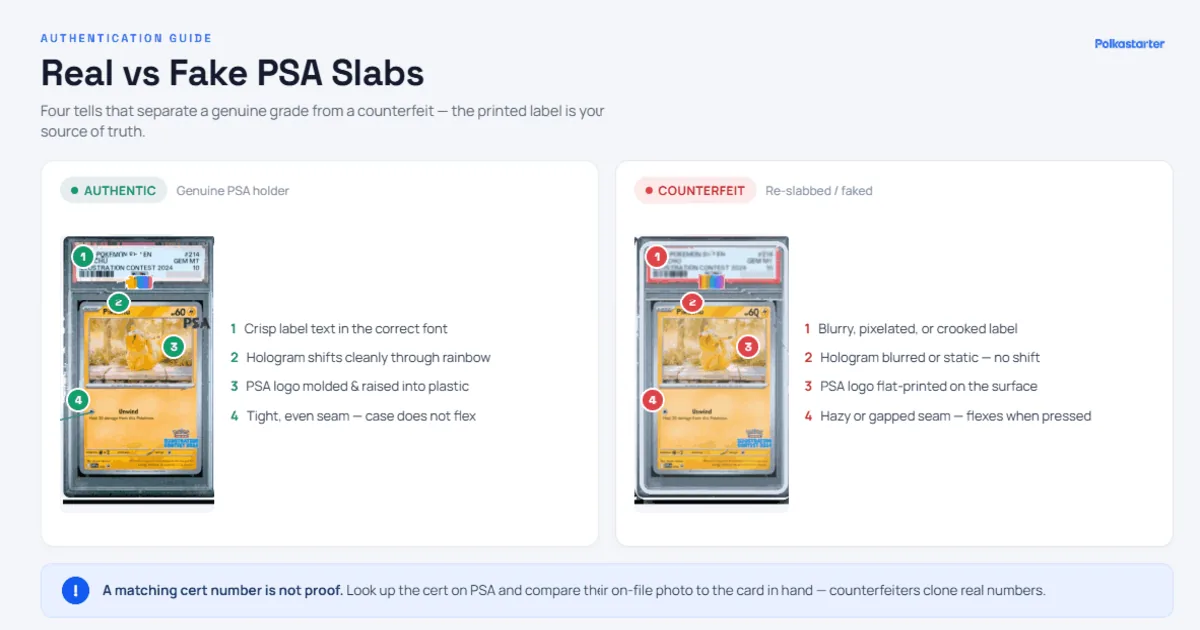
- Holder build. On a real PSA slab the word PSA is molded or raised into the plastic, and the sonic-weld seam is even and tight. Nerdbeak notes authentic cases "do not flex or pop," and you should check the seam for "hazy frosting along the edges, gaps in the seal, or any flex when you press the halves together." Fakes often print the logo flat or skip it, and the case flexes.
- Label hologram and font. Tilt the label. A real PSA hologram shifts cleanly through rainbow color and stays sharp, and CGC's holographic strip shifts with depth. Fakes look blurred, static, or single-color, with blurry or crooked text. Still photos hide this, so for anything valuable insist on a tilt video.
- Grade-versus-condition sanity check. A card in a "PSA 10 Gem Mint" holder should look the part, roughly 55/45 front centering and no edge or corner whitening. Obvious whitening or clearly off-center borders on a claimed PSA 10 is a contradiction, either a faked label or a swapped card. For what the grades actually require, see how PSA grading works.
Your Pre-Purchase Checklist
Before you pay, especially online, run this. Treat any single fail as a stop.
- Does the card feel firm and correctly textured?
- Does the back swirl match a known-real card, dappled blue with a crisp frame edge?
- Under a loupe, does the yellow border show a clean rosette that matches a real card from the same set?
- Is there a dark inner layer at the cut edge?
- Are the font, the é accent, the set symbol, the energy symbols, and the spelling all correct?
- For graded cards: does the cert match on the official site, does the on-file photo match the card in hand, and does the holder pass the build, hologram, and grade-versus-condition checks?
- For sealed: is the price plausible, and is it free of any "guaranteed rares" claim?
- If buying online, ask for clear, in-focus photos of the back, the corners, and the holder seam, plus a tilt video for foils and slabs.
Why This Matters for Marketplace Buyers
Counterfeits are a buyer-trust problem, and the fix is the same wherever you shop: inspect the card, not the listing. Verify the print and the holder, compare to a known-genuine reference, and ask for the photos and video that let you do it. Those habits protect you on eBay, at a card shop, or on newer marketplaces like Polkastarter. The safest place to buy is one that makes authenticity easy to verify before money changes hands.
Educational content only. Counterfeiting methods change, and no single test is a guarantee. When a purchase is high value, get a second opinion or a professional authentication.
Frequently Asked Questions
How can you tell if a Pokémon card is fake?
Compare it to a known-genuine card from the same set and run several checks: the feel, the blue swirl on the back, the rosette dot pattern under a loupe, the dark inner layer at the cut edge, and the font, the é accent, the set symbol, and the spelling. A failed check is strong evidence a card is fake. Passing is not proof it is real, because good fakes copy the obvious details, so stack several tells rather than relying on one.
Does the light test actually work?
Only partly. Holding a card to a bright light catches cheap single-layer fakes that glow, and Pokemon's support page endorses it, but TCGplayer warns it is "extremely unhelpful when you're already unsure about a card." Modern super-fakes add a dark inner layer and pass it, and some genuine thin, older, Japanese, or thick textured cards can seem to fail. Use it as a fast first screen, never as proof a card is real.
How do you tell if a Pokémon card is real?
You confirm the absence of fakes' tells against a known-genuine reference, rather than relying on any single "proof." Check that the loupe shows a matching rosette, the cut edge shows a dark core, the back swirl and front print match a real card from the same set, the é accent and set symbol are correct, and the card feels right. The more checks it passes side by side with a genuine card, the safer it is, though high-value cards still merit professional authentication.
Can a fake Pokémon card be graded, or can a PSA slab be fake?
Both happen. Counterfeiters fake the slab itself, copy real cert numbers onto fake labels, and crack open genuine holders to re-seal them around a swapped or lower-grade card. A matching cert number confirms the record, not the object in hand. Always compare the grader's on-file photo to the encased card and inspect the holder for re-sealing.
How do you spot a fake PSA slab?
Verify the cert here and compare the on-file image to the card. Then check the holder: a real PSA slab has the logo molded into the plastic and a tight, even seam that does not flex or pop, and a real label hologram shifts cleanly through rainbow color. Fakes print the logo flat, have hazy or gapped seams, and show blurred or static holograms. For anything valuable, ask for a tilt video.
Are off-center or Japanese Pokémon cards fake?
No. Off-center borders are a factory and condition issue that lowers a grade, not a sign of a fake, and real cards can be noticeably off-center. Japanese cards are genuine Pokémon products, they simply use different fonts, backs, and rarity codes than English cards. Compare any card to the correct genuine version for its region and era before judging it.
Where to Go From Here
The reliable way to tell a real Pokémon card from a fake is to read the print, not the price: feel, swirl, rosette, edge, and a quick scan for errors, all against a known-genuine card. Remember the one rule, a failed check means fake, but passing does not mean real. For graded cards, trust the card in the holder, not the number on the label. When the value is high, verify before you pay and get a second opinion.
Sources
- Pokemon Support, Did I purchase fake or counterfeit cards (art. 360002068953)
- TCGplayer, How to Spot Fake Pokémon Cards
JustInBasil, How to Identify Fake Pokémon Cards - PSA Security, A Buyer's Guide
- PSA Cert Verification
- CGC Cards, cert verification
.png)

Ilknur Gubel is a social media manager at Polkastarter. Ilknur has spent the past four years working as a project manager, marketing manager, and social media strategist across Web3. She has held marketing and project management positions at several crypto companies, including Polygen, Nitro League, Kaizen.Finance, and ChainPort.
At Polkastarter she has covered trading card releases, collectible market pricing, and how token holders can spend crypto on real cards and videogames.
Based in Istanbul, Ilknur earned a bachelor's degree in sociology from Istanbul Aydın University.
You can connect with her on LinkedIn for more information.