.avif)
.png)
.avif)


Content
Pokémon Card Rarity Symbols Explained: Chart and Meanings

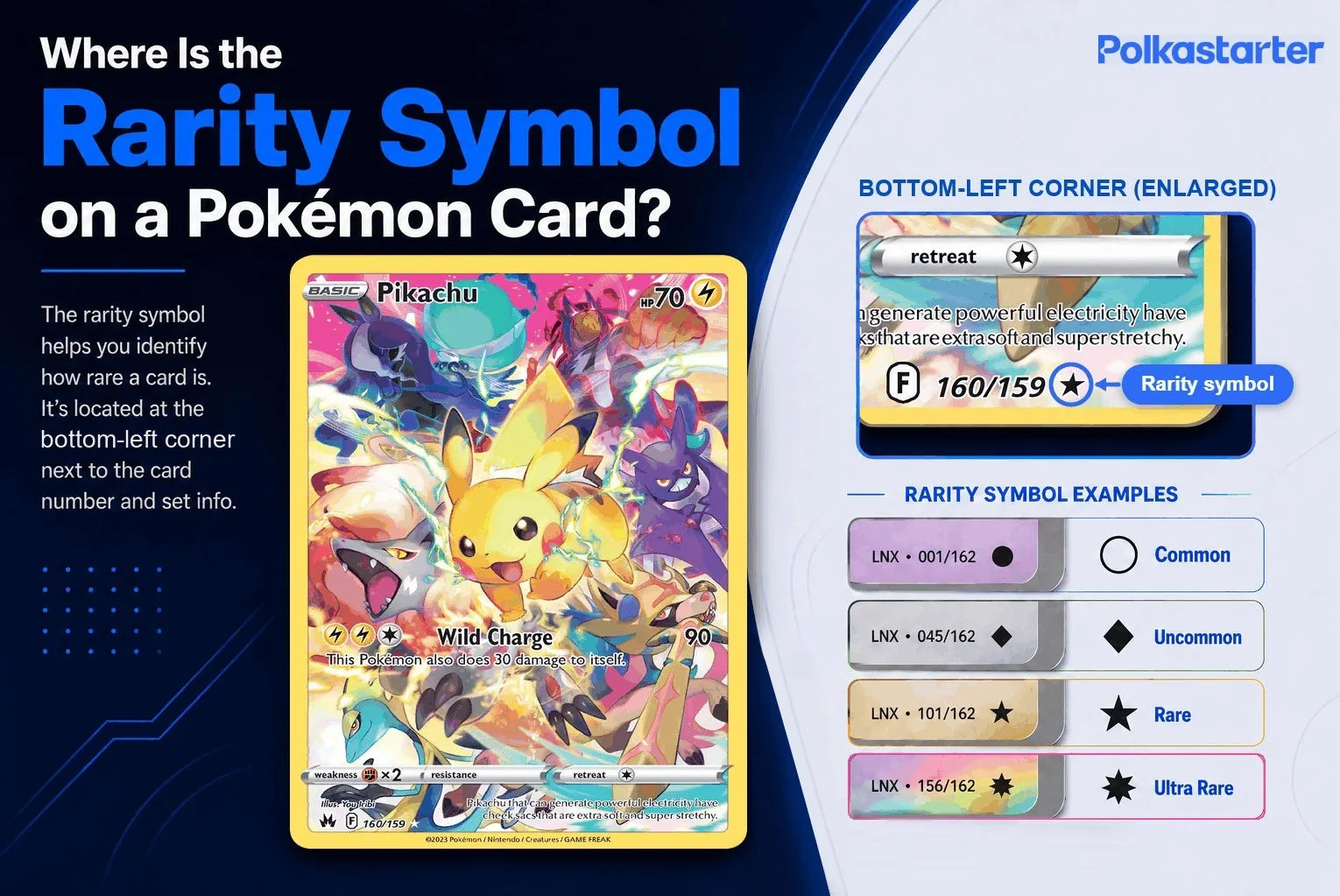
Four things live in that corner, and people mix them up constantly.
- Collector number. The card's slot in the set, like 25/198. If the left number is bigger than the right, like 199/198, it is a "secret rare" printed beyond the set size.
- Set symbol. A small logo unique to the expansion. It tells you which set, not how rare.
- Rarity symbol. The circle, diamond, or stars. This is the one that tells you rarity.
- Expansion code box. A small black box with white letters, the set's code. It is an inventory tag, not a rarity mark, so do not mistake it for the symbol.
If a card has no symbol in that corner at all, skip to the no-symbol section. That usually means a promo or a Japanese card.
The Rarity Symbol Decoder
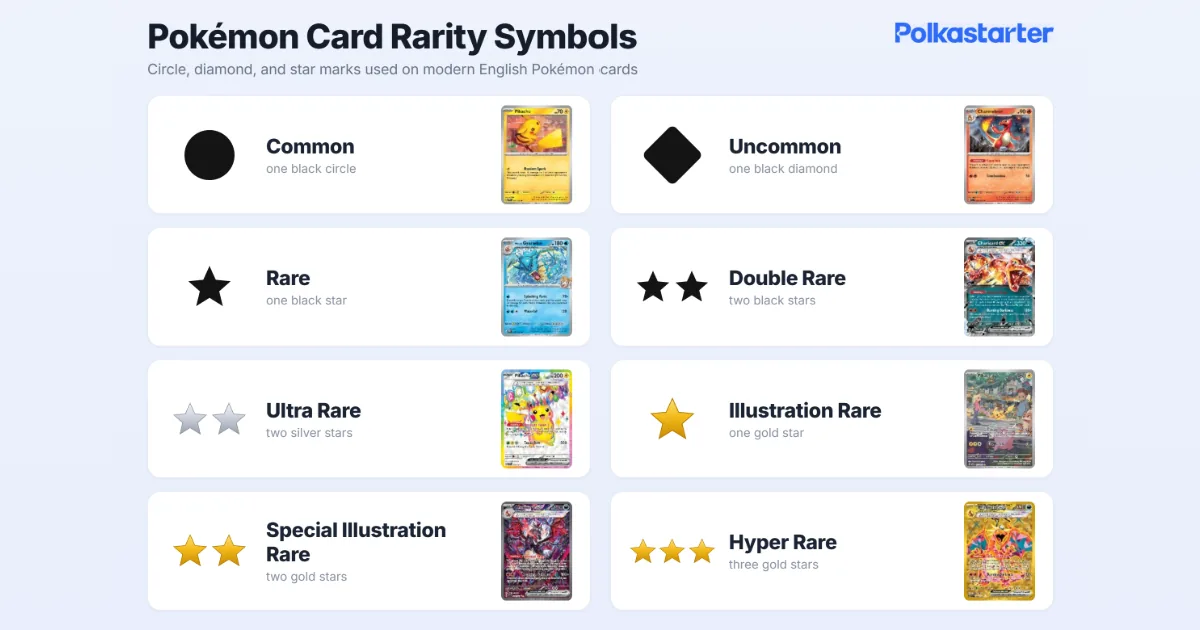
Here is the full modern (Scarlet and Violet era) set. The shape tells you the tier, and the color and number of stars tell you how special.
- Black circle = Common. Basic Pokémon and standard cards, the bulk of a pack.
- Black diamond = Uncommon. Stage 1 Pokémon, many Trainers and Items.
- Black star = Rare. The main rare of the pack. In modern sets it is holofoil by default.
- Two black stars = Double Rare. The standard ex cards, textured and high-HP.
- Two silver stars = Ultra Rare. Full-art ex and full-art Supporters.
- One gold star = Illustration Rare (IR). Alternate-art versions of regular Pokémon, full-bleed artwork.
- Two gold stars = Special Illustration Rare (SIR). Alternate-art ex and Supporters, among the most chased pulls.
- Three gold stars = Hyper Rare. The gold cards, fully gilded borders, numbered beyond the set size.
Pokémon's own Scarlet and Violet rarity update spells these out: "double rare cards are represented with two solid black stars," and "hyper rare cards will be represented with three shiny gold stars," while the older "solid black symbols for common, uncommon, and rare, circle, diamond, and star, will remain unchanged" (Pokemon.com).
Two notes that save confusion. The star color matters as much as the count. Two black stars (Double Rare) is a common ex, while two gold stars (Special Illustration Rare) is a top-tier chase card. And the system keeps growing. The current Mega Evolution era added two more tiers on top of this chart, covered next.
What Each Special Rarity Actually Means
The basic three, Common, Uncommon, and Rare, are self-explanatory. The newer ones cause the most questions, so here is the plain version.
- Double Rare (two black stars). Your everyday ex card. Powerful in play, textured, and the most common big pull. Real, but rarely a high-dollar card on its own.
- Ultra Rare (two silver stars). Full-art ex or full-art Supporter, where the character breaks out of the normal frame across the whole card.
- Illustration Rare (one gold star). An alternate-art regular Pokémon, drawn into a full scene. These are art-driven, and some have become genuinely sought after.
- Special Illustration Rare (two gold stars). The alternate-art version of an ex or Supporter. This is the tier most modern collectors hunt, and where a lot of a set's secondary-market value concentrates.
- Hyper Rare (three gold stars). The gold-bordered, fully gilded cards numbered past the set size. Flashy and scarce, though gold does not automatically mean expensive. Demand for the specific character still decides.
The Newest Tiers: Mega Evolution Era
The current Mega Evolution era (2025 to 2026) added two chase tiers above the standard chart. They are new and rare, so they cause fresh confusion.
- Mega Attack Rare. Marked by two pastel stars, one pink and one green. These are full-art Mega Pokémon ex with the card's signature attack name printed in Japanese script. They debuted in Mega Evolution, Ascended Heroes, which released January 30, 2026.
- Mega Hyper Rare. A fully gold, embossed card showing a front-facing Mega-Evolved Pokémon, marked with a gold sparkle symbol rather than the three gold stars of a standard Hyper Rare. These are the rarest pulls in current Mega-era boosters.
Expect this list to keep changing. Pokémon adds new rarities most years, which is exactly why you read the symbol on the card in front of you instead of trusting a fixed list forever.
Looks Rare but Usually Isn't
This is where beginners lose money. Shine, sparkle, and "old" are not rarity.
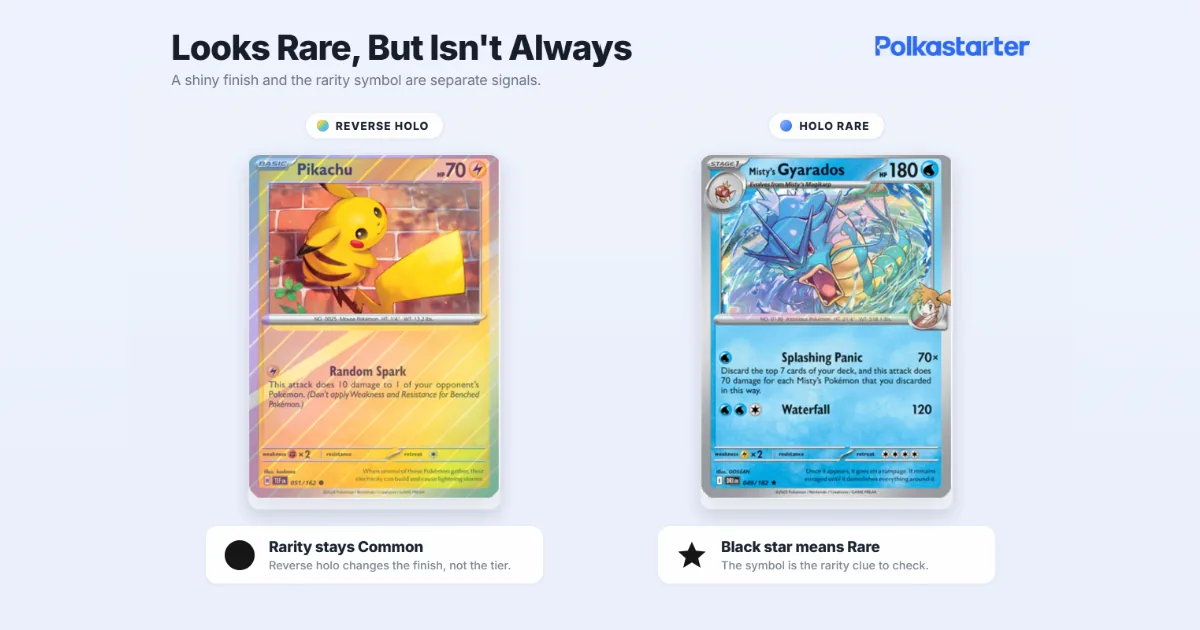
- Reverse holo. The whole card shines except the artwork. Any rarity can be printed as a reverse holo, including Commons and Uncommons. The symbol still tells the truth. A reverse-holo Common is still a Common.
- Holo energy and shiny bulk. Foil treatment was added to plenty of low-rarity cards. Pretty, not rare.
- "It is old, so it is rare." Age is not rarity. Plenty of vintage Commons are worth cents.
- Promo stamps. A black star with the word PROMO is a promo, not a high rarity by default. Some promos are valuable, most are not.
The rule of thumb: read the symbol, not the shine. Then check the character, set, and condition before you get excited.
Set Symbols vs Rarity Symbols
These are the two icons people confuse most. They sit near each other and do completely different jobs.
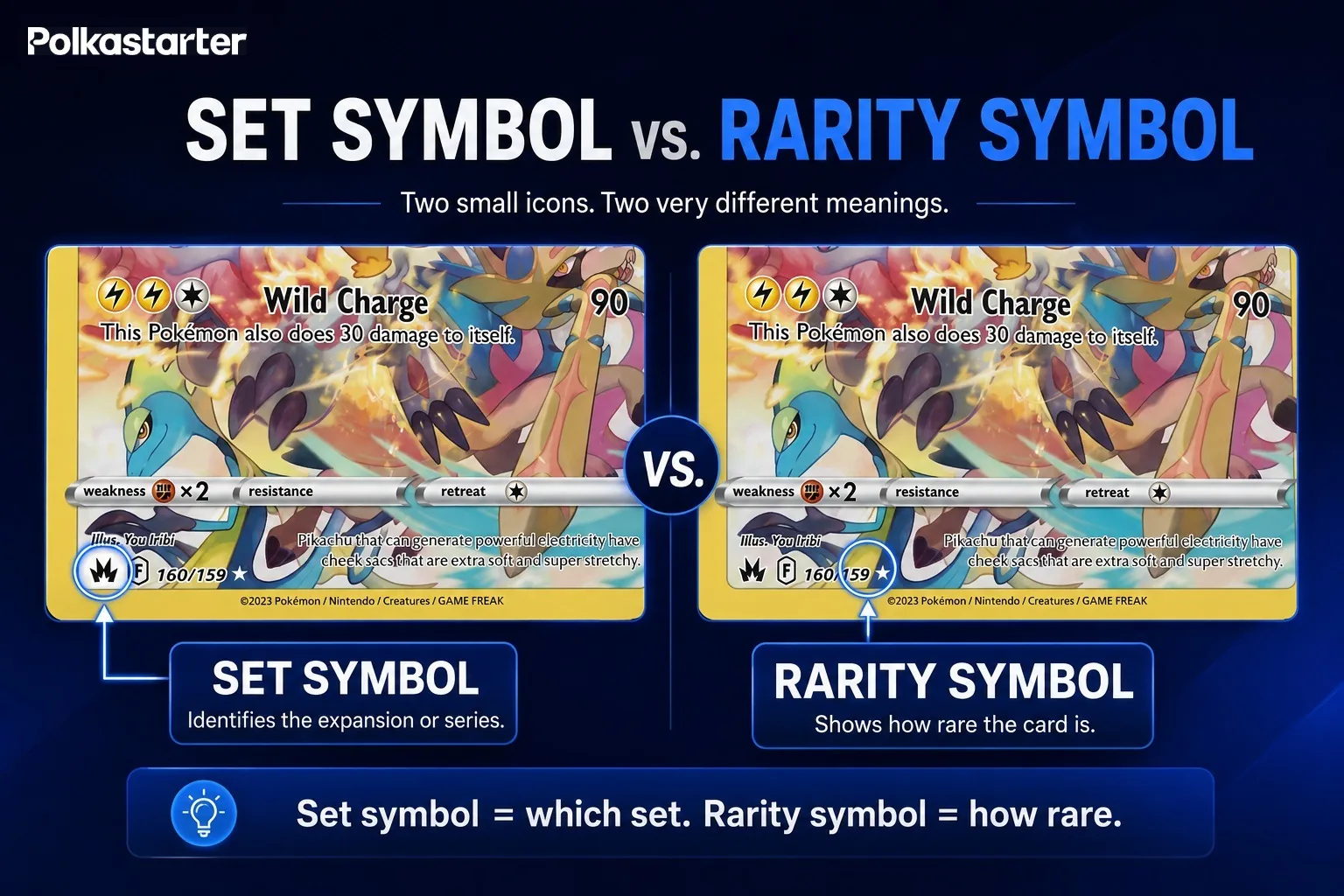
- The set symbol is a small logo, a sword, a fist, a stylized letter, that identifies the expansion the card came from. It is the same on a Common and a Hyper Rare from that set.
- The rarity symbol is the circle, diamond, or stars that identifies how rare the card is within that set.
If you are trying to value or grade a card, you need both. The set symbol plus the collector number pins down exactly which card it is, and the rarity symbol tells you its tier.
What If My Card Has No Rarity Symbol?
A missing symbol is common and rarely means "ultra rare." The usual explanations:
- It is a promo. Black Star Promos and box or tournament cards often carry a PROMO mark instead of a standard rarity symbol.
- It is Japanese. Japanese cards do not use the shape-and-star system. They print letter codes near the collector number instead, which is its own decoder, covered in the next section.
- It is older or non-standard. Some early, jumbo, or special-product cards were printed without a standard symbol.
What a missing symbol does not mean is instant value. Confirm what the card actually is before assuming it is special. And if your card has no symbol simply because the text is Japanese, the next section decodes it.
Japanese Pokémon Card Rarity Symbols
Japanese cards skip the shapes and print a letter code near the collector number. The basics line up with English, but the top tiers flip, which is exactly what trips up cross-market buyers.
- C is Common, U is Uncommon, R is Rare, and RR is Double Rare. So far, the same as English.
- JP SR (Super Rare) equals English Ultra Rare.
- JP UR (Ultra Rare) equals English Hyper Rare, the gold card.
- JP AR (Art Rare) equals English Illustration Rare.
- JP SAR (Special Art Rare) equals English Special Illustration Rare.
The trap is the name. A Japanese "UR" is not an English "Ultra Rare," it is the tier English calls Hyper Rare. Read the Japanese code itself, do not translate the word. Korean and Chinese cards also print their own codes rather than the English shapes, so the same rule holds: match the code to its own system, not to the English name.
Does Rarity Make a Pokémon Card Valuable?
Rarity is one input, not the answer. Price is decided by a stack of factors.
- Character and art. A popular Pokémon or a striking alternate art carries demand a generic card never will.
- Set and print run. Heavily printed modern sets flood the market. Scarce older prints do not.
- Condition. Centering, corners, edges, and surface. A common card in gem-mint shape can outsell a higher-rarity card with whitening and scratches.
- Demand right now. Collectible prices move. Today's chase card can cool off.
A higher rarity tier raises the ceiling, but condition and demand decide where a specific card actually lands.
Pokémon TCG Pocket Rarity Is Different
One common mix-up: the symbols above are for physical Pokémon cards. Pokémon TCG Pocket, the mobile app, uses its own in-app rarity system of diamonds, stars, and a crown rather than the printed circle, diamond, and star tiers. If you are decoding a card you can hold, use the chart above. If you are looking at a card inside the app, you are reading the app's separate system, so do not match one to the other.
How Rarity Connects to Grading and Buying
Rarity is not a grade. A Special Illustration Rare with soft corners and surface scratches can still grade low and sell for less than a clean version of a lesser card. When you are buying, read the rarity symbol and the condition, and confirm the set symbol and collector number match the listing before you trust a "rare" label. For how condition turns into a grade, see how PSA grading works.
That habit, verify the symbol, the set, the collector number, and the condition before you trust a "rare" label, is the core of buying collectibles safely anywhere, whether on eBay, at a local card shop, or on newer marketplaces like Polkastarter.
Frequently Asked Questions
Where is the rarity symbol on a Pokémon card?
On modern English cards it sits in the bottom-left corner, next to the collector number, for example 25/198. Older English cards usually place it in the bottom-right. It is a small circle, diamond, or one to three stars.
What do the Pokémon card rarity symbols mean?
A black circle is Common, a black diamond is Uncommon, and a black star is Rare. Modern Scarlet and Violet sets add more: two black stars (Double Rare), two silver stars (Ultra Rare), one gold star (Illustration Rare), two gold stars (Special Illustration Rare), and three gold stars (Hyper Rare).
What if my Pokémon card has no rarity symbol?
Most often it is a promo card (look for a black star and the word PROMO), a Japanese card (which uses letter codes instead of shapes), or an older or non-standard print. A missing symbol does not automatically make a card rare or valuable.
What are the Japanese Pokémon card rarity symbols?
Japanese cards use letter codes near the collector number instead of shapes. The basics match (C is Common, U is Uncommon, R is Rare, RR is Double Rare), but the top tiers flip: JP SR equals English Ultra Rare, JP UR equals English Hyper Rare, JP AR equals English Illustration Rare, and JP SAR equals English Special Illustration Rare. Read the Japanese code itself rather than translating the name.
Does a rarer symbol mean a card is more valuable?
Not on its own. Rarity is one input. Price depends on the character, the set, the print run, condition, and current demand. A common card in gem-mint condition can outsell a higher-rarity card that nobody wants.
Is Pokémon TCG Pocket rarity the same as physical card rarity?
No. The circle, diamond, and star symbols are for physical cards. Pokémon TCG Pocket, the mobile app, uses its own in-app system of diamonds, stars, and a crown. They are separate systems, so do not read an app rarity as if it were the printed symbol on a physical card.
Where to Go From Here
Read the symbol first, then the shine. The circle, diamond, and star system tells you the tier, the star color and count tell you how special, and the set symbol plus collector number pin down exactly which card you are holding. Once you can decode that corner, you can tell a real chase card from a pretty Common in a couple of seconds, and you will not overpay for "rare" again.
Educational content only. Rarity is one input into a card's value, not a guarantee of it.
Sources
.png)

Ilknur Gubel is a social media manager at Polkastarter. Ilknur has spent the past four years working as a project manager, marketing manager, and social media strategist across Web3. She has held marketing and project management positions at several crypto companies, including Polygen, Nitro League, Kaizen.Finance, and ChainPort.
At Polkastarter she has covered trading card releases, collectible market pricing, and how token holders can spend crypto on real cards and videogames.
Based in Istanbul, Ilknur earned a bachelor's degree in sociology from Istanbul Aydın University.
You can connect with her on LinkedIn for more information.