.avif)
.png)
.avif)


Content
What Is TAG Grading? The 1,000-Point Score and the Pristine 10, Explained

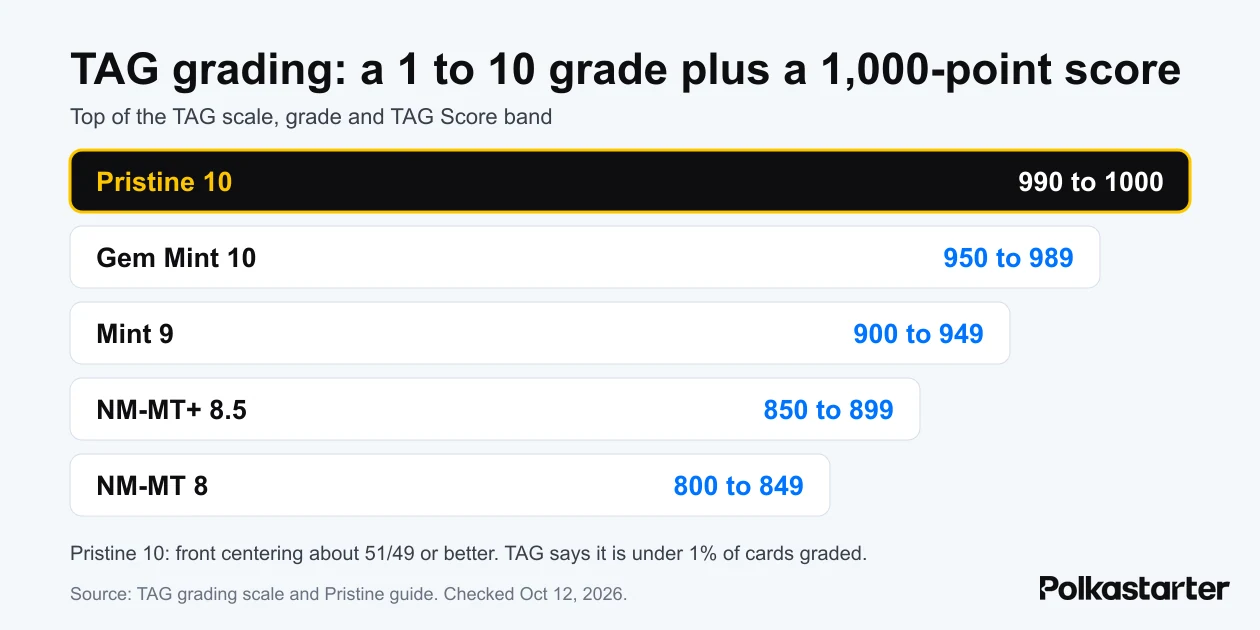
TAG grading is the card grading service of Technical Authentication & Grading, which grades cards on the usual 1 to 10 scale and, from its Standard tier up, adds a 1,000-point TAG Score from computer imaging. Its top grade, a Pristine 10, needs a score of 990 to 1000, according to TAG's scale page. TAG's scale page, checked October 12, 2026, says the score answers the question, "how strong of a 10 is this?" Below is how TAG grades, how its 10s differ from a PSA 10, what it costs in 2026, and what TAG slabs actually sold for this month.
Current as of October 12, 2026.
How TAG Grades a Card
TAG describes a process that starts with imaging, not a grader's eye.
Imaging: TAG uses photometric stereo imaging with machine-learning software to measure each card's centering, surface, corners and edges, according to its help center.
Human check: TAG's verification team confirms the imaging results and the card's authenticity before slabbing, then the slab goes through quality control.
DIG report: every card gets a Digital Imaging and Grading report, reached by QR code or cert number, that maps the flaws TAG found. TAG calls them DINGS, short for Defects Identified of Notable Grade Significance, per its DIG page.
Pop report: TAG publishes its own population report, separate from PSA's.
The TAG Scale and the TAG Score
Every grade maps to a band of the 1,000-point score, per TAG's scale page:
Pristine 10: 990 to 1000
Gem Mint 10: 950 to 989
Mint 9: 900 to 949
NM-MT+ 8.5: 850 to 899
NM-MT 8: 800 to 849
Below that, the bands continue in 50-point steps down to Poor 1 at 100 to 149, with half grades at every level except between 9 and 10, so there is no TAG 9.5. TAG says a Pristine 10 represents less than 1% of the cards it grades.
What a Pristine 10 needs: front centering generally no worse than 51/49, back centering no worse than 52/48 for trading card games (54.5/45.5 for sports), and a virtually flawless surface, corners and edges, per TAG's Pristine guide.
What a Gem Mint 10 needs: front centering within about 55/45 and back within about 65/35 for trading card games (70/30 for sports), per TAG's grading rubric.
For comparison, a PSA 10 allows about 55/45 on the front and 75/25 on the back under PSA's grading standards (checked October 12, 2026). So on centering, a TAG Gem Mint 10 matches a PSA 10 on the front and is tighter on the back for trading card games (65/35 against 75/25), while a TAG Pristine 10 is far stricter on both sides. Beckett's top label works differently again, explained in our guide to the BGS Black Label.
TAG vs PSA: Same Card, Same Night
The cleanest market test came on the evening of October 11, 2026, when two 2003 Skyridge Gengar #H9 holos closed within an hour of each other:
TAG Pristine 10 (TAG Score 990, Pop 1 when Goldin listed it): $268,400 at Goldin, a $220,000 winning bid after 51 bids plus Goldin's 22% buyer's premium.
PSA 10 (PSA Pop 100 per the lot page): $336,000 with buyer's premium after 47 bids at Fanatics Collect, in its Weekly Auction.
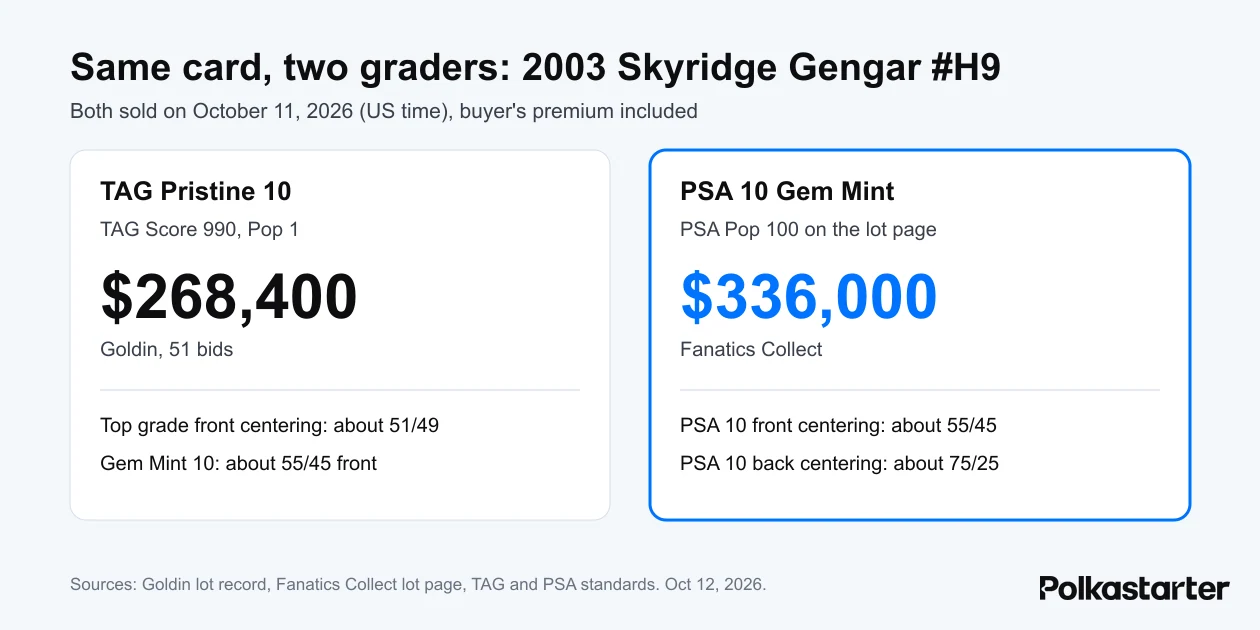
The PSA 10 brought about 25% more, even though the TAG copy holds the stricter grade. That TAG copy scored 990, the lowest score that still earns Pristine, and it was the only one at its tier against 100 PSA 10s, so one pair of sales does not set a rule. It does suggest buyers paid more for the PSA label on this card. TAG slabs can command big money on their own, too: a Pikachu Illustrator graded TAG 8 sold for $488,000 at Goldin in April 2026, a $400,000 winning bid plus the 22% premium. Our most valuable Pikachu cards guide covers the bigger Illustrator sales, and our most valuable Gengar cards guide covers the rest of the Skyridge Gengar market.
What TAG Costs in 2026, and the Backlog
TAG's service tiers as of September 30, 2026, per its help center:
Base: the 1 to 10 grade without the TAG Score, estimated 60 business days, insurance up to $500 per card. TAG's Pristine guide says any card that grades Pristine 10 gets the TAG Score anyway.
Standard: $59.95 per card, estimated 45 business days, includes the TAG Score.
Priority: $79.95 per card, estimated 30 business days.
Express: $149.95 per card, estimated 10 business days.
Premier: $299.95 per card, estimated 3 to 5 business days, with 1,000-point subscores.
TAG's submit page says its grading price does not change with a card's value, so there is no value-based upcharge.
2026 has been rough on turnaround. TAG's backlog tracker shows it paused Base (the tracker calls it Basic) and Standard submissions on May 1 and Express on May 28, and says its backlog peaked at about 420% of its monthly processing capacity. It reopened with a limited drop on August 27 and a Pokémon-only drop on September 16. In its latest update, dated September 30, 2026, TAG said expanded tiers were open, the backlog was down about 96% from its peak, and it expected full catch-up in October. TAG notes that its turnaround times are estimates, not guarantees, and that it may pause service levels again if demand spikes.
Is TAG Right for Your Cards?
Use TAG when the score matters. For a card that might be a true Pristine 10, the TAG Score and DIG report show exactly how strong the grade is, and even a Base submission gets the score if the card grades Pristine.
Use PSA when resale is the goal. The Gengar pair suggests buyers still pay more for a PSA 10 of the same card. Our guide on how PSA grading works covers PSA's process and fees.
Check availability first. With tiers paused and reopened through 2026, look at TAG's tracker before you ship.
Frequently Asked Questions
What does TAG stand for in card grading?
Technical Authentication & Grading. It grades cards on the 1 to 10 scale, and its Standard and higher tiers add a 1,000-point TAG Score from computer imaging.
What is a TAG Pristine 10?
TAG's top grade, for cards that score 990 to 1000 on its 1,000-point scale. TAG says it represents less than 1% of the cards it grades, and it requires front centering of about 51/49 or better.
Is a TAG 10 worth more than a PSA 10?
Not in the clearest recent test. On October 11, 2026, a TAG Pristine 10 Skyridge Gengar sold for $268,400 at Goldin, while a PSA 10 of the same card sold for $336,000 at Fanatics Collect.
How much does TAG grading cost?
As of September 30, 2026, TAG's tiers run from $59.95 per card for Standard to $299.95 for Premier, with a Base tier below them. Turnaround estimates range from 60 business days down to 3 to 5.
Where to Go From Here
A grade is only worth what the next buyer will pay for it. If you want to collect real, vaulted cards without waiting on a grading queue, the Polkastarter marketplace gives you a free mystery pack when you sign up, and every Lootbox lists its contents, values, and chances before you open.
Details checked October 12, 2026. Prices are past sale results and service prices change. Nothing here is financial advice. Polkastarter is not affiliated with TAG, PSA, Beckett, Goldin, Fanatics Collect or the other companies named.
Sources
- TAG: Grading scale, accessed October 12, 2026
- TAG: Grading rubric, accessed October 12, 2026
- TAG Help Center: How do I get a Pristine 10 grade?, published March 7, 2026, accessed October 12, 2026
- TAG Help Center: What are the steps of TAG's grading process?, accessed October 12, 2026
- TAG Help Center: What are TAG's available grading services?, services as of September 30, 2026, accessed October 12, 2026
- TAG: Submit, accessed October 12, 2026
- Goldin: 1998 Pokémon Japanese Promo Holo Illustrator Pikachu TAG NM-MT 8, sold April 2026, accessed October 12, 2026
- TAG: DIG reports, accessed October 12, 2026
- TAG: Backlog tracker, accessed October 12, 2026
- TAG: Population report, accessed October 12, 2026
- Goldin: 2003 Pokémon Skyridge Holo #H9 Gengar TAG Pristine 10, closed October 11, 2026, accessed October 12, 2026
- Fanatics Collect: 2003 Pokémon Skyridge Holo Gengar #H9 PSA 10, closed October 11, 2026, accessed October 12, 2026
- PSA: Grading Standards, accessed October 12, 2026
.png)

Ilknur Gubel is a social media manager at Polkastarter. Ilknur has spent the past four years working as a project manager, marketing manager, and social media strategist across Web3. She has held marketing and project management positions at several crypto companies, including Polygen, Nitro League, Kaizen.Finance, and ChainPort.
At Polkastarter she has covered trading card releases, collectible market pricing, and how token holders can spend crypto on real cards and videogames.
Based in Istanbul, Ilknur earned a bachelor's degree in sociology from Istanbul Aydın University.
You can connect with her on LinkedIn for more information.