.avif)
.png)
.avif)


Content
Gold Pokémon Cards: Are They Real, and What Are They Worth?

The Short Answer: Yes and no, because "gold Pokémon card" describes at least three very different things. A few are genuine, ultra-rare official cards worth tens of thousands of dollars. Most are real but inexpensive, either modern gold-foil cards worth a few dollars or licensed 1999 Burger King novelties worth tens of dollars. And the most common one people own, the shiny gold-plated metal card from an online marketplace, is an unlicensed replica with almost no resale value. The single most useful fact is the one that surprises everyone: the truly valuable "gold" cards are not gold-colored at all.
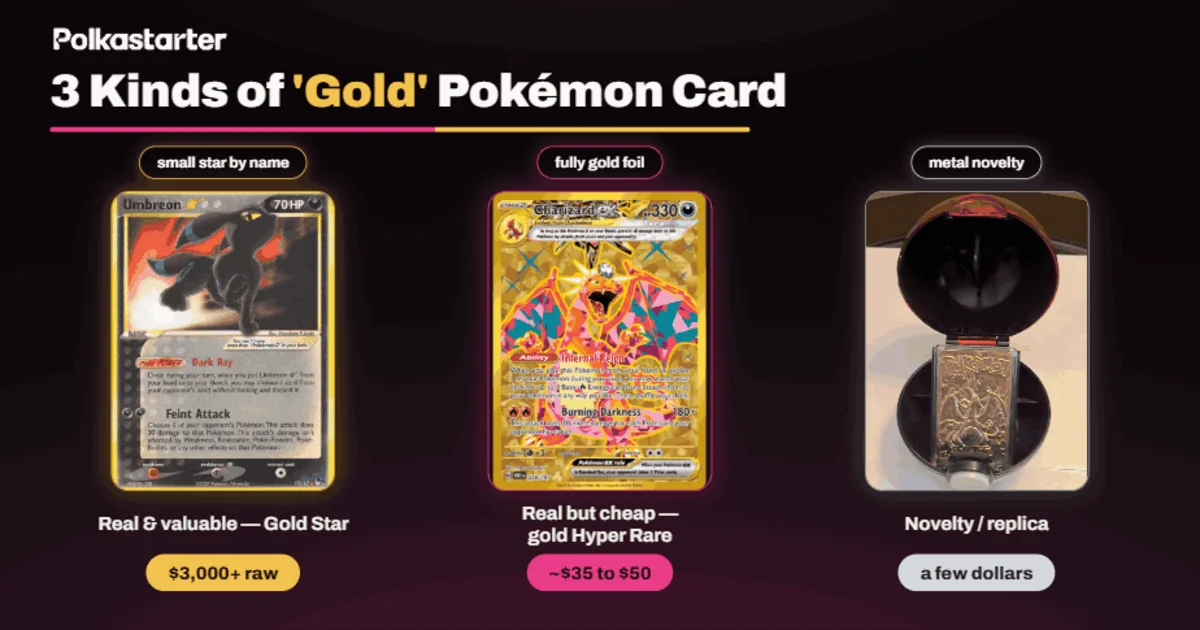
The Three Kinds of Gold Pokémon Card
Before you value anything, sort it into one of these three buckets.
- Real and valuable: the EX-era Gold Star cards (2004 to 2007). Official paper cards, named for a small gold star symbol, not a gold color. The grails reach five figures.
- Real but cheap or novelty: modern gold-foil Secret Rares (a few dollars to a few hundred) and the 1999 Burger King gold-plated cards (tens of dollars). Genuine, just not rare.
- Fake or replica: mass-produced gold-plated metal cards sold on Amazon, eBay, and AliExpress, and outright counterfeits. Unlicensed, not gradable as official, near-zero resale value.
The rest of this guide walks each bucket with current prices.
Real and Valuable: Gold Star Cards
This is the bucket worth real money, and it is the one almost nobody means when they say "gold card." A Gold Star is an ultra-rare EX-era subset (2004 to 2007) marked by a small gold star symbol next to the Pokémon's name, with alternate-color shiny artwork on normal paper. The card itself is not gold.

- Charizard Gold Star (EX Dragon Frontiers, 2006), the most iconic. Raw near-mint about $3,000 to $3,600, PSA 10 about $55,000 to $60,000.
- Rayquaza Gold Star (EX Deoxys, 2005). Raw about $5,000 to $5,300, PSA 10 about $45,000 to $50,000. Note that realized graded sales can run lower than aggregator estimates, for example a PSA 9 sold for about $25,000 in late 2025.
- Espeon Gold Star (POP Series 5, 2007). Raw about $4,500, PSA 10 about $30,000 to $33,000.
- Umbreon Gold Star (POP Series 5, 2007). Raw about $4,300 to $4,500. PSA 10 is thinly traded and volatile, from a documented record near $20,000 up to aggregator headlines of $40,000 to $60,000, so treat it as a wide range.
- Other Gold Stars (Mewtwo, Pikachu, Mew, Latias, Latios, Gyarados, and more) are real and scarce but well below the grails: roughly $150 to $1,500 raw, and about $1,000 to $10,000 in PSA 10 depending on the Pokémon.
If your card has that little gold star by the name and an EX-era set symbol, identify the exact Pokémon and set and pull recent sold comps, because this is the one that can be worth a small fortune.
Real but Cheap: Modern Gold Secret Rares
These are the cards most people picture: shiny, full gold-foil cards from modern sets. They are official, and they are usually cheap. A modern gold card carries a three-gold-stars symbol (the Scarlet and Violet "Hyper Rare"), a glitter-gold background, and a collector number higher than the set total, for example 228 of 197.
- Gold Charizard ex (Obsidian Flames, 2023), the textbook modern gold Charizard, is worth only about $35 to $50 raw and roughly $300 to $330 in PSA 10. A real gold Charizard worth tens of dollars is the myth-bust at the heart of this whole topic.
- Most common gold Secret Rares run about $4 to $30 raw. Chase ones go higher, for example a Giratina VSTAR Gold in PSA 10 around $150 to $250.
- One common mislabel: the Champion's Path Charizard VMAX (2020) is often called "the gold Charizard VMAX," but it is a Rainbow Rare, not a full-gold card. It is worth more (about $200 to $400 raw) for different reasons.
The lesson: a gold finish does not mean a card is valuable. The symbol, the set, and the specific Pokémon decide the price.
Real but Novelty: the 1999 Burger King Gold Cards
If your gold card is metal and came from a fast-food meal, you likely have a 1999 Burger King card. For the "Pokémon: The First Movie" promotion, Burger King sold a 23-karat gold-plated card for $1.99, a thick metal card with a picture and a Pokédex blurb, no game stats, packaged in a spring-hinged Poké Ball case with a certificate. There are six designs: Charizard, Pikachu, Jigglypuff, Mewtwo, Poliwhirl, and Togepi.
They are genuine licensed items, but they were mass-produced and saved in mint condition, so supply dwarfs demand.
- Loose, out of the case: about $5 to $15 each.
- Sealed in the Poké Ball case: commonly about $15 to $30, with Charizard and Pikachu reaching $40 to $60 or more.
- A complete sealed set of six: roughly $120 to $250.
The "23K gold" is thin plating with negligible melt value. As ScreenRant put it, these cards will not make you rich. They are nostalgia, not an investment.
Fake or Replica: Gold-Plated Metal Cards
This is the bucket most "gold Pokémon card" owners actually have, and it is the hardest truth in this guide. The shiny gold-plated metal cards sold all over Amazon, eBay, and AliExpress, often Charizard, Pikachu, or a copied Secret Rare design, are not licensed by The Pokémon Company, not tournament-legal, and not gradable as official cards. They sell new for roughly $10 to $70, but that is an asking price, not a resale value, and the real resale demand is close to zero. One industry source estimated that over 30 percent of "golden" Pokémon cards on secondary marketplaces are replicas or unauthorized, so treat that figure as a directional warning, not a hard stat.
A few distinctions worth keeping straight:
- A generic metal card with no Burger King or official provenance is a replica, worth a few dollars at most.
- A metal or paper card that copies a real card's exact image to deceive, or carries impossible game text like "500 damage," is an outright fake, worth nothing. For the full real-versus-fake checklist, see how to tell if a Pokémon card is fake.
- The one genuine "solid gold" exception is the 2016 Ginza Tanaka 24K gold Pikachu, a Japan-only lottery piece with about 11 grams of real gold, originally around $2,000 and now a five-figure auction item. Treat any unprovenanced "solid gold card" as a replica until it is authenticated.
How to Tell Which Gold Card You Have
Run this quick check to place your card in one of the three buckets.
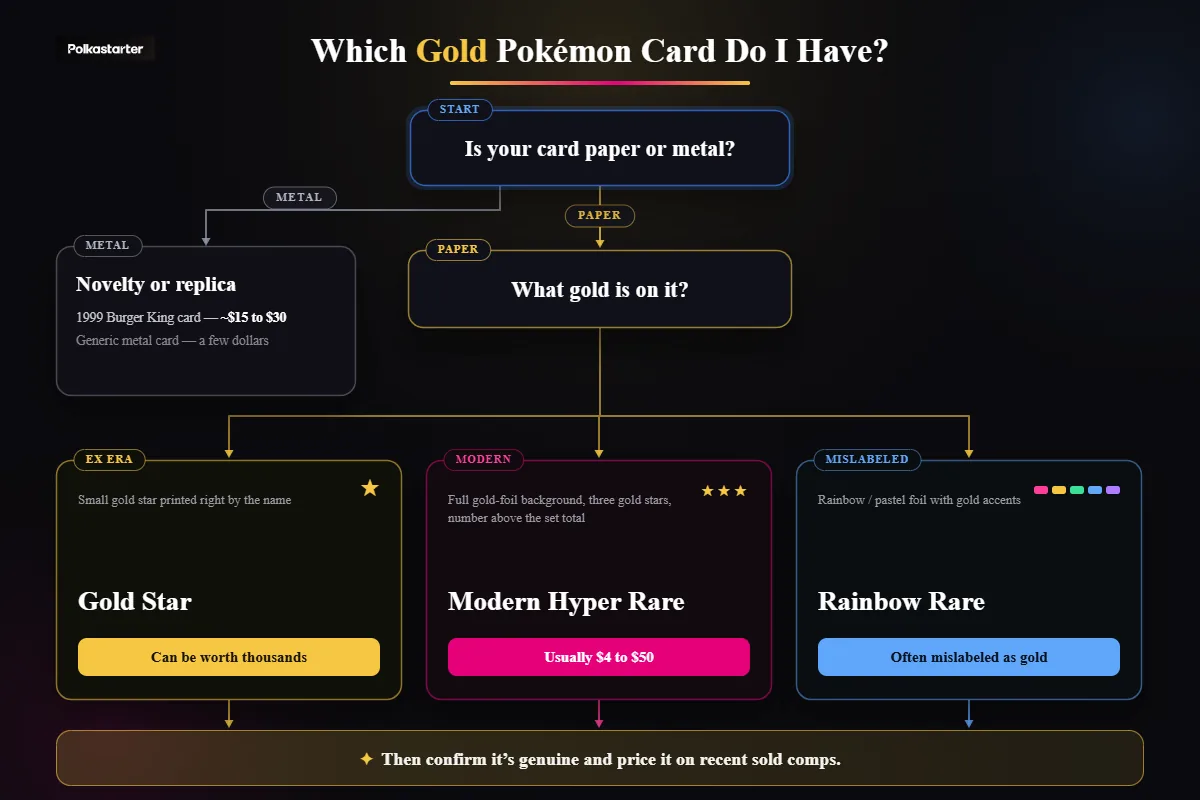
- Paper or metal? A heavy metal card is always a novelty or replica, never a playable card, skip to step 4. A normal paper card (about 1.7 to 1.8 g, standard matte back) goes to step 2.
- What kind of gold is on the paper card? A small gold star by the name with an EX-era set symbol means a Gold Star, potentially very valuable. A full gold-foil background with three gold stars and a collector number above the set total means a modern Hyper Rare, real but usually cheap. A rainbow or pastel foil with gold accents is a Rainbow Rare, often mislabeled gold.
- Confirm it is not a counterfeit. Use the light test (a real card has a dark core and blocks most light), a 10x loupe for the rosette dot pattern, and check the set symbol and collector number against a reference. For anything worth real money, professional grading settles real-versus-fake. See how PSA grading works.
- If it is metal: from a 1999 Burger King meal in a Poké Ball case, it is a licensed novelty (tens of dollars). A generic gold or chrome metal card with no official provenance is a replica worth a few dollars. Replica tells include energy symbols that are entirely gold with no color, a fully gold or chrome back, flat metal with no embossed art texture, and no real set symbol or collector number.
Then price the real ones with recent sold comps, not asking prices: TCGplayer Market Price, eBay Sold listings, and PriceCharting. To see how the most valuable cards in the whole hobby compare, see our guide to the most valuable Pokémon cards.
Why This Matters for Buyers and Sellers
Gold sells the dream, and scammers know it, which is why "gold" is the most misunderstood word in the hobby. Before you buy a gold card, or get excited about one in a drawer, sort it into the right bucket, confirm it is genuine, and price it on recent sold comps. Those habits protect you anywhere you trade, on eBay, at a card shop, or on newer marketplaces like Polkastarter.
Current as of June 2026, prices move. Every figure here is an approximate range as of June 2026, and graded prices in particular move sharply with recent sales. Aggregator estimates often run higher than realized auction results, so before you buy or sell, spot-check live comps on TCGplayer Market, eBay Sold, PriceCharting, and PSA Auction Prices Realized for the exact card and grade. The gold-plated novelties largely do not appear in price guides at all, which itself tells you how little real market they have.
Frequently Asked Questions
Are gold Pokémon cards real?
Some are, in three different ways. The valuable ones are the EX-era Gold Star cards (2004 to 2007), official paper cards named for a small gold star symbol, not a gold color. Modern gold-foil Secret Rares are also official, but usually cheap. The 1999 Burger King gold cards are genuine licensed novelties. But the shiny gold-plated metal cards sold online are unlicensed replicas, not official Pokémon cards at all.
Are gold Pokémon cards worth anything?
It depends entirely on which kind you have. A Gold Star card can be worth tens of thousands of dollars, for example a Charizard Gold Star around $55,000 to $60,000 in PSA 10. A modern gold Charizard ex is worth about $35 to $50 raw. A Burger King gold card is worth roughly $15 to $30. A generic gold-plated metal replica has almost no resale value, often only a few dollars.
How much is a gold Pokémon card worth?
Identify the type first. EX-era Gold Star grails (Charizard, Rayquaza, Espeon, Umbreon) run from a few thousand dollars raw to tens of thousands graded. Other Gold Stars are roughly $150 to $1,500 raw. Modern gold Secret Rares are usually $4 to $30 raw. Burger King metal cards are about $15 to $30. Gold-plated replicas have near-zero resale value. Then check recent eBay Sold and PriceCharting comps for the exact card and grade.
Are the 1999 Burger King gold Pokémon cards worth anything?
A little, but not much. They are real 23-karat gold-plated metal novelties from a 1999 Burger King promotion, with six designs (Charizard, Pikachu, Jigglypuff, Mewtwo, Poliwhirl, and Togepi). Most sell for about $15 to $30 sealed in the Poké Ball case, with Charizard and Pikachu a bit higher, and a complete sealed set of six for roughly $120 to $250. They were mass-produced and saved, so they are nostalgia rather than an investment.
Are gold-plated metal Pokémon cards real or worth anything?
The generic gold-plated or 24K metal Pokémon cards sold on Amazon, eBay, and AliExpress are not official Pokémon cards. They are unlicensed novelties, not tournament-legal, and cannot be graded as authentic. They sell new for about $10 to $70, but resale demand is close to zero, so they are worth only a few dollars on the secondary market. The 1999 Burger King metal cards are the one licensed exception, and even those are low value.
How can you tell if a gold Pokémon card is fake?
First decide what it is supposed to be. A metal card is a novelty or replica, never a playable card. For a paper card, use the light test (a real card has a dark inner layer and blocks most light), a 10x loupe to check for a clean rosette dot pattern, and compare the set symbol and collector number to a reference. Energy symbols that are entirely gold with no color, a fully gold back, or impossible game text are replica or fake tells. For anything valuable, professional grading is the definitive check.
Where to Go From Here
Gold is the most misunderstood word in Pokémon collecting. The valuable gold cards are the Gold Star cards, which are not gold-colored, while most of the shiny gold cards people own are cheap modern foils, licensed novelties, or unlicensed replicas. Sort your card into the right bucket, confirm it is genuine, and price it on recent sold comps, and you will know in a minute whether you are holding a few dollars or a few thousand.
Educational content only. Collectible prices are volatile, every figure here is an approximate June 2026 snapshot that will change, and nothing here is investment advice. Always verify with sold listings and professional authentication for high-value cards.
Sources
- Gold Star values (the valuable bucket)
- PriceCharting, Charizard Gold Star (Dragon Frontiers): pricecharting.com
- PriceCharting, Rayquaza Gold Star (EX Deoxys): pricecharting.com
- PriceCharting, Espeon Gold Star (POP Series 5): pricecharting.com
- PriceCharting, Umbreon Gold Star (POP Series 5): pricecharting.com
- PSA Auction Prices, EX Deoxys Rayquaza (realized graded comps): psacard.com
- Sports Card Investor, Gold Charizard ex (Obsidian Flames 228/197): sportscardinvestor.com
- TCGplayer, Obsidian Flames Charizard ex 228/197: tcgplayer.com
- Bulbapedia, Hyper rare card: bulbapedia.bulbagarden.net
- TheGamer, most valuable gold rare cards: thegamer.com
- ScreenRant, Burger King gold cards won't make you rich: screenrant.com
- PriceCharting, Burger King gold-plated Charizard: pricecharting.com
- PSA Auction Prices, 1999 Burger King Charizard: psacard.com
- Goldin, 1999 23K gold-plated complete set: goldin.co
- Fanatics Collect (confirms the six characters): x.com/FanaticsCollect
- Your Playmat, metallic Pokémon cards and licensing: yourplaymat.com
- PokeCardHQ, are gold Pokémon cards real: pokecardhq.com
- Legit App, how to authenticate metal Pokémon cards: legitapp.com
- JustInBasil, how to identify fake Pokémon cards: justinbasil.com
- CGC Cards, counterfeit card alert: cgccards.com
.png)

Ilknur Gubel is a social media manager at Polkastarter. Ilknur has spent the past four years working as a project manager, marketing manager, and social media strategist across Web3. She has held marketing and project management positions at several crypto companies, including Polygen, Nitro League, Kaizen.Finance, and ChainPort.
At Polkastarter she has covered trading card releases, collectible market pricing, and how token holders can spend crypto on real cards and videogames.
Based in Istanbul, Ilknur earned a bachelor's degree in sociology from Istanbul Aydın University.
You can connect with her on LinkedIn for more information.