.avif)
.png)
.avif)


Content
Most Expensive Yu-Gi-Oh Cards: The Records and the Honest 2026 Prices

The most expensive Yu-Gi-Oh card ever documented is a one-of-one drawn from a child's Make-A-Wish sketch, sold by that child two decades later for $311,211. Below it sits a market most price lists get wrong twice, quoting rumored sales that never happened and 2021 peak prices that have since halved. Here is the verified record list, the honest 2026 ladder for the vintage grails, and the news most collectors have not caught, the Quarter Century era is over.
The All-Time Documented Sales
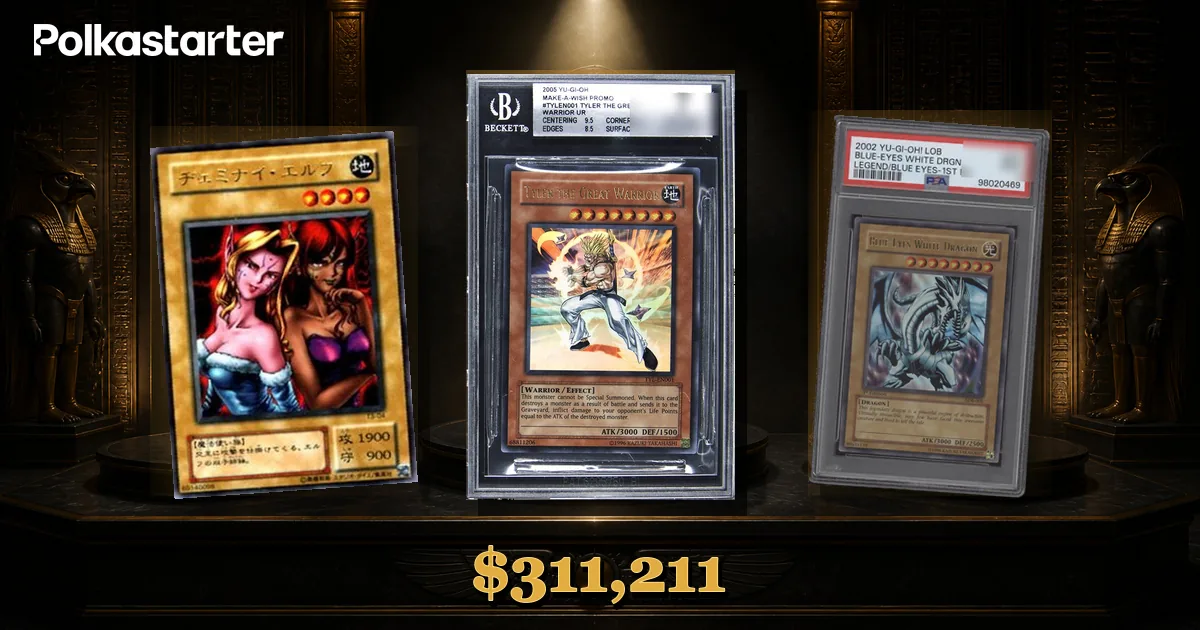
1. Tyler the Great Warrior. $311,211
- eBay auction closed April 29, 2023, the highest documented public Yu-Gi-Oh sale, primary-sourced through YGOrganization
- The story that makes it the best card in all of collecting: created through the Make-A-Wish Foundation for Tyler Gressle, who fought a rare childhood cancer, drew the initial art himself (a Dragon Ball Future Trunks homage), and had it turned into a real one-of-one card with concept art from Kazuki Takahashi. Gressle turned down $75,000 for it in 2015, sold it himself in 2023, and kept the original sketches.
2. Alternate Artwork Gemini Elf, 2001 Asia Championship prize. Reported ~$254,791
- Private sale via a Japanese dealer, May 2024, 40 million yen, the fourth-place prize card handed out by Kazuki Takahashi himself. The same copy traded at about $175,000 in 2018. Most older lists miss it entirely.
3. Masahiro the Dark Clown, 2001 Second National Tournament prize. $173,923, with a dispute
- eBay, September 2025, one of three Japanese prize cards featuring the winner's own face. The caveat belongs in print, a Konami USA representative publicly claimed in 2010 that these three cards were fake, while the card's appearance on the OCG's 2010 restricted list argues for authenticity. The market paid six figures with the dispute attached.
And the legend: the stainless-steel Black Luster Soldier. The 1999 Japanese tournament prize surfaced in 2013 with a 998 million yen asking price, roughly ten million dollars, which is the only documented number in its entire history. Every "it sold for $2 million" claim is rumor, no sale has ever been verified, and any list printing one as fact is copying folklore. The honest phrasing is ours, the most famous Yu-Gi-Oh card has never had a confirmed price. Where the verified records sit against other hobbies, sports cards at $12.9 million and a Pokemon card at $16.5 million, is in our most expensive trading cards ranking.
The Vintage Ladder: Honest 2026 Prices
The uncomfortable truth this page exists to tell, vintage Yu-Gi-Oh grails trade at roughly half their 2020 to 2021 peaks, and most lists still quote the peaks. As of August 5, 2026:
- Blue-Eyes White Dragon LOB-001 1st Edition: raw about $2,100, PSA 9 about $8,600, PSA 10 at $32,000 to $50,000 across 2026 sales. The famous $85,000 PSA 10 sale was August 2021, the peak, not the price.
- Crush Card Virus, Shonen Jump Championship prize (2007): $14,500 to $20,500 by grade across 2025 to 2026 sales, against a $49,999 peak in June 2020.
- Cyber-Stein, the first SJC prize (2004): raw about $4,500, BGS 9 at $10,200 to $12,000, against a $30,100 peak in October 2020.
- Des Volstgalph, SJC prize: PSA 10 at $12,500, March 2026, the freshest prize-card comp on the list.
- Dark Magician, KC Grand Tournament 2nd Place (2021): $37,500 with premium at Heritage in December 2024, and a correction most lists need, this is a Duel Links video game tournament prize, not a physical-TCG event card.
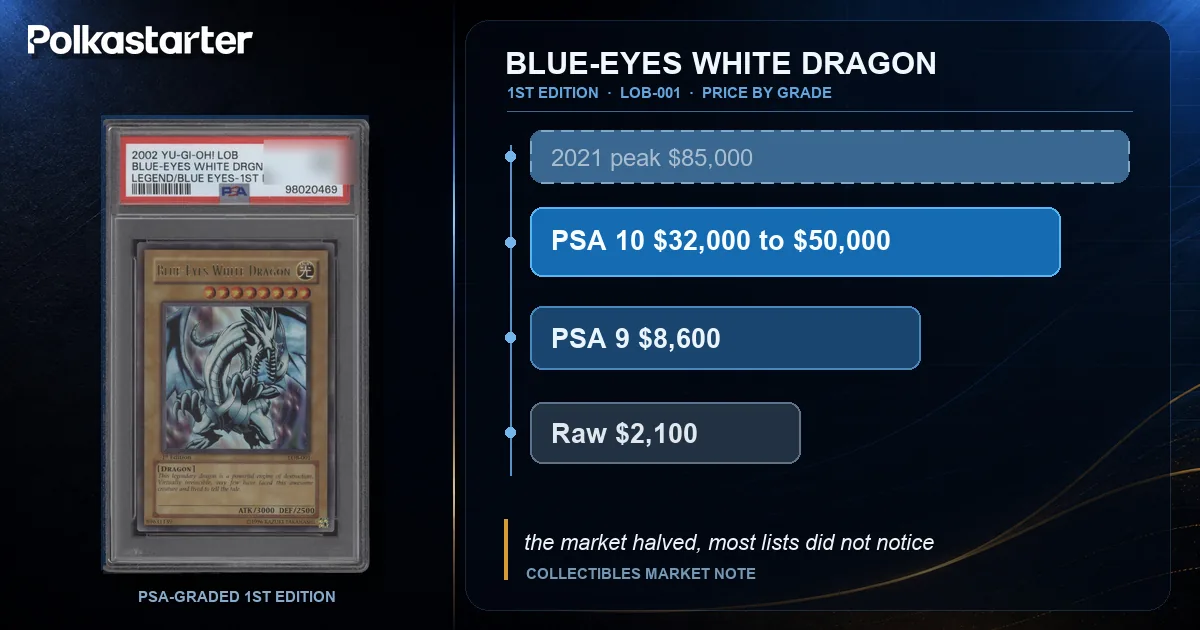
None of this makes the cards bad holdings, it makes the 2020 prices a bubble and the 2026 prices a market. Buy against comps, not against memories, and at these figures verify every slab.
The Prize Card System
Yu-Gi-Oh's six-figure tier exists because Konami has handed out one-of-few prize cards continuously for two decades, the Shonen Jump Championships from 2004, the Yu-Gi-Oh Championship Series from 2010, and the World Championship annually. The system is alive, the 2025 YCS prize was Anotherverse Stratios and the 2025 Worlds winners received Light Leading the Valiant in Extra Secret Rare. The older Worlds grails, Armament of the Lethal Lords and its siblings, have no credible recent sales, the prices you see attached to them in listicles are lore, and we will not print them. Prize scarcity is the same physics as every hobby's trophy tier, the population logic is laid out in our rarest Pokemon cards ranking.
Which Packs Have the Valuable Cards Now
The question everyone asks, answered with the 2026 reality most have not caught. Quarter Century Secret Rares are finished. The last QCSR sets were Quarter Century Stampede (April 2025) and Alliance Insight, Starlight Rare took over the top slot from June 2025, and 2026's Rarity Collection V (April 17, $5.99 packs) carries Starlight, Platinum Secret, and the TCG's first Extended Art cards instead. Two consequences:
- The QCSR supply is permanently fixed, the chase lives in 2023 to 2025 sealed product, the Rarity Collection sets, Quarter Century Bonanza and Stampede, and the era's core sets.
- The prices are humbler than the hype, today's top QCSRs trade at roughly $60 to $150, Heavy Storm at $145, Dark Armed Dragon at $120, Mirror Force at $96. If you read that QCSRs are worth many hundreds, the article is stale.
The 2026 TCG calendar for chase hunters: Battles of Legend Glorious Gallery (June), the World Championship 2026 Limited Pack with Ukiyo-e art variants (August 8), Magnificent Monsters (September 4), and Beyond the Brave (October 9). And the 30th anniversary wave, the franchise turns 30 on September 30, 2026, is Japan-led so far, the OCG's Original Artwork Collection with serial-numbered Grand Master Rares lands September 26, with no TCG-side equivalent announced yet.
Your Old Collection, Honestly
Three truths for everyone with a childhood binder. First, the "1996" on your cards is the manga copyright date, not a print date, the manga debuted September 30, 1996, Konami's Japanese card game launched February 1999, and the English TCG began March 8, 2002, no playable Yu-Gi-Oh card predates those dates. Second, if your cards are genuinely from 1998 to 1999, they are Bandai's 118-card series, real, collectible, and modest, the flagship Bandai Blue-Eyes averages around $215 graded, commons a few dollars. Third, the edition line decides everything, 1st Edition Legend of Blue Eyes commons bring about $5, staples $30 to $50, the Blue-Eyes itself $2,100 raw, and a sealed 1st Edition booster box about $20,750, while the unlimited reprints most collections actually hold are bulk worth cents. Check the edition stamp before you dream, and for how a young TCG's grails behave next door, our One Piece ranking runs the same honest math.
Frequently Asked Questions
What is the most expensive Yu-Gi-Oh card?
Tyler the Great Warrior, the one-of-one Make-A-Wish card, sold for $311,211 on eBay in April 2023, the highest documented public sale. A tournament-prize Gemini Elf reportedly sold privately for about $254,791 in 2024. The famous stainless-steel Black Luster Soldier has never had a verified sale, its rumored figures are folklore.
What is the rarest Yu-Gi-Oh card?
The one-of-one and one-of-few tournament prizes, Tyler the Great Warrior is unique, the 2001 championship prizes exist in single digits, and the steel Black Luster Soldier is one of one. Among retail cards, early prize-era Shonen Jump Championship cards number in the dozens. Rarity in Yu-Gi-Oh is a tournament history, not a pack pull.
Which Yu-Gi-Oh packs have the most valuable cards?
As of 2026, none in print carry the famous chase. Quarter Century Secret Rares ended with April 2025's Quarter Century Stampede, Starlight Rare replaced the slot, and current top QCSRs trade at $60 to $150 in the 2023 to 2025 sealed products that contain them. Today's products chase Starlight, Platinum Secret, and the new Extended Art cards introduced in Rarity Collection V.
Are old Yu-Gi-Oh cards worth anything?
Usually not much, and the edition line is everything. First Edition Legend of Blue Eyes cards hold real value, about $5 for commons up to $2,100 raw for the Blue-Eyes itself, while unlimited reprints are bulk worth cents. Cards marked 1996 are not from 1996, that is the manga copyright date, and genuine pre-2002 English cards do not exist.
Did a Yu-Gi-Oh card really sell for $2 million?
No verified sale supports it. The stainless-steel Black Luster Soldier was listed in 2013 for 998 million yen, roughly $10 million, and rumors of a $2 million private sale have circulated for years without documentation. The highest documented Yu-Gi-Oh sale remains $311,211. In this hobby, a listing is not a sale and a rumor is not a record.
Where to Go From Here
Yu-Gi-Oh's market is a story market, a child's wish at the top, tournament history in the middle, and a bulk ocean underneath, with prices that reward the collectors who check comps instead of legends. Know your edition, date your comps, and ignore any number without a receipt. And when opening packs is the fun, the Polkastarter marketplace shows every card, value, and chance in every Lootbox before you rip, free mystery pack at signup.
All sales and prices verified August 5, 2026 via YGOrganization, PriceCharting sale logs, Konami's product pages, and the cited coverage, reported and disputed items labeled, markets move. Nothing here is investment advice. Polkastarter is not affiliated with, endorsed by, or sponsored by Konami, Shueisha, or any auction house named.
Sources
- YGOrganization, the Tyler the Great Warrior sale
- Wargamer, the maintained record list and the Masahiro sale
- PriceCharting, the vintage ladders and prize-card comps (read directly, August 5, 2026)
- Konami's official product pages, Rarity Collection V and the anniversary wave
- Yugipedia, the prize-card system and the Bandai era
- Heritage Auctions, the Dark Magician KC sales
- ICv2, the 2026 TCG release calendar
.png)

Ilknur Gubel is a social media manager at Polkastarter. Ilknur has spent the past four years working as a project manager, marketing manager, and social media strategist across Web3. She has held marketing and project management positions at several crypto companies, including Polygen, Nitro League, Kaizen.Finance, and ChainPort.
At Polkastarter she has covered trading card releases, collectible market pricing, and how token holders can spend crypto on real cards and videogames.
Based in Istanbul, Ilknur earned a bachelor's degree in sociology from Istanbul Aydın University.
You can connect with her on LinkedIn for more information.