.avif)
.png)
.avif)


Content
How to Verify a Graded Card Is Real: The Cert Check, the Match Check, and the Slab Check

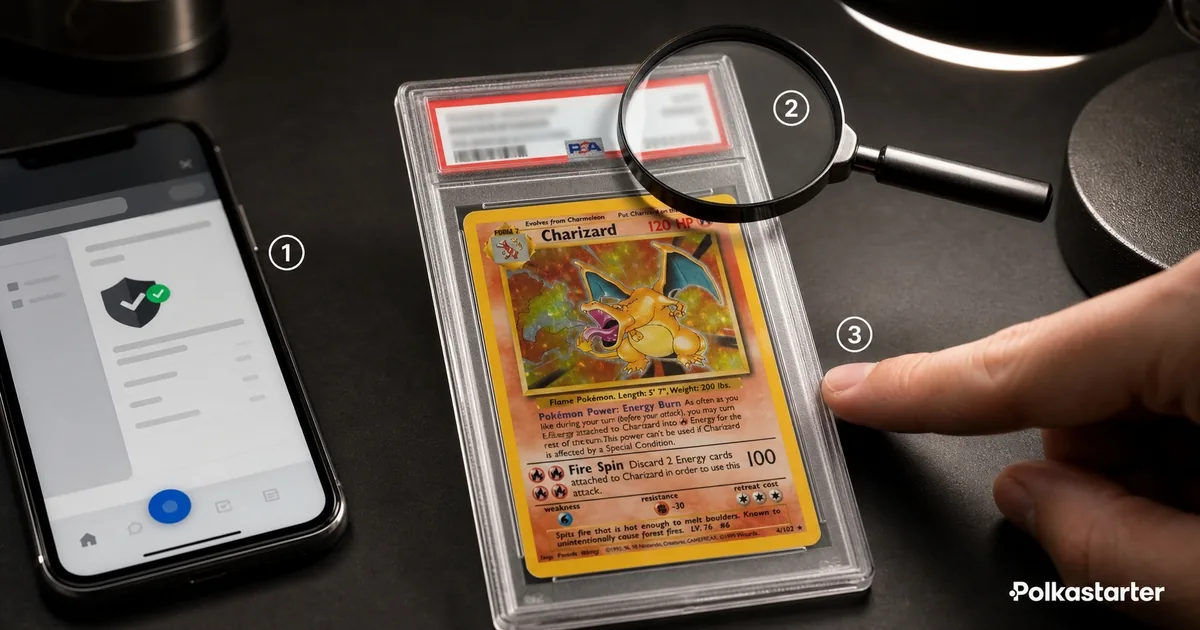
A graded slab is supposed to be the end of doubt, and counterfeiters know it, which is why fake slabs now carry real certification numbers copied from genuine cards. PSA itself warns that a cert lookup alone does not eliminate the risk. The full verification takes about two minutes and three layers, look the cert up, match it against the card in front of you, and inspect the slab itself. This guide walks all three, for PSA, BGS, and CGC.
Why the Cert Lookup Alone Is Not Enough
Here is the trick that catches even careful buyers. A counterfeiter takes the cert number from a real, expensive graded card, prints it on a fake label, seals it around a fake or lesser card, and lists it for sale. You scan the QR code or type the number in, the grader's website shows you a real entry... and everything looks legitimate, because the number is legitimate. The slab is not.
That is why PSA's fraud report matters here, over $200 million in counterfeit and altered cards intercepted in a single year, with fake Pokemon cards up 125 percent, the full numbers are in our fraud report breakdown. The lookup is step one of three, never the whole check.
Step 1: The Cert Lookup
Every graded card carries a unique certification number on its label, usually 8 to 10 digits. Look it up directly on the grader's own site, all three tools are free:
- PSA: psacard.com/cert, no account needed. Newer entries include photos of the actual graded card, which makes the next step much stronger.
- BGS (Beckett): beckett.com/grading/card-lookup.
- CGC Cards: cgccards.com/certlookup.
Use the grader's own site, not a third-party mirror, and type the number rather than trusting a QR code on the label, a fake label can point its QR anywhere. If the number returns nothing, walk away, no exceptions.
Step 2: The Match Check
Now compare the database entry against the physical card in front of you, field by field:
- Card name, set, year, and card number must match exactly. A cert registered to a 1999 Base Set Charizard sitting on a label around a different card is the reused-cert trick in action.
- The grade must match, including sub-grades on BGS slabs, and a BGS overall grade that does not mathematically fit its four sub-grades is label fraud on its face.
- If PSA shows photos of the graded card, compare them to what you are holding, centering, surface marks, and print quirks are fingerprints, two different copies of the same card will not match perfectly.
- Any mismatch means walk away. Not negotiate. Walk.
Step 3: The Slab Check
The physical holder is where fakes fail, because the graders' cases are precision products and copies rarely survive close inspection:
- The hologram and label effects. PSA's modern labels shift between green, gold, and silver as you tilt them, flat or single-color holograms are the classic fake tell, and newer PSA slabs add a hidden lighthouse mark that appears under UV light plus embedded NFC that counterfeiters struggle to duplicate.
- The seams and edges. Genuine cases are sonically welded clean. Hazy frosting along the edges, visible glue, gaps in the seal, or any flex when you gently press the halves together means the case was opened or never genuine.
- The label printing. Compare letter spacing, font weight, and alignment against a slab you know is real, grader labels are perfectly centered and consistent, drift and fuzzy print are counterfeit signatures.
- BGS specifics. The sub-grade stickers sit firmly and straight, and the inner label matches the outer, peeling stickers or a missing inner label are major red flags.
For which grader's slabs command what premium once you know yours is real, our CGC versus PSA comparison covers it, and whether grading a raw card is worth the fee at all is its own math, covered in is PSA grading worth it.
Buying Online: The Extra Layer
You cannot press the seams through a screen, so make the seller do the check for you:
- Ask for a tilt video of the label showing the hologram shift, and edge photos of all four seams for anything expensive.
- Ask for the cert number before you buy and run steps one and two yourself.
- Price is a tell. A graded grail meaningfully below recent sold prices from an anonymous seller is the oldest red flag in the hobby, our raw-card version of this guide covers the rest of the tells.
- Buy where someone is accountable. A platform with a real company, support, and returns beats an anonymous listing every time, and the gap widens as fakes multiply.
Frequently Asked Questions
How do I check if a PSA cert number is real?
Type the number into PSA's own cert verification tool at psacard.com/cert, it is free and needs no account. The entry shows the card's details, and newer entries include photos of the actual graded card. But a real cert entry does not prove the slab is real, counterfeiters reuse genuine numbers, so always match the entry against the physical card and inspect the slab itself.
Can a fake slab have a real cert number?
Yes, and this is the most important thing to understand about slab fraud. Counterfeiters copy cert numbers from genuine expensive cards onto fake labels, so the lookup returns a legitimate entry. PSA itself warns that verification of a cert number does not eliminate risk. The defense is the match check, the database entry must match the exact card and grade in front of you, and the physical slab inspection.
How do I spot a fake PSA slab?
Tilt the label, real PSA holograms shift between green, gold, and silver while fakes sit flat. Check newer slabs for the hidden lighthouse mark under UV light. Inspect the edges for hazy frosting, seal gaps, or flex when gently pressed, genuine cases are welded clean. And compare the label's print quality against a known-real slab, drift, fuzzy text, or off-center alignment are counterfeit tells.
Is a graded card always authentic?
The card inside a genuine, untampered slab from a major grader carries that grader's authentication, which is the whole point of grading. The risk is the slab itself being counterfeit or tampered with, which is why the three-layer check exists. Verify the cert, match it to the card, inspect the holder, and the grade means what it says.
What should I do if I bought a fake slab?
Document everything with photos, contact the platform or payment provider for a refund claim, and report the listing. The grader wants to know too, PSA and its peers track counterfeit holders. And check the seller's other listings, slab counterfeiters rarely sell just one. Buying from accountable platforms with return policies is what makes this recoverable instead of a loss.
Where to Go From Here
Two minutes, three layers, look it up, match it, inspect it, and the slab premium you pay is protected. In a year when fakes grew 125 percent, that habit is the cheapest insurance in the hobby. And if you would rather start from a place where the checking is done, the Polkastarter marketplace carries graded cards on an accountable platform, with every Lootbox listing its cards, values, and chances before you open, and your first one free at signup.
Educational content only. Verification tools and slab security features are as published by the graders and may change with new holder designs, and nothing here is investment advice. Polkastarter is not affiliated with, endorsed by, or sponsored by PSA, Beckett, CGC, or Pokémon.
Sources
.png)


Ilknur Gubel is a social media manager at Polkastarter. Ilknur has spent the past four years working as a project manager, marketing manager, and social media strategist across Web3. She has held marketing and project management positions at several crypto companies, including Polygen, Nitro League, Kaizen.Finance, and ChainPort.
At Polkastarter she has covered trading card releases, collectible market pricing, and how token holders can spend crypto on real cards and videogames.
Based in Istanbul, Ilknur earned a bachelor's degree in sociology from Istanbul Aydın University.
You can connect with her on LinkedIn for more information.