.avif)
.png)
.avif)


Content
PSA Grading Scale: What Every Grade From 1 to 10 Means

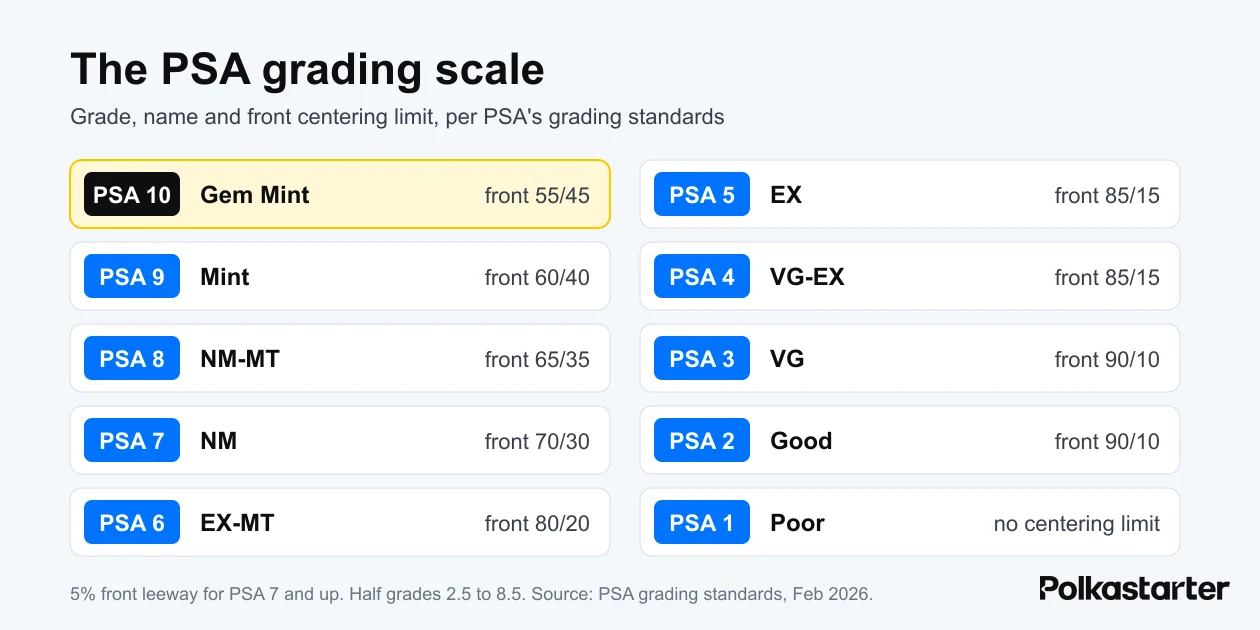
The PSA grading scale runs from PSA 1 (Poor) to PSA 10 (Gem Mint), with half grades in between, and a PSA 10 must be centered within about 55/45 on the front and 75/25 on the back, according to PSA's grading standards. Below is what every grade allows, what the letters like OC and MK mean, how Authentic and the N codes work, and what one grade point can do to a card's price.
Current as of October 12, 2026. Grade wording is from PSA's grading standards page as archived in February 2026.
The PSA Grading Scale, Grade by Grade
PSA gives each grade a name and, from PSA 1.5 up, a front and back centering limit. The higher the grade, the less wear and the tighter the centering:
PSA 10, Gem Mint
- Centering: about 55/45 front, 75/25 back
- What it means: "A PSA Gem Mint 10 card is a virtually perfect card," PSA writes on its grading standards page (archived February 23, 2026). Four sharp corners, sharp focus, full original gloss and no staining. PSA allows a slight printing imperfection if it does not hurt the card's appeal
PSA 9, Mint
- Centering: about 60/40 front, 90/10 back
- What it means: a superb card with only one minor flaw, such as a very slight wax stain on the back, a minor printing imperfection or slightly off-white borders
PSA 8, NM-MT (Near Mint-Mint)
- Centering: about 65/35 front, 90/10 back
- What it means: looks like a Mint 9 at first glance, but closer inspection can show the slightest fraying at one or two corners, a minor print flaw or slightly off-white borders
PSA 7, NM (Near Mint)
- Centering: about 70/30 front, 90/10 back
- What it means: slight surface wear on close inspection and slight fraying on some corners. Most of the original gloss remains
PSA 6, EX-MT (Excellent-Mint)
- Centering: 80/20 front, 90/10 back
- What it means: visible surface wear or a printing defect that does not hurt the overall appeal, possibly a very light scratch
PSA 5, EX (Excellent)
- Centering: 85/15 front, 90/10 back
- What it means: very minor rounding of the corners is becoming evident, with some loss of gloss and possible minor edge chipping
PSA 4, VG-EX (Very Good-Excellent)
- Centering: 85/15 front, 90/10 back
- What it means: slightly rounded corners, noticeable but modest surface wear, and possibly a light crease
PSA 3, VG (Very Good)
- Centering: 90/10 front and back
- What it means: some corner rounding, though not extreme, and possibly a visible crease
PSA 2, Good
- Centering: 90/10 front and back
- What it means: accelerated corner rounding, surface wear that is starting to become obvious, and possibly several creases
PSA 1.5, Fair, and PSA 1, Poor
- Centering: about 90/10 front and back for a 1.5. PSA lists no centering limit for a 1
- What it means: heavy wear. A Fair card must be fully intact, while a Poor card can be missing small pieces and its eye appeal has nearly vanished
For PSA 7 and up, PSA allows a 5% leeway on the front centering figure, and graders may allow a small variance on any card based on its overall eye appeal.
Half Grades: Why There Is a PSA 8.5 but No 9.5
PSA added half-point grades effective February 1, 2008, Sports Collectors Digest reported at the time. The rule on PSA's standards page (archived February 23, 2026): "Cards that exhibit high-end qualities within each particular grade, between PSA 2 and PSA 9, may achieve a half-point increase." PSA says centering gets a clear focus when it decides.
That means half grades run from 2.5 to 8.5, alongside the separate PSA 1.5 (Fair) grade. There is no PSA 9.5, and a PSA 10 is the top of the scale. Other graders work differently: Beckett uses subgrades and a 9.5 Gem Mint, explained in our guide to the BGS Black Label.
Qualifiers: OC, ST, PD, OF, MK and MC
A qualifier flags one specific problem next to the number on the label. PSA applies MK and MC whenever they are warranted. For OC, ST, PD and OF, PSA's standards page says the card either carries the qualifier or gets a lower number that reflects the flaw. Since a June 2021 policy change, PSA has said those four are assigned at the grader's discretion and most often lower the numerical grade instead of appearing on the label.
OC (Off Center): the centering misses the limit for the grade the card would otherwise get.
ST (Staining): staining beyond what the grade allows.
PD (Print Defect): a print defect beyond what the grade allows.
OF (Out of Focus): the image is out of focus or out of register.
MK (Marks): any writing, ink or pencil marks, or the impression left by writing.
MC (Miscut): an atypical cut for the issue, such as part of the card cut off or part of a second card showing.
Check the label for a qualifier before you compare prices, because a PSA 8 OC and a PSA 8 are not the same card.
Authentic, Authentic Altered and the N Codes
Some cards get no number at all.
Authentic: PSA is only certifying that the card is genuine, with no numerical grade.
Authentic Altered (AA): the card is genuine but altered, for example by trimming, recoloring, restoration or cleaning. PSA uses it case by case, and only if the submitter listed AA as the minimum grade.
N codes: cards PSA will not grade come back in a card saver with a code. N1 is evidence of trimming, N2 restoration, N3 recoloration, N4 questionable authenticity, N5 altered stock, N6 minimum size requirement, N7 evidence of cleaning, N8 miscut and N9 means PSA does not grade that issue. PSA's N5 Altered Stock code covers pressing out creases and wrinkles, the alteration covered in our explainer on card pressing and PSA.
How PSA Measures Centering, and the 5% Leeway
PSA measures centering by comparing the borders left to right and top to bottom, at the most off-center part of the card. Its standards page adds a 5% leeway on front centering for cards that grade PSA 7 or better. PSA's own example: a card that meets every other PSA 9 requirement and measures 60/40 on the front automatically meets the PSA 9 centering standard, and at 65/35 it may still qualify if the card's eye appeal is good.
PSA used to write that leeway into each range. In the December 29, 2023 archived copy of the page, a PSA 10 read approximately 55/45 to 60/40 on the front, a PSA 9 60/40 to 65/35, a PSA 8 65/35 to 70/30 and a PSA 7 70/30 to 75/25. The 2026 copies list only the first figure, and the 5% leeway note is still on the page. We found no PSA announcement of a stricter standard, so treat 55/45 as the safe target for a PSA 10 and 60/40 as the edge, where eye appeal decides.
To measure a border yourself, divide the wider border by the two borders combined. A card with a 2.2 mm left border and a 1.8 mm right border measures 2.2 out of 4.0, which is 55/45.
What One Grade Does to Price: The 1986 Fleer Jordan
The 1986 Fleer Michael Jordan rookie #57 shows how steep the top of the scale is:
PSA 8: $7,200 with buyer's premium at SCP Auctions in its Spring 2025 Premier auction, which closed April 5, 2025, after 13 bids.
PSA 9: $40,800 with buyer's premium at Fanatics Collect on June 19, 2026, after 28 bids.
PSA 10: $168,000 in the same SCP Spring 2025 auction (lot, 18 bids), and $228,000 at Fanatics Collect on December 19, 2025, after 16 bids.
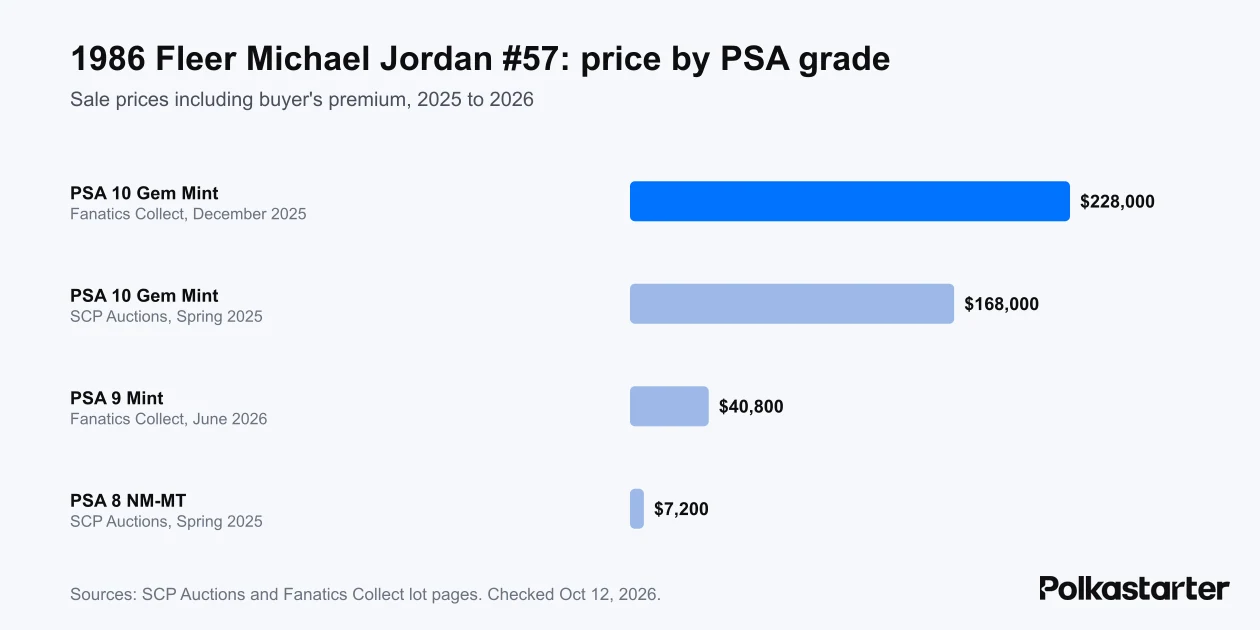
These are single sales at two auction houses between April 2025 and June 2026, so read the ladder as a snapshot, not a price guide.
Scarcity at the top is a big part of it. The December 2025 Fanatics Collect lot says only 332 of the more than 29,600 copies PSA had graded, about 1.1 percent, earned a PSA 10. Our guide on how to read the PSA pop report shows how to find those counts for your own card.
PSA's own numbers set expectations for submitters. On its getting started page, checked October 12, 2026, PSA says about 90 percent of ultra-modern sports cards (2017 to present) and modern trading card games (2003 to present) have graded PSA 8 or higher, and about 80 percent of vintage TCG cards (before 2003) have graded PSA 7 or higher. PSA adds that it grades each card individually, without regard to those stats.
How to Use the Scale Before You Submit
Measure centering first. It is the easiest flaw to measure at home, and it caps the grade no matter how sharp the corners are.
Price the grade you expect, not the one you hope for. On the Jordan above, the step from PSA 9 ($40,800 in June 2026) to PSA 10 ($168,000 to $228,000 in 2025) was worth more than $127,000.
Know what PSA will not grade. Trimmed, recolored or cleaned cards come back as N codes or Authentic Altered, not with a number.
Our guide on how PSA grading works covers tiers, fees and the submission steps.
Frequently Asked Questions
What is the highest PSA grade?
PSA 10, Gem Mint. PSA describes it as a virtually perfect card with four perfectly sharp corners, full original gloss and front centering within about 55/45.
Does PSA give a 9.5?
No. PSA half grades run from 2.5 to 8.5, for cards with high-end qualities within grades 2 to 8. There is no PSA 9.5 and nothing above a PSA 10.
What does OC mean on a PSA card?
OC means off center. The card meets the other standards of its grade, but its centering misses that grade's limit. PSA either adds OC to the grade or gives the card a lower number, and since June 2021 PSA has said it most often lowers the number.
What does PSA Authentic mean?
PSA has confirmed the card is genuine but gave it no numerical grade. Authentic Altered means the card is genuine but has been altered, for example trimmed or recolored.
Where to Go From Here
A grade is a price tag in shorthand, and knowing the scale keeps you from overpaying for a number. If you want to collect real, vaulted cards without the grading wait, the Polkastarter marketplace gives you a free mystery pack when you sign up, and every Lootbox lists its contents, values, and chances before you open.
Details checked October 12, 2026. Prices are past sale results and change over time. Nothing here is financial advice. Polkastarter is not affiliated with PSA, Collectors, Beckett, SCP Auctions, Fanatics Collect or the other companies named.
Sources
- PSA: Grading Standards, as archived February 23, 2026 (archived copy), accessed October 12, 2026
- PSA: Grading Standards, archived December 29, 2023, accessed October 12, 2026
- PSA: Getting Started With Grading, accessed October 12, 2026
- PSA: Customer Update, June 2021, published June 2021, accessed October 12, 2026
- Sports Collectors Digest: PSA Introduces Half Grades for Trading Cards, published January 17, 2008, accessed October 12, 2026
- SCP Auctions: 1986 Fleer #57 Michael Jordan Rookie PSA 10, Spring 2025 Premier, accessed October 12, 2026
- SCP Auctions: 1986 Fleer #57 Michael Jordan Rookie PSA 8, Spring 2025 Premier, accessed October 12, 2026
- Fanatics Collect: 1986 Fleer Michael Jordan Rookie #57 PSA 9, sold June 19, 2026, accessed October 12, 2026
- Fanatics Collect: 1986 Fleer Michael Jordan Rookie #57 PSA 10, sold December 19, 2025, accessed October 12, 2026
.png)

Ilknur Gubel is a social media manager at Polkastarter. Ilknur has spent the past four years working as a project manager, marketing manager, and social media strategist across Web3. She has held marketing and project management positions at several crypto companies, including Polygen, Nitro League, Kaizen.Finance, and ChainPort.
At Polkastarter she has covered trading card releases, collectible market pricing, and how token holders can spend crypto on real cards and videogames.
Based in Istanbul, Ilknur earned a bachelor's degree in sociology from Istanbul Aydın University.
You can connect with her on LinkedIn for more information.