.avif)
.png)
.avif)


Content
How to Read the PSA Pop Report: What Population Numbers Really Tell You

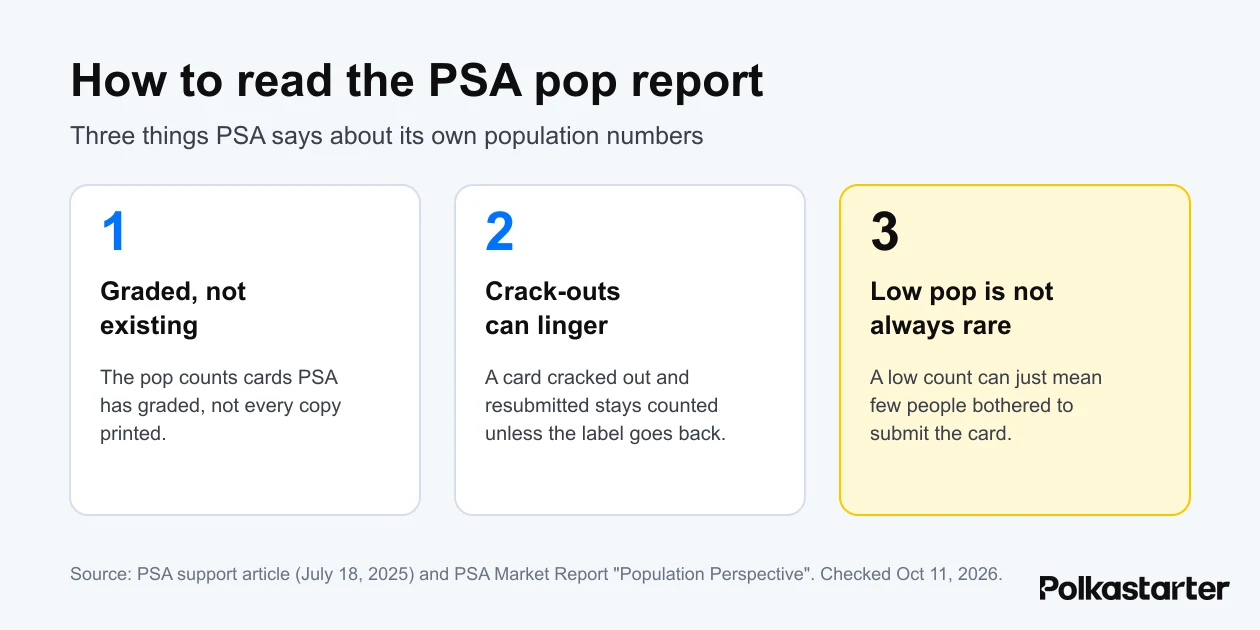
The PSA pop report (Population Report) is PSA's running count of every card it has graded, broken down by set, card and grade, and PSA itself calls it a living database that is not 100% perfect, in its July 18, 2025 support article on the report. A PSA 10 count tells you how many copies PSA has graded at that grade, not how many copies exist. Below is how to read the numbers, the caveats PSA spells out, and real 2026 auction examples that show why population matters and where it misleads.
Current as of October 11, 2026.
What the PSA Pop Report Counts
PSA described the report as a complete listing of every item it has authenticated and graded since the company launched in 1991, with an exact count for each grade from PSA 1 to PSA 10, in its 2012 announcement making the report free.
What a row shows: one card, such as a set and card number, with how many copies PSA has graded at each grade.
Pop Higher: on PSA's CardFacts pages, as shown on October 11, 2026, this column shows how many copies sit at a higher grade than the row you are reading. For a PSA 9, it is the number of PSA 10s.
CardFacts: the same pages add a Condition Census, a list of the ten finest PSA-graded examples of a card, which PSA calls a work-in-progress.
Access: when we checked on October 11, 2026, opening a set page on psacard.com/pop sent us to a PSA sign-in page, so plan on signing in with a PSA account to browse the full tables.
Three Caveats PSA Itself Gives
1. It counts graded cards, not cards in existence. In an undated PSA Market Report column on population, PSA wrote: "The population numbers do not represent ALL CARDS IN EXISTENCE, they merely represent the ones that have been graded by PSA." The same article notes that cards rejected for alteration, restoration or questionable authenticity are not in the counts.
2. Crack-outs can stay in the count. PSA's support article (July 18, 2025) says collectors crack cards out of their holders to get them signed, to resubmit them or to sell them raw, and "unless we get that label back, there's no way for us to know that the population needs to be updated." So a cracked and resubmitted card can be counted again unless its old label went back to PSA.
3. Low pop is not always rare. PSA's Market Report gives the example of a Mint 9 with a pop of 4 that looked like a bargain but was low pop only because few people had bothered to submit a card worth very little.
PSA also uses the report to tell collectors whether it can grade a card: if the card appears in the pop, it is highly likely PSA can grade it, the support article says.
How Population Shows Up in 2026 Prices
Auction houses quote PSA counts in their lot descriptions, and Goldin notes its figures are accurate when a lot is posted and subject to change. Five 2026 examples, as stated when each lot was posted:
Gold Star Mudkip #107, EX Team Rocket Returns
- Goldin's October 2026 listing: 42 PSA 10s out of more than 1,410 graded copies. A PSA 10 sold for $1,020,000 at Fanatics Collect on September 20, 2026, covered in our report on that sale
Expedition holo Dragonite #9
- Goldin's May 2026 listing: more than 2,180 graded, with fewer than 2 percent at PSA 10. This copy sold for $55,244 with buyer's premium at Goldin in June 2026
POP Series 5 Gold Star Espeon #16
- Goldin's October 2026 listing: more than 850 graded, with fewer than 7 percent at PSA 10
Raincoat Pikachu, 2015 Art Academy promo
- The Fanatics Collect listing showed 57 PSA 10s for a prize card whose winners each received 100 copies, according to Kotaku, and the card sold for $8.4 million in September 2026. Kotaku called the result an odd contradiction, since 57 PSA 10s should rule it out of Illustrator Pikachu territory, and noted much cheaper PSA 10 sales earlier in 2026. Our Raincoat Pikachu report covers the sale
Art Academy Mudkip by Daisuke Ochiai
- The Fanatics listing in September 2026 said two copies had graded PSA 10. Goldin's October 2026 listing for another copy says three. Counts move as more cards are graded
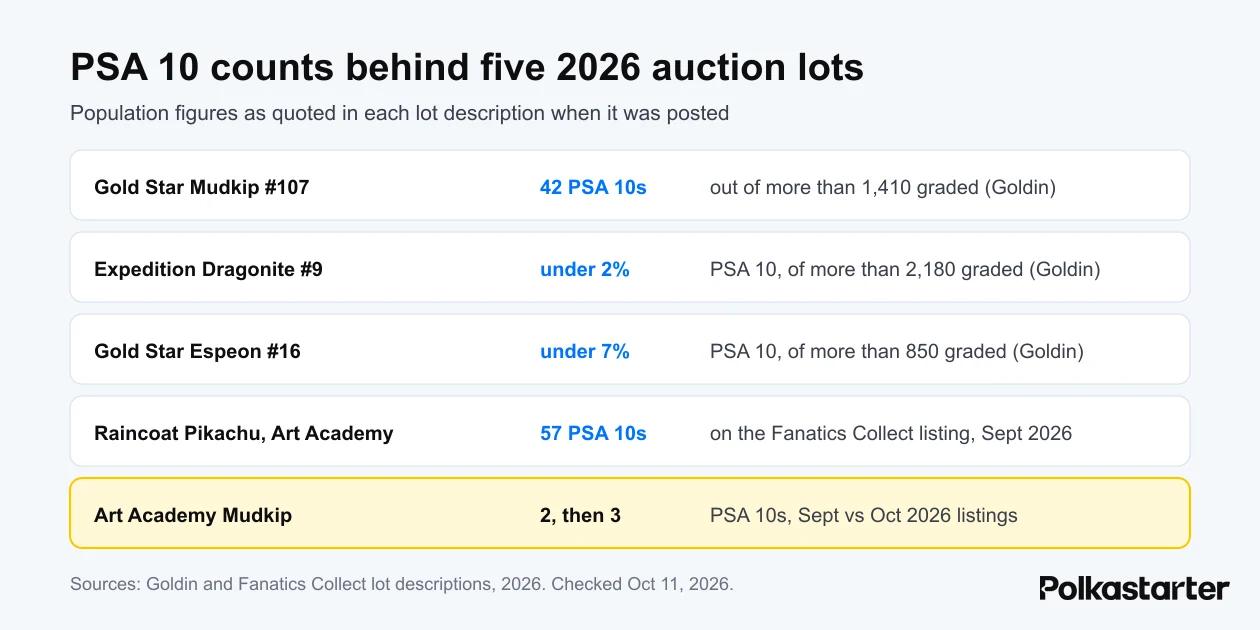
Gem rate: the share of graded copies that hit PSA 10. Per Goldin's listings, Gold Star Mudkip was under 3 percent (42 of more than 1,410), Expedition Dragonite under 2 percent and Gold Star Espeon under 7 percent. A low gem rate on a card many people have graded is a stronger signal than a low raw count.
Sources can also disagree on the same card. For the 1997 Gold 1st Place Trophy Pikachu now in Goldin's October auction, ICv2 called it the only copy in PSA's census on October 7, 2026, while Goldin's own listing says it is one of eight. Check the grader's own report, and the date, before you rely on a count.
How to Use the Pop Report When You Buy
Compare grades, not just the top count. The gap between a card's PSA 9 and PSA 10 counts tells you how hard the top grade is to reach.
Date every number. Populations usually rise as more cards are graded, so a count in an old listing may already be out of date.
Check the cert, not just the pop. The pop tells you how many copies PSA has graded at a grade. The cert tells you the slab in front of you is real. Our guide on how to verify a graded card walks through it, and our explainer on how PSA grading works covers fees and submission.
Other graders count separately. CGC and TAG publish their own population reports. Beckett's site, pop report included, still redirected to its tech updates page on October 11, 2026. Beckett said on October 2 that it took its platforms offline after detecting suspicious activity and that pop reports return in the first phase of its restoration. A PSA count says nothing about copies graded elsewhere. Our CGC vs PSA comparison covers the differences.
Frequently Asked Questions
What is the PSA pop report?
It is PSA's database of every card it has graded, with a count for each grade. PSA calls it a living database and says it is not 100% perfect, because cards cracked out of their holders stay counted unless the label is returned to PSA.
Does the PSA pop report show how many cards exist?
No. PSA says the population numbers represent only the cards it has graded, not all cards in existence, and they leave out cards PSA rejected for alteration, restoration or questionable authenticity.
What does Pop Higher mean on PSA?
Pop Higher is the number of copies of the same card graded higher than the row you are reading. On a PSA 9 row, it equals the number of PSA 10s.
Is a low population card always rare?
No. PSA's own Market Report describes a card with a pop of 4 that was low pop only because few collectors had submitted a card of little value. Low pop matters most on cards that many people have tried to grade.
Where to Go From Here
The pop report is one input, not a price tag. If you want to collect real, vaulted cards, the Polkastarter marketplace gives you a free mystery pack when you sign up, and every Lootbox lists its contents, values, and chances before you open.
Details checked October 11, 2026. Population counts change as cards are graded. Nothing here is financial advice. Polkastarter is not affiliated with PSA, Collectors, CGC, TAG, Beckett, Goldin, Fanatics Collect or the other companies named.
Sources
- PSA Support: What is the POP Report and how do I use it?, published July 18, 2025, accessed October 11, 2026
- PSA: Market Report, Population Perspective, accessed October 11, 2026
- PSA: PSA Population Report and SMR Online Price Guide Now Available Free, published January 2012 (per Sports Collectors Digest), accessed October 11, 2026
- PSA CardFacts: 1983 Topps Jim Breech #233, accessed October 11, 2026
- Fanatics Collect: 2004 Pokémon EX Team Rocket Returns Holo Mudkip Gold Star #107 PSA 10, sold September 20, 2026, accessed October 11, 2026
- Goldin: 2004 EX Team Rocket Returns Gold Star Mudkip #107 PSA 10 (live auction), accessed October 11, 2026
- Goldin: 2002 Pokémon Expedition Holo #9 Dragonite PSA 10, sold June 2026, accessed October 11, 2026
- Goldin: 2007 Pokémon POP Series 5 Gold Star #16 Espeon PSA 10 (live auction), accessed October 11, 2026
- Fanatics Collect: 2015 Pokémon Japanese XY Promo Art Academy Fujishima Pikachu PSA 10, sold September 2026, accessed October 11, 2026
- Kotaku: Raincoat Pikachu Art Academy PSA 10 sale, published September 30, 2026, accessed October 11, 2026
- Fanatics Collect: 2015 Pokémon Japanese XY Promo Art Academy Daisuke Ochiai Mudkip PSA 10, sold September 2026, accessed October 11, 2026
- Goldin: 2015 Pokémon Japanese XY Promo Art Academy Daisuke Ochiai Mudkip PSA 10 (live auction), accessed October 11, 2026
- ICv2: First Place Promo Pre-Bids Over $1 Million in Goldin's 2026 Pokémon 30th Anniversary Auction, published October 7, 2026, accessed October 11, 2026
- Goldin: 1997 Pokémon Japanese Promo Gold 1st Place 1st Tournament #1 Trophy Pikachu PSA 8 (live auction), accessed October 11, 2026
- Beckett: Tech updates, update of October 2, 2026, accessed October 11, 2026
.png)

Ilknur Gubel is a social media manager at Polkastarter. Ilknur has spent the past four years working as a project manager, marketing manager, and social media strategist across Web3. She has held marketing and project management positions at several crypto companies, including Polygen, Nitro League, Kaizen.Finance, and ChainPort.
At Polkastarter she has covered trading card releases, collectible market pricing, and how token holders can spend crypto on real cards and videogames.
Based in Istanbul, Ilknur earned a bachelor's degree in sociology from Istanbul Aydın University.
You can connect with her on LinkedIn for more information.