.avif)
.png)
.avif)


Content
The Most Valuable N64 Games in 2026 (and How to Tell If Yours Is Worth Money)

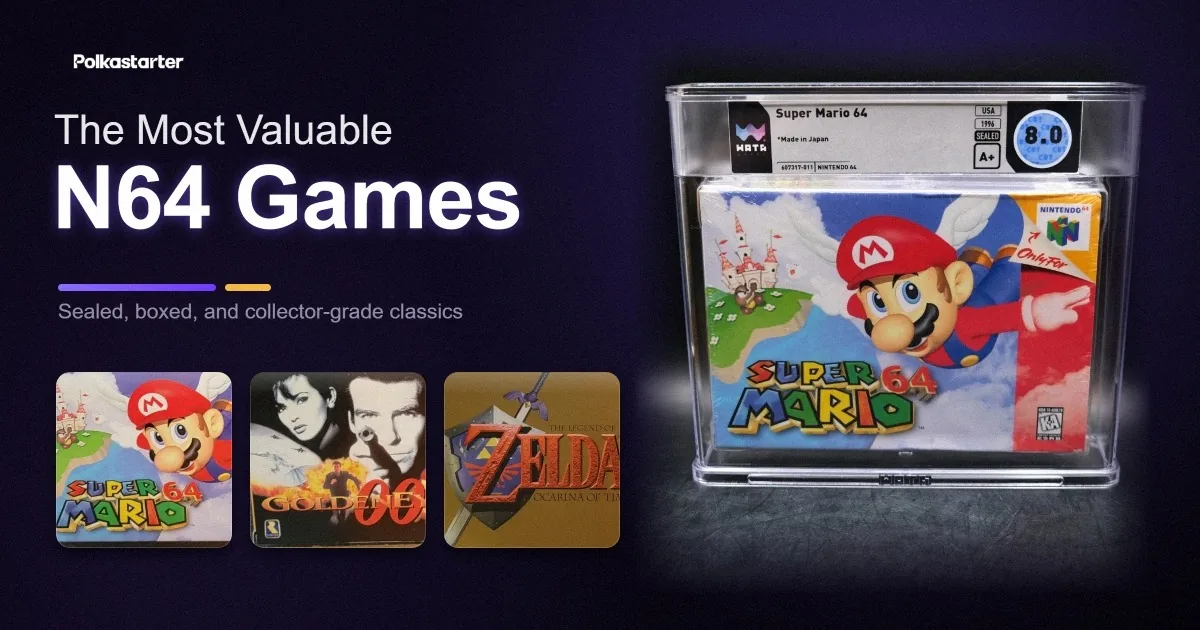
The most valuable N64 game is a sealed Super Mario 64, one copy of which sold for $1.56 million. Almost no one owns that. The more useful question is whether the cartridge in your closet is worth money, because with N64 games the same title can be worth $30 loose or thousands sealed, and a few rare carts are worth a small fortune in any condition. This guide ranks the most valuable and rarest N64 games, explains why they got expensive, and shows you how to tell what your own copy is actually worth.
What Is the Most Valuable N64 Game?
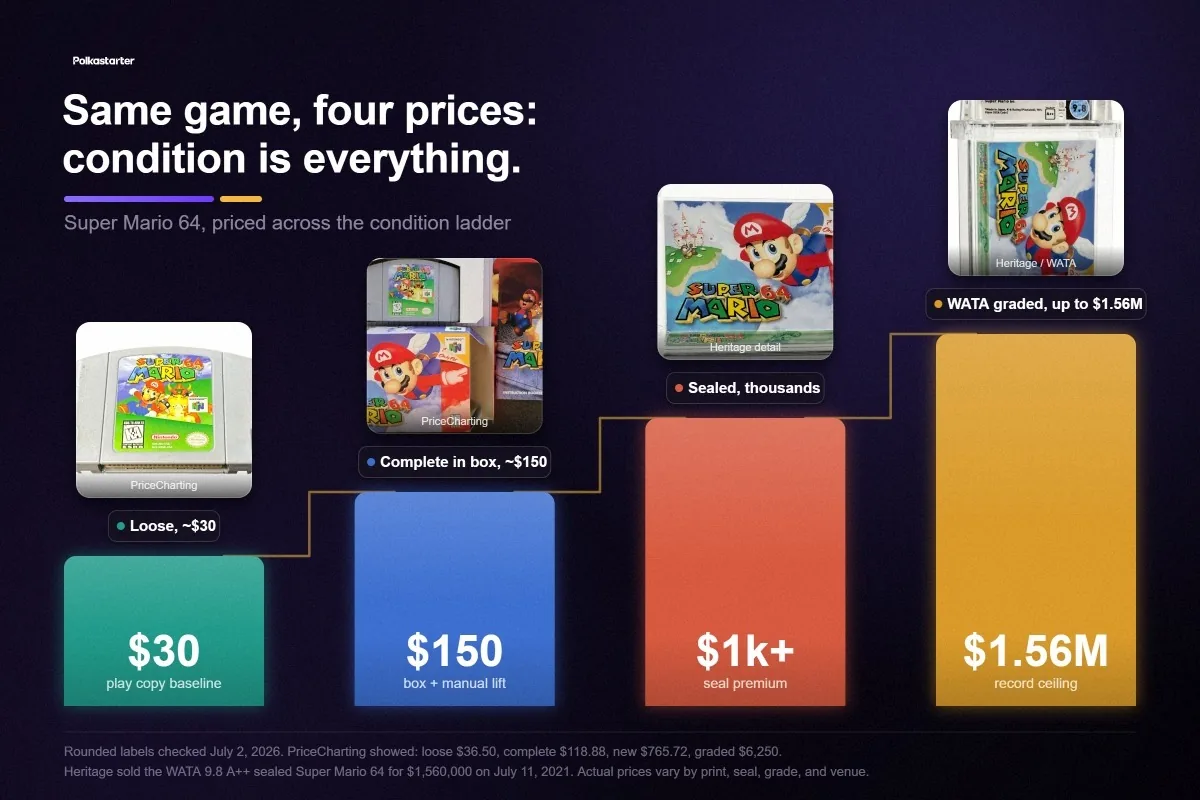
The most valuable N64 game is a sealed, high-grade Super Mario 64. A WATA 9.8 A++ copy sold for $1,560,000 in July 2021, which briefly made it the most expensive video game ever sold. A loose Super Mario 64 cartridge, the exact same game, is worth about $30 to $40. Nearly all of that value is the sealed, graded condition, not the game itself.
That gap is the single most important thing to understand about N64 values, so we will come back to it. First, the ranking.
The Record-Holders: Sealed and Graded
These set the ceiling. You are very unlikely to own one, but they show what condition does to price. All are sealed, professionally graded copies.
- Super Mario 64. The record, a WATA 9.8 A++ sealed copy at $1,560,000 (2021).
- The Legend of Zelda: Ocarina of Time. A WATA 9.8 A++ sealed copy sold for $228,000.
- Mario Kart 64. A WATA 9.6 "red label" sealed copy sold for $144,000 (Heritage, 2022).
- GoldenEye 007. Sealed graded copies have reached into the tens of thousands, with a top example reported around $192,000 and other sealed sales near $33,600.
- Super Smash Bros. A WATA 9.0 new-in-box copy sold for $20,000.
The prices above are peak-era, sealed, top-grade sales. Loose copies of every one of these games are $25 to $45.
The Rare Carts Collectors Chase
The middle tier, and the fun one, because these carts are genuinely scarce in any condition, not just sealed. This is where a lucky find can be worth real money.
- ClayFighter: Sculptor's Cut. The N64 holy grail. A 1998 Blockbuster rental exclusive that never hit store shelves, with only about 20,000 made. A loose cartridge runs about $1,000, and a complete copy with box and manual around $4,000.
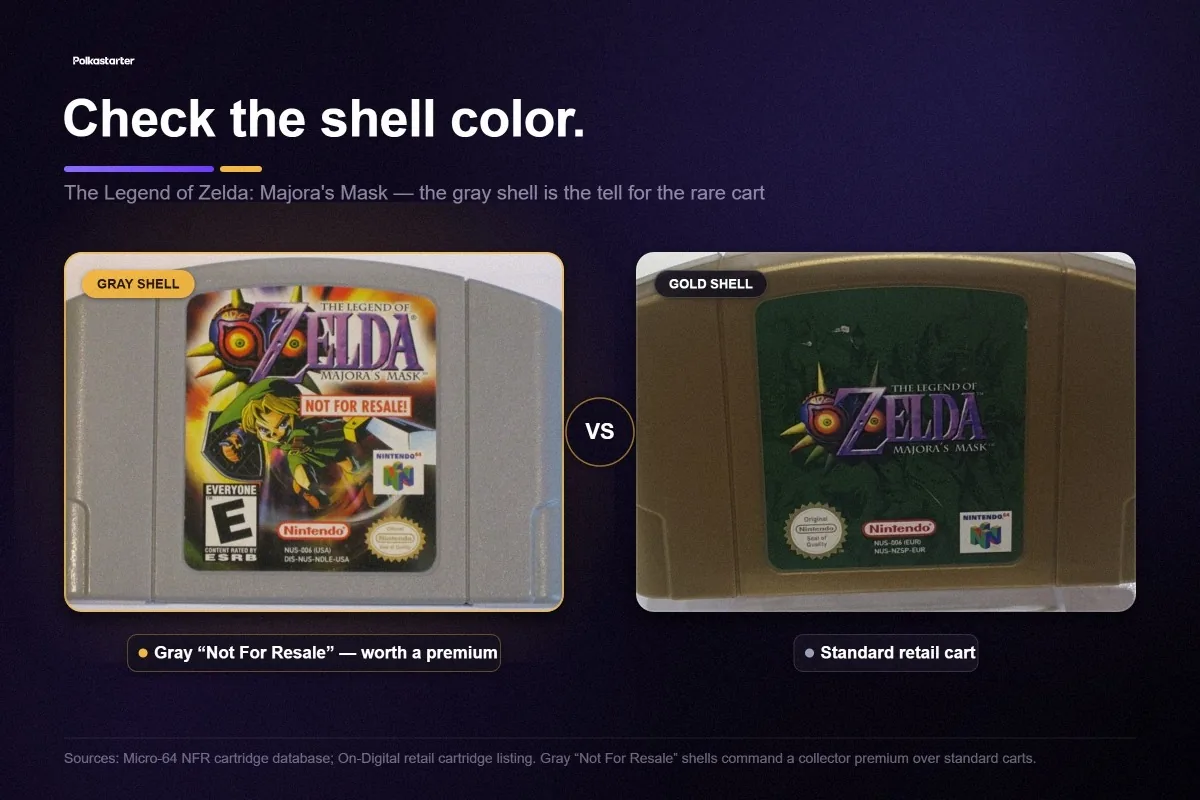
- Gray "Not For Resale" carts. The promotional and demo carts that Nintendo sent to retailers, in a distinctive gray shell and often with beta content. The gray Majora's Mask (Toys R Us demo) is worth far more than the common gold retail cart, and the gray Donkey Kong 64 promo cart runs around $2,000. More on why below.
- Worms Armageddon. A short North American N64 print that makes the NA cartridge scarce, with new copies reaching four figures.
The N64 Games You Might Actually Own
This is where most people live. These are the titles a childhood collection might really hold.
- Conker's Bad Fur Day. The mature-rated Rare classic with a short print. Loose runs about $150 to $300 or more, complete in box far higher.
- Bomberman 64: The Second Attack. A scarce late release, loose about $150 to $300 or more.
- Late and low-print titles like Resident Evil 2, Snowboard Kids 2, and Mario Party 3 climb well above common games, especially complete in box.
- General guide: common N64 titles run $15 to $30 loose, popular first-party Nintendo games $30 to $70, and rarer or late-release titles $80 to $150 or more. A complete-in-box copy is worth roughly three to ten times the loose cartridge.
Why Old N64 Games Are Expensive
Here is the honest part, and it mirrors the Pokémon story. N64 games are not all rare in the print sense. Nintendo sold Super Mario 64 and GoldenEye by the millions. What is rare is a clean, complete, or sealed survivor, because N64 boxes were thin cardboard that got thrown out and cartridges were played to death.
So the price is set by condition and nostalgia, not scarcity, for the mainstream titles. The exceptions are the genuinely low-print carts, the Blockbuster exclusives, the gray promo carts, and the short late releases, which are scarce in any condition. And the market has cooled since its 2020 to 2021 peak, so the seven-figure headlines are the ceiling, not the going rate. For the same pattern in the Pokémon world, see our most valuable Pokémon games guide.
How to Tell If Your N64 Game Is Worth Money
Work through these in order, because each one changes the value of the same game dramatically.
- Condition and completeness first. This is the whole ballgame. A loose cartridge is the floor, a complete in box copy with the box, manual, and inserts is worth far more, a factory sealed copy is worth the most, and a professionally graded copy is the top.
- Check the cartridge color. A gray shell instead of the usual black can mean a Not For Resale promo or demo cart, which is worth a premium. Confirm it against a known reference, since gray is a red flag for both value and fakes.
- Confirm the region. NTSC, PAL, and Japanese copies of the same game can price very differently, sometimes by a lot.
- Check it is genuine, not a reproduction. Repro carts are common, more on the tells below.
- Then grade the condition honestly. Label wear, box crushing, and missing inserts pull the price down.
How to Look Up What Your Game Is Worth
Once you know the exact game and its condition, price it on real sold data, not asking prices.
- PriceCharting. The standard for game values, it splits prices by loose, complete in box, new, and graded, which is exactly the split that matters here.
- eBay, Sold Items filter. Completed sales show what copies in your condition actually sell for, and you can match condition from the photos.
- Graded and sealed copies: cross-reference WATA and VGA populations and recent auction results at Heritage, since games are graded by WATA or VGA, not by the PSA or CGC services that grade cards.
- Then act on it. Once your number is set, the Polkastarter marketplace is where you can buy or sell rare cards and sealed games.
Watch Out for Reproductions and Resealed Games
Value attracts fakes, and N64 games have two big ones.
- Reproduction cartridges. Fake carts and fake "gray" NFR carts are common, especially for the pricier titles. Tells include the wrong shell color or screws, an off or crooked label, a board inside that does not match a genuine cartridge, and missing the correct Nintendo etching. A game that will not save or boots a slightly wrong title screen is a red flag.
- Resealed and fake-graded copies. A "sealed" game can be rewrapped, and a graded slab can be counterfeit. Buy sealed and graded copies only from reputable sellers, and verify a WATA or VGA certification number against the grader directly.
- When in doubt, buy it already graded by WATA or VGA from a trusted source, which authenticates the seal and the condition and removes the risk.
Frequently Asked Questions
What is the most valuable N64 game?
A sealed, high-grade Super Mario 64. A WATA 9.8 A++ copy sold for $1,560,000 in 2021, briefly the most expensive video game ever. A loose copy of the same game is worth about $30 to $40, so the value is in the sealed, graded condition. Other record-holders include a sealed Ocarina of Time at $228,000 and Mario Kart 64 at $144,000.
Are old N64 games worth money?
Some are, but condition decides almost everything. A loose common cartridge is usually $15 to $30, a complete boxed copy of a sought-after title can be $100 to several hundred, and a sealed graded copy of a top game reaches thousands or, at the very top, six and seven figures. A few rare carts like ClayFighter Sculptor's Cut and the gray Not For Resale promos are worth a lot in any condition.
What is the rarest N64 game?
ClayFighter: Sculptor's Cut is the collector holy grail, a 1998 Blockbuster rental exclusive with only about 20,000 made, worth roughly $1,000 loose and $4,000 complete. The gray Not For Resale promo and demo carts, like the gray Majora's Mask and Donkey Kong 64, are rarer still and worth a premium over the standard retail versions.
How can you tell if your N64 game is worth money?
Check condition and completeness first. A loose cartridge is the floor, a complete-in-box copy with the box and manual is worth far more, and a factory-sealed or WATA-graded copy is worth the most. Check the cartridge color, a gray shell can mean a valuable Not For Resale cart, confirm the region, make sure it is genuine and not a reproduction, then look up recent sold comps on PriceCharting and eBay Sold.
Are sealed N64 games worth more?
Yes, by a wide margin. Sealing proves the game was never opened, so a sealed copy can be worth ten to twenty times a loose cartridge of the same game. A professional grade from WATA or VGA adds even more, because it authenticates the seal and rates the condition. This is why the record N64 sales are all sealed, graded copies.
What is a gray "Not For Resale" N64 cartridge?
A gray-shelled promotional or demo cartridge that Nintendo sent to retailers rather than selling at retail, often containing beta content. Because far fewer exist than the standard black retail carts, the gray versions of games like Majora's Mask and Donkey Kong 64 are worth a premium. Verify a gray cart carefully, since the color is also a common target for fakes.
Where to Go From Here
The million-dollar sealed copies grab headlines, but the value that matters is the cartridge you own. Sort it by condition first, loose, complete, or sealed, check the shell color and region, confirm it is genuine, and price it on recent sold comps. Do that and you will know in minutes whether your old N64 game is a $20 cartridge or a genuine collector grail.
Educational content only. Collectible prices are volatile, the retro game market cooled after its 2020 to 2021 peak, every figure here is an approximate July 2026 snapshot that will change, and nothing here is investment advice.
Sources
.png)

Ilknur Gubel is a social media manager at Polkastarter. Ilknur has spent the past four years working as a project manager, marketing manager, and social media strategist across Web3. She has held marketing and project management positions at several crypto companies, including Polygen, Nitro League, Kaizen.Finance, and ChainPort.
At Polkastarter she has covered trading card releases, collectible market pricing, and how token holders can spend crypto on real cards and videogames.
Based in Istanbul, Ilknur earned a bachelor's degree in sociology from Istanbul Aydın University.
You can connect with her on LinkedIn for more information.