.avif)
.png)
.avif)


Content
Are Japanese Pokémon Cards Worth More Than English? (2026 Value Guide)

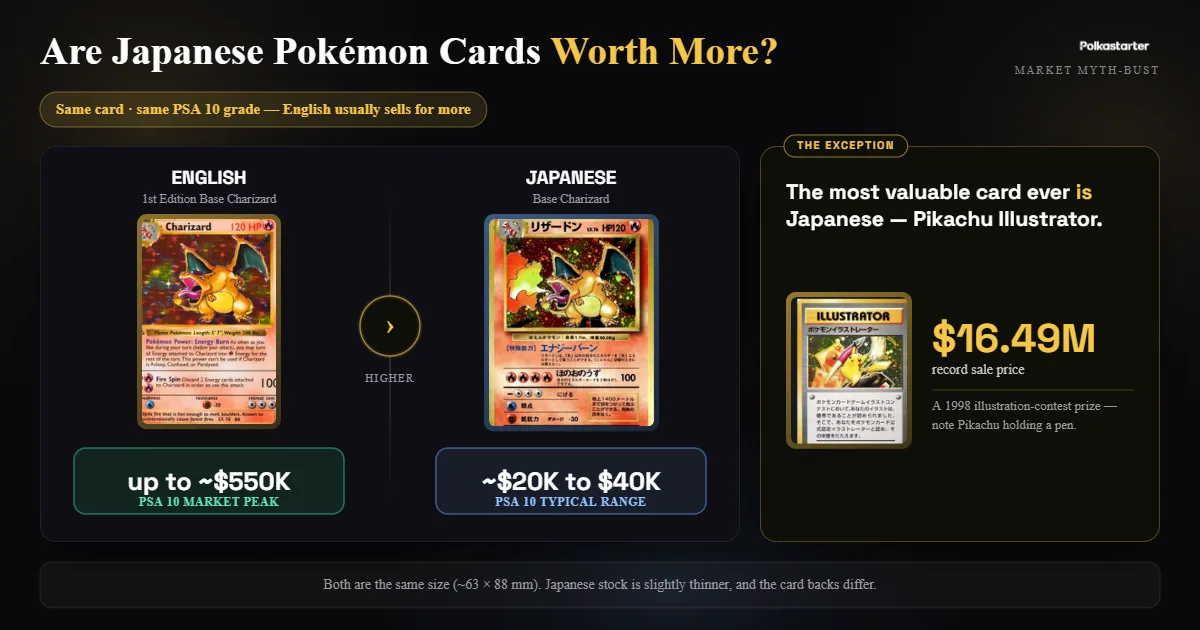
The Short Answer: For the same card in the same grade, the English version almost always sells for more. Most Japanese cards trade at a discount, often 25 to 50 percent cheaper on sealed boxes and sets, and far cheaper on iconic vintage singles. The surprising part is why: it is not about quality. Japanese cards are widely regarded as the better-printed of the two. The catch is that the single most valuable Pokémon card in existence is Japanese, and there is a clear pattern to which Japanese cards command a premium. Below is the honest version of both.
Why Japanese Cards Are Usually Cheaper
Here is the counter-intuitive part. Japanese cards print sharper, cut cleaner, and grade gem mint more often than English cards, yet they sell for less. Price is set by demand, not condition, and four things drive it.
- Supply. Japanese sets release first, print in larger home-market quantities, and get restocked and reprinted, so they are less scarce than a first-run English print. (Print numbers are hobby estimates, the Pokémon Company does not publish them.)
- Demand and market size. The global price is set by Western nostalgia. Millions of collectors who grew up on English cards drive demand, and that is the single most-cited reason.
- Tournament use. English cards carry baseline demand from competitive play in English regions, which Japanese cards do not (more on this below).
- The grading market. PSA and the deepest population data and liquidity sit on the English side, so English cards sell faster even though Japanese cards grade higher.
The flagship example: a PSA 10 English 1st Edition Base Set Charizard reaches six figures, up to a record $550,000, while a PSA 10 Japanese Base Set Charizard typically sells in the range of about $20,000 to $40,000 (hobby estimates, verify live comps). Same Pokémon, same grade, very different price.
When a Japanese Card IS Worth More
The "Japanese is worth more" belief survives because of a real pattern: the cards that beat English are almost always ones with no English equivalent. Four buckets.
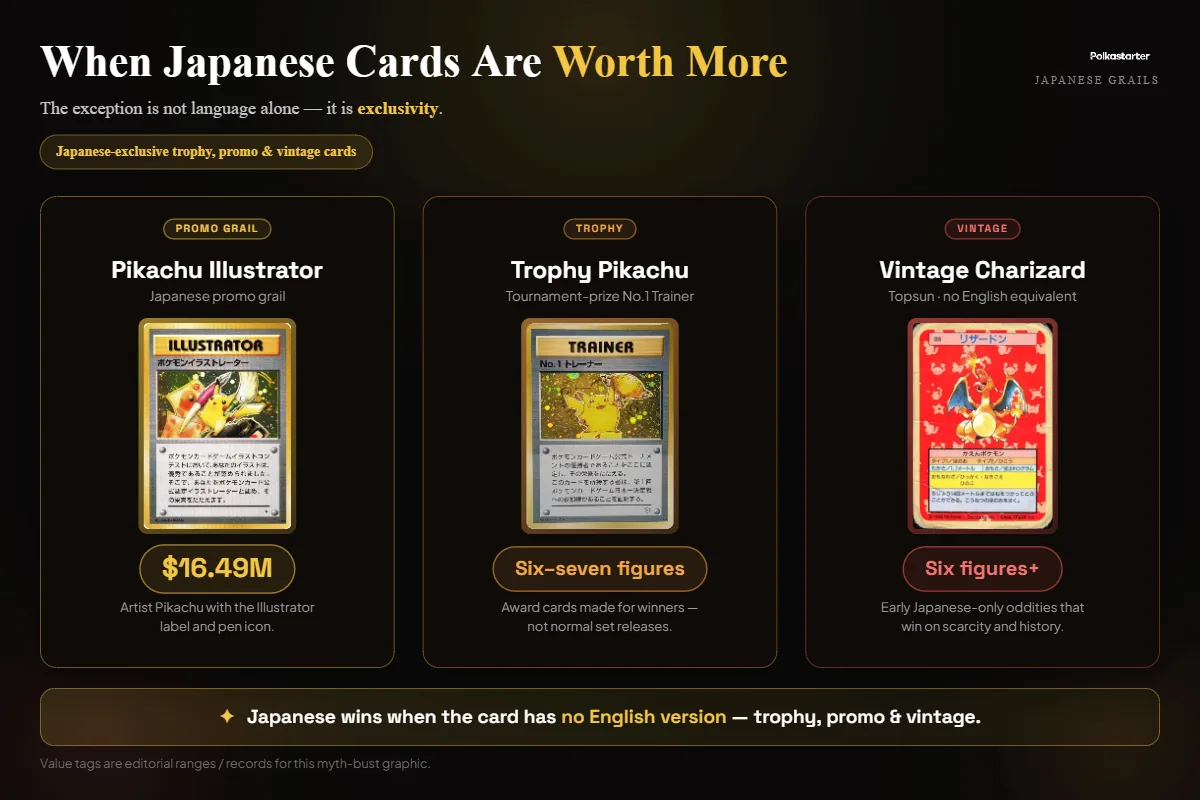
- Contest and trophy prizes. The 1998 Pikachu Illustrator (about 41 copies, Japanese only) is the most valuable Pokémon card ever, its unique PSA 10 selling for $16.49 million in February 2026. The 1997 to 1998 Trophy Pikachu No. 1, 2, and 3 (about 14 of each) run from low six figures up to seven figures for the top No. 1 examples. See our most valuable Pokémon cards guide for the full grails list.
- Japanese-exclusive event promos. The 1999 Tropical Mega Battle cards, like Tropical Wind (about 74 copies) and the No. 2 Trainer (about 6 known), trade from roughly $10,000 to $50,000 and up.
- Vintage first-run variants. The Japanese No Rarity Base Set Charizard (1996 first print) reaches five to seven figures, with a top graded copy reported around $1.7 million. The 1995 Topsun Charizard (Japanese, with no English version) had a PSA 10 sell for about $493,230.
- The occasional modern chase card. A few top Japanese Special Art Rares run about $150 to $400 raw. Historically Japanese alt arts ran 20 to 40 percent cheaper than English, though in 2025 the English Umbreon ex passed the Japanese version for the first time, which shows this bucket is the exception, not the rule.
The bottom line: a Japanese card is worth more when it is a vintage, promo, or trophy card that English never printed, not for an ordinary modern single.
Japanese vs English: the Real Differences
Beyond price, here is how the two actually differ.
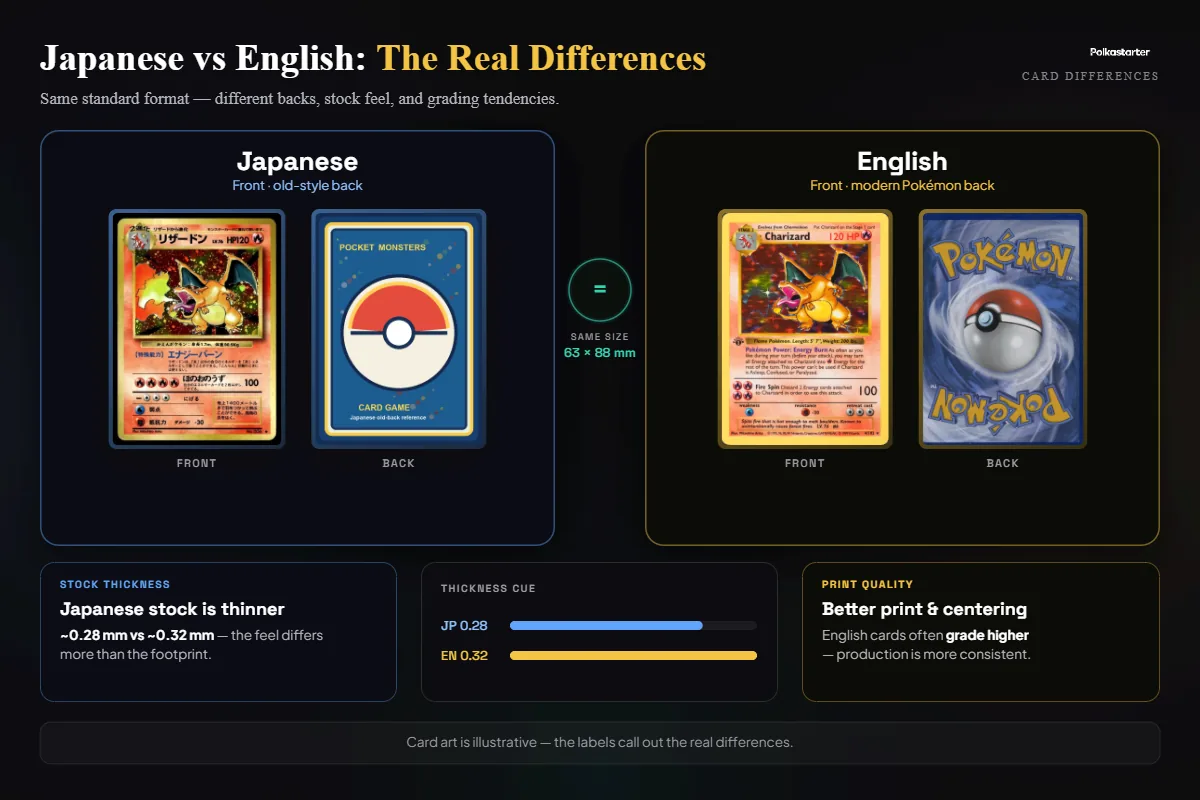
- Print quality. Japanese cards are known for better centering and quality control, and they tend to grade higher. Collectors estimate a PSA 10 rate of roughly 15 to 20 percent for Japanese versus 8 to 12 percent for English (hobby estimates, not official PSA data). Since grading fees are the same, Japanese can offer better grading odds.
- Size and stock. They are effectively the same standard size, about 63 by 88 mm, but Japanese stock is slightly thinner (around 0.28 mm versus 0.32 mm), and some collectors use Japan-sized sleeves.
- The back. The card backs differ in design, which is normal and not a sign of a fake. It does matter for tournaments and for spotting counterfeits.
- Release timing and sealed price. Japanese sets release earlier and the sealed product is cheaper, often about $50 to $70 a box at release versus $100 to $140 or more for English.
Are Japanese Cards Tournament Legal?
Mostly no for competitive English play, but they are fully legal to own. Japanese cards are not legal in English-region Play! Pokémon events like League Cups and Regionals, because cards must match the language of the region, and the different back would count as a marked card in an English deck. They are completely legal to own, import, collect, casually play, and grade. The one narrow exception is that at International, World, and Regional Championships, players may use cards legal in their own home country, so a Japanese player can use Japanese cards there. Confirm the current wording on the official Play! Pokémon Tournament Handbook before relying on it for an event.
How to Tell If a Japanese Pokémon Card Is Real
The general method is the same as for English cards, the rosette dot pattern under a loupe, the holo behavior, the light test, and the card stock, all covered in our full guide on how to tell if a Pokémon card is fake. A few Japanese-specific tells, used together since no single test is conclusive:
- The back is the top tell. A genuine Japanese back shows a deep, evenly saturated blue with tight centering. A washed-out or purplish back, or worse, a "Japanese" card printed with the English back design, is a major red flag.
- Holo. Real Japanese foil shifts cleanly and the texture can be felt, not just seen. Fakes look flat, cloudy, or like an oily rainbow printed on top.
- The copyright line. It must list the correct rightsholders and an era-matching year string with a correctly rendered accent in Pokémon. Match it to a known scan of that exact set, since the year string changes by set.
- Font and kanji. Crisp, consistent characters. Even a non-reader can spot mis-shaped kanji against a real reference.
Counterfeiters focus on high-value vintage and chase cards, so apply the most scrutiny there, and for anything expensive, buy it already graded by PSA or CGC to remove the risk.
Where to Buy Japanese Cards Safely
Genuine Japanese product comes from the Pokémon Card Laboratory in Japan, and most international buyers go through established Japan-based retailers, reputable proxy services, or strong-feedback sellers on TCGplayer and eBay. Watch the red flags: prices far below market, sealed product that is "too cheap," and sellers who cannot explain where their stock comes from. Buying a card already graded removes counterfeit risk entirely. (Specific shops change, so vet any seller's feedback and sourcing yourself, none of this is an endorsement.)
Should You Collect Japanese or English?
It depends on your goal, and plenty of serious collectors do both.
- Choose English for the deepest Western resale market and liquidity, the nostalgia premium, and tournament use.
- Choose Japanese for a lower price per card, much cheaper sealed boxes, Japan-exclusive sets and promos, earlier releases, and better grading odds.
If you are buying to resell to a Western audience, English wins. If you are buying to enjoy, to open sealed product affordably, or to chase Japan-only cards, Japanese is the better value.
Current as of June 2026, prices move. Every figure here is an approximate range as of June 2026, and the high-end market is volatile. The same-card English-over-Japanese pattern holds broadly, but specific dollar figures move, so spot-check live comps on PriceCharting, TCGplayer, eBay Sold, and PSA Auction Prices Realized for the exact card and grade before you buy or sell.
Frequently Asked Questions
Are Japanese Pokémon cards worth more than English?
For the same card in the same grade, usually no. The English version almost always sells for more, and Japanese sealed product often runs 25 to 50 percent cheaper. The exception is cards with no English equivalent, like Japanese-exclusive trophy, promo, and vintage cards, where Japanese wins, including the Pikachu Illustrator, the most valuable Pokémon card ever at $16.49 million.
Why are Japanese Pokémon cards cheaper?
Not because of quality, Japanese cards are actually printed better and grade higher. They cost less because of demand. Japanese sets print in larger quantities and get restocked, Western nostalgia drives the global market toward English cards, Japanese cards are not legal in English tournaments, and English cards have the deeper grading and resale market. Demand, not condition, sets the price.
Are Japanese Pokémon cards worth anything?
Yes, but value comes from the specific card, not the language. Common modern Japanese singles are inexpensive, often cheaper than the English version. Japanese-exclusive promos, trophy cards, and vintage first-run cards can be worth thousands to millions. Identify the exact card and check recent eBay Sold and PriceCharting comps for the Japanese version specifically.
Can you use Japanese cards in English Pokémon tournaments?
Generally no. Japanese cards are not legal in English-region Play! Pokémon events, because cards must match the region's language and the different back counts as marked. They are fully legal to own, import, collect, casually play, and grade. At International and World Championships, players may use cards legal in their own home country.
How can you tell if a Japanese Pokémon card is fake?
Use the same checks as for any card (the loupe rosette test, the light test, the holo and card stock) and combine several, since no single test is conclusive. The Japanese-specific tells are the back (a deep even blue, never the English back design on a Japanese card), the holo texture, and a correct copyright line and kanji matched to a real scan of that set. For high-value cards, buy graded to remove the risk.
Are Japanese Pokémon cards better quality than English?
Generally yes on print quality. Japanese cards are known for sharper printing, cleaner cuts, and better centering, and they tend to grade gem mint more often. That is exactly why the value gap is so counter-intuitive: the better-made cards usually sell for less, because price follows demand, not condition.
Where to Go From Here
So are Japanese Pokémon cards worth more? For the card in your hand, probably not, the English version usually wins, even though the Japanese one is often better made. But the rarest Japanese cards, the ones English never printed, sit at the very top of the entire hobby. Identify your exact card, check the Japanese comps, confirm it is real, and you will know which side of that line you are on.
Educational content only. Collectible prices are volatile, every figure here is an approximate June 2026 snapshot that will change, and nothing here is investment advice.
Sources
- Play! Pokémon TCG Tournament Handbook (official, the legality source): pokemon.com
- Sports Illustrated, Pikachu Illustrator $16.49M record: si.com
- PriceCharting (the price-data authority): pricecharting.com
- TCGplayer, Japanese Pokémon FAQ: help.tcgplayer.com
- Bulbapedia (the Pokémon encyclopedia): bulbapedia.bulbagarden.net
.png)

Ilknur Gubel is a social media manager at Polkastarter. Ilknur has spent the past four years working as a project manager, marketing manager, and social media strategist across Web3. She has held marketing and project management positions at several crypto companies, including Polygen, Nitro League, Kaizen.Finance, and ChainPort.
At Polkastarter she has covered trading card releases, collectible market pricing, and how token holders can spend crypto on real cards and videogames.
Based in Istanbul, Ilknur earned a bachelor's degree in sociology from Istanbul Aydın University.
You can connect with her on LinkedIn for more information.