.avif)
.png)
.avif)


Content
Is Card Pressing Alteration? What PSA's Rules Say About Pressed Cards

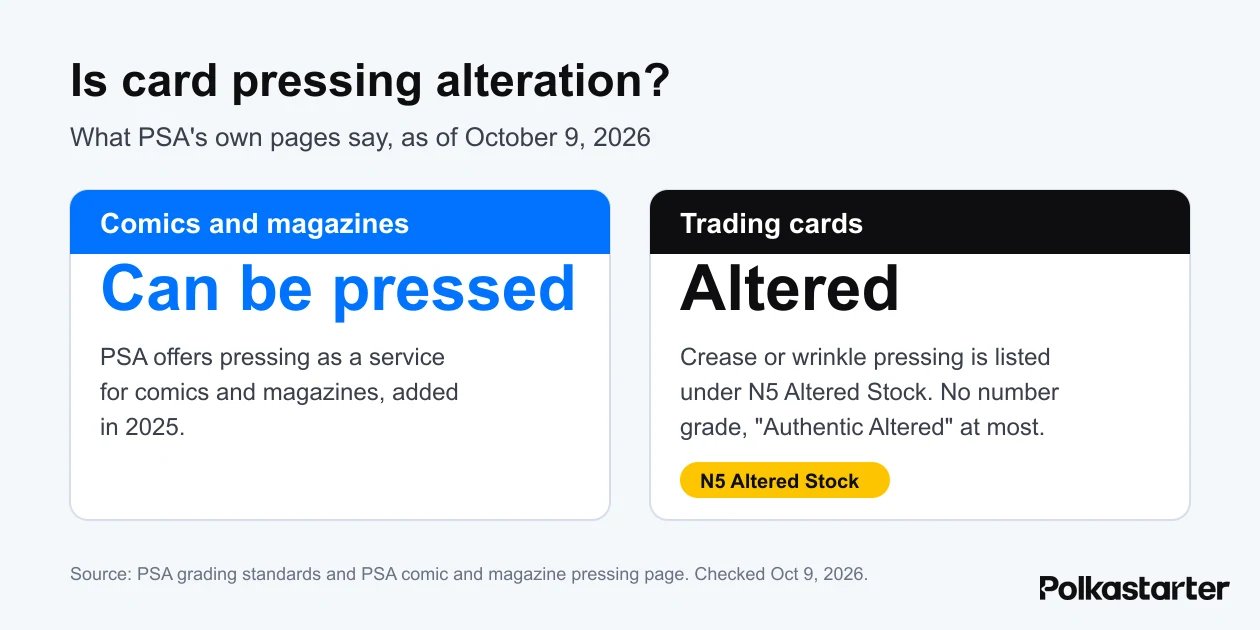
Is card pressing alteration? At PSA, yes. Its grading standards list crease and wrinkle pressing under the N5 Altered Stock code, and PSA's comic pressing page says a pressed card is not eligible for a number grade (both checked October 9, 2026). That can look odd, because PSA itself sells pressing as an add-on for comics and magazines. Below is the exact rule, why comics get a pass and cards do not, what an "Authentic Altered" label means, and what to check before you buy.
Current as of October 9, 2026. Rules quoted from PSA's own pages. Other graders publish their own policies.
What PSA's Grading Standards Say About Pressing
PSA's grading standards (checked October 9, 2026) set a flat rule under the heading "Ungradable Cards": "PSA will not grade cards that bear evidence of trimming, re-coloring, restoration, or any other forms of tampering, or are of questionable authenticity."
Pressing sits inside that rule through the N5 code. PSA's Altered Stock definition includes, but is not limited to, paper restoration, crease or wrinkle pressing, scratch removal and enhanced gloss. The same code covers any foreign substance applied to the surface, such as cleaning spray or wax.
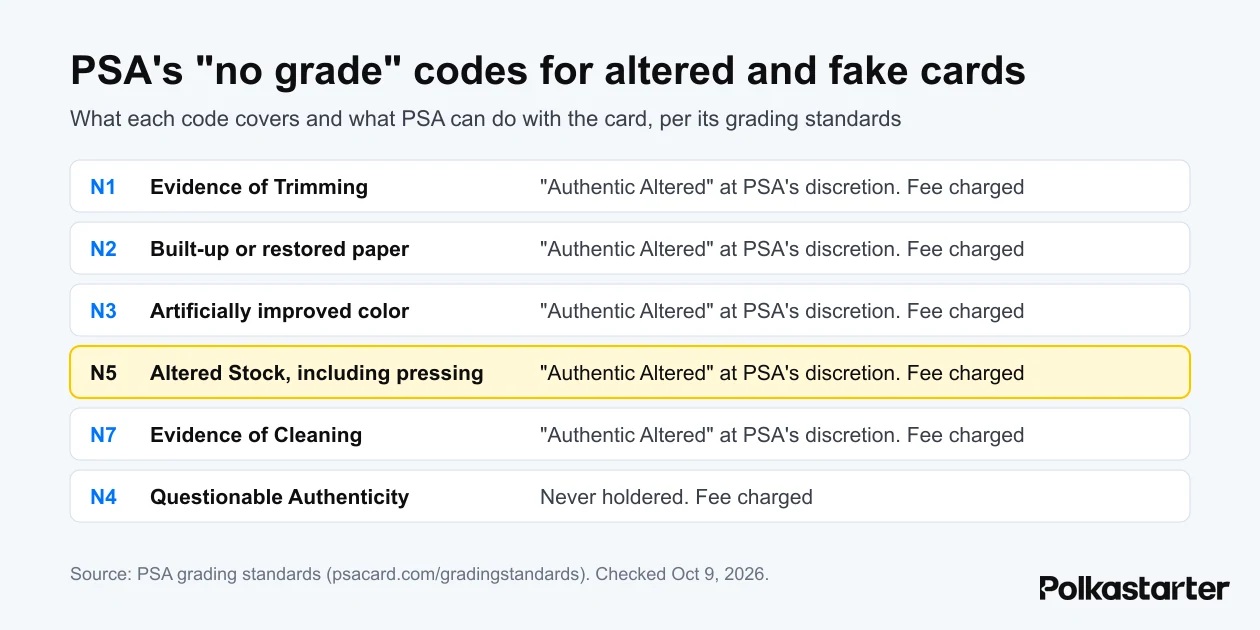
A card that gets an N code receives no number grade. For the five alteration codes (N1, N2, N3, N5 and N7), PSA can still put the card in a holder as "Authentic Altered", but only at the grader's discretion and only if you listed "AA" as your minimum grade on the submission form. PSA notes the minimum grade option is only available on select service levels, and the field appears in the Online Submission Center when it is. PSA charges the grading fee either way.
Here are the codes that deal with altered or problem cards, in PSA's own terms:
N1 Evidence of Trimming
- Covers: edges that look cut down with scissors, a scalpel or another blade, including hooked, unusually sharp, oddly colored or wavy edges
- Outcome: no number grade, "Authentic Altered" at the grader's discretion if requested, fee charged
N2 Evidence of Restoration
- Covers: paper stock that has been built up, such as torn corners rebuilt to look new
- Outcome: no number grade, "Authentic Altered" at the grader's discretion if requested, fee charged
N3 Evidence of Recoloration
- Covers: color that looks artificially improved
- Outcome: no number grade, "Authentic Altered" at the grader's discretion if requested, fee charged
N5 Altered Stock
- Covers: pressing out creases or wrinkles, paper restoration, scratch removal, enhanced gloss, and surface substances such as cleaning spray or wax
- Outcome: no number grade, "Authentic Altered" at the grader's discretion if requested, fee charged
N7 Evidence of Cleaning
- Covers: whitener on borders, or a solution used to remove wax, candy, gum or tobacco stains
- Outcome: no number grade, "Authentic Altered" at the grader's discretion if requested, fee charged
N4 Questionable Authenticity
- Covers: a card that looks counterfeit or an autograph judged not genuine
- Outcome: never encapsulated, fee still charged
Two codes are not about alteration at all. N6 (significantly undersized against factory specifications) and N8 (an abnormal factory cut) carry no grading fee. PSA can holder either card as "Authentic" at the grader's discretion if you listed "Auth" as the minimum grade, and the fee then applies. A ninth code, N9, covers issues PSA does not grade at all, also with no fee.
Why PSA Presses Comics but Not Cards
PSA opened comic book and magazine grading in July 2025 and launched an in-house pressing add-on with it, Otia reported on July 14, 2025. By San Diego Comic-Con that month, PSA was taking comic pressing orders at the show.
PSA's comic pressing page explains why the same process is off limits for cards:
Since the 1990s: PSA has refused to give number grades to modified or altered cards, because grading them would lower the value of unaltered ones.
Paper stock: comic and magazine pages are thin, and PSA says professional pressing leaves no visible trace on them.
Card stock: PSA says pressing a card can often make its condition worse.
The outcome: in PSA's words, "a pressed card will not be eligible for a numeric grade and would receive an 'Authentic Altered' designation at PSA."
The debate is current. Sports Illustrated Collectibles ran a feature on where card care ends and alteration begins on October 4, 2026.
What "Authentic Altered" and "Authentic" Mean on a PSA Label
Authentic Altered: PSA judged the card genuine but altered. It carries no number grade, so it can never be sold as a PSA 8 or PSA 10.
Authentic: this is the label to read most carefully. PSA's Guarantee terms say PSA does not always print "Altered" on the label because of character and spacing limits. The terms tell owners to treat an "Authentic" label as potentially the same as "Authentic Altered", and the Guarantee does not pay out on the difference between the two.
Number-graded cards: the Guarantee does cover a card that PSA later decides should not have received its grade. In that case PSA can, at its sole discretion and under the Guarantee terms, buy the card back at market value or refund the difference in value. The Guarantee is for later buyers, not the original submitter. The cert must have been active when you bought the card, you need proof of purchase, claims are capped at $250,000 per card, and PSA charges a $25 review fee if it upholds the original grade.
How to Protect Yourself as a Buyer or Seller
Look up the cert number. Every PSA holder has a certification number you can check on PSA's site. Our guide on how to verify a graded card walks through it.
Read "Authentic" as possibly altered. PSA's own Guarantee terms say an "Authentic" label must be viewed as potentially interchangeable with "Authentic Altered" and equal in value, so the label alone is no proof the card is untouched.
Do not press out a crease before grading. PSA names crease and wrinkle pressing in N5 and says a pressed card is not eligible for a numeric grade, so pressing risks an N5 and a full fee. A card with an honest crease still gets a number grade. Our explainer on how PSA grading works covers what each grade means.
Weigh the fee first. PSA charges the full grading fee when a card comes back with an alteration code (N1, N2, N3, N5 or N7) or N4, so a raw card you suspect was altered can cost you the fee and still come back without a number grade. See whether PSA grading is worth it and the current PSA backlog before you submit.
Check other graders' own rules. This guide covers PSA only. If you are weighing CGC instead, start with our CGC vs PSA comparison and read that grader's published standards before you send a card.
Frequently Asked Questions
Is card pressing considered alteration?
At PSA, yes. PSA's grading standards list crease and wrinkle pressing under the N5 Altered Stock code, and a card with that code gets no number grade. This was PSA's published standard as of October 9, 2026.
Will PSA grade a pressed card?
Not with a number. PSA's comic pressing page says a pressed card is not eligible for a numeric grade and would receive an "Authentic Altered" designation. Under the N5 code, that holder is at the grader's discretion and only if "AA" is listed as the minimum grade, on service levels that offer a minimum grade, and the grading fee is charged either way.
Why can comics be pressed but trading cards cannot?
PSA says comic and magazine paper is thin and shows no trace of professional pressing, while pressing a card can often worsen its condition. PSA has also refused to number-grade altered cards since the 1990s to protect the value of unaltered ones. PSA launched comic pressing as a paid add-on in July 2025.
What does "Authentic Altered" mean on a PSA card?
It means PSA judged the card genuine but altered, for example trimmed, recolored, restored, pressed or cleaned. The card has no number grade. PSA's Guarantee terms also say an "Authentic" label may stand for "Authentic Altered", because PSA does not always print "Altered" on the label.
Can you fix a creased card without altering it?
Not under PSA's rules. Pressing out a crease or wrinkle is named in the N5 Altered Stock code, so the card would lose its chance at a number grade. A creased card that has not been worked on can still receive a number grade.
Where to Go From Here
Leaving a card exactly as it came out of the pack is still the safest way to protect its grade. If you would rather collect real cards that are already vaulted, the Polkastarter marketplace gives new members a free mystery pack at signup, and every Lootbox lists its contents, values, and chances before you open.
Details checked October 9, 2026. Grading rules can change, so check PSA's current standards before you submit. Nothing here is financial advice. Polkastarter is not affiliated with PSA, Collectors, Sports Illustrated or the other companies named.
Sources
- PSA: Grading Standards, accessed October 9, 2026
- PSA: Comic Book and Magazine Pressing, accessed October 9, 2026
- PSA: Terms and Conditions of the PSA Authenticity and Grade Guarantee, accessed October 9, 2026
- PSA: PSA at San Diego Comic-Con, pricing, services and more, published 2025 (undated page), accessed October 9, 2026
- Otia: PSA magazine grading program launches but turnaround time jumps to 75 days, published July 14, 2025, accessed October 9, 2026
- Sports Illustrated Collectibles: Card care vs card alteration, where is the line, published October 4, 2026, accessed October 9, 2026
.png)

Ilknur Gubel is a social media manager at Polkastarter. Ilknur has spent the past four years working as a project manager, marketing manager, and social media strategist across Web3. She has held marketing and project management positions at several crypto companies, including Polygen, Nitro League, Kaizen.Finance, and ChainPort.
At Polkastarter she has covered trading card releases, collectible market pricing, and how token holders can spend crypto on real cards and videogames.
Based in Istanbul, Ilknur earned a bachelor's degree in sociology from Istanbul Aydın University.
You can connect with her on LinkedIn for more information.