.avif)
.png)
.avif)


Content
Pokémon Master Sets: Define Complete Before You Start Collecting

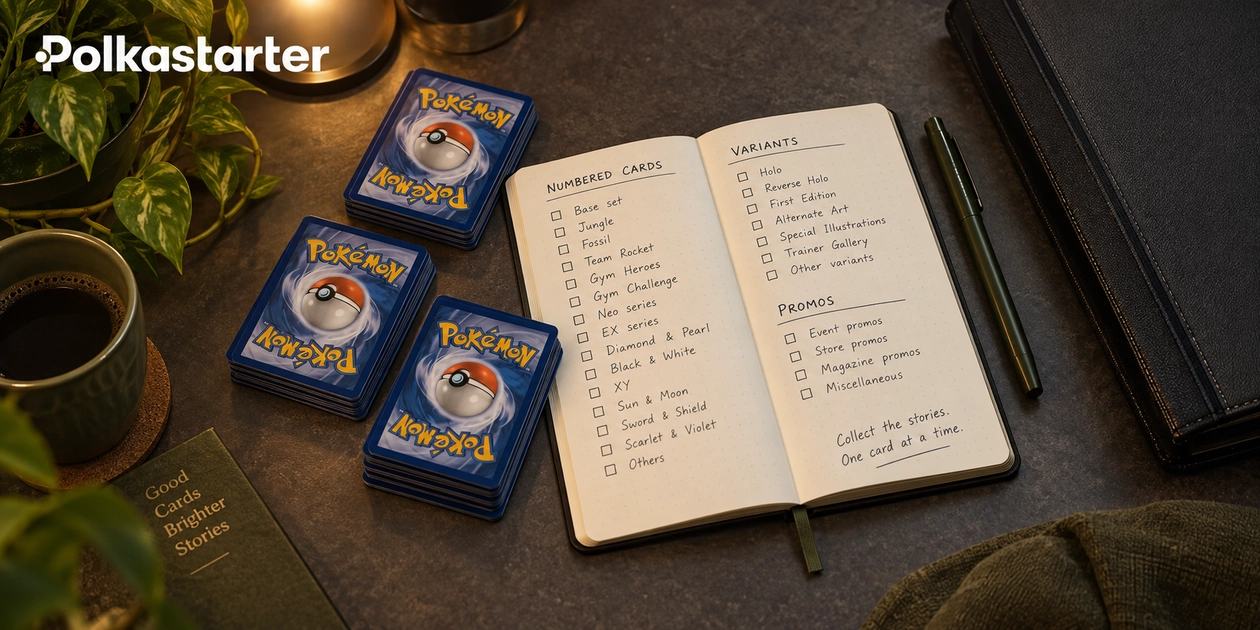
A Pokémon master set needs a written definition of complete. One collector may include every numbered card and its available reverse foil. Another may also include product promos, retailer stamps, foil Energy variants or oversized cards. If those choices are not stated, two listings can both say complete while offering different collections.
The solution is not to find the most demanding definition and spend until you satisfy it. Define the project you actually want, use an official checklist as the starting point, and record any additions separately.
Start With the Numbered Set, Then Add Variants Deliberately
For this guide, a numbered set means one copy of every entry on the expansion's numbered checklist, including entries beyond its printed denominator. A master-set project adds the variants you explicitly choose to include. This is a working convention for organizing a collection, not a universal official Pokémon rule.
Separate a card's collector number from its finish. A standard and reverse-foil version can share a number but occupy different positions in your collection. Conversely, not every card necessarily exists in every finish. Confirm the version against the checklist or a documented release rather than creating an empty slot for an imaginary variant.
Our Pokémon rarity reference helps identify the card category. It does not by itself decide which parallel versions or promos your personal project includes.
Why 151 Does Not Mean a 151-Card Finish Line
The official English Scarlet & Violet 151 checklist has numbered entries through 207, including cards beyond the main set's 165 denominator. That is already different from the 151 Pokémon in the expansion's name. It still is not a universal total for every finish, promo or related collectible someone might include.
Products create another boundary. The official 151 Ultra-Premium Collection listing, launched October 6, 2023, lists a Mew ex foil promo, a Mewtwo full-art foil promo and an etched metal Mew ex card. Those inclusions demonstrate why an expansion checklist and a product's contents are different records.
Does your project include the metal card? Do related promos sit in the same binder or in a separate appendix? Either approach can be coherent if you disclose it. The confusion begins when a seller's short title is treated as an itemized inventory.
For historical context, PokéBeach's 151 release guide documents product promos and retailer-stamped cards. Those were specific release-era items, not a promise that a store still distributes them in September 2026.
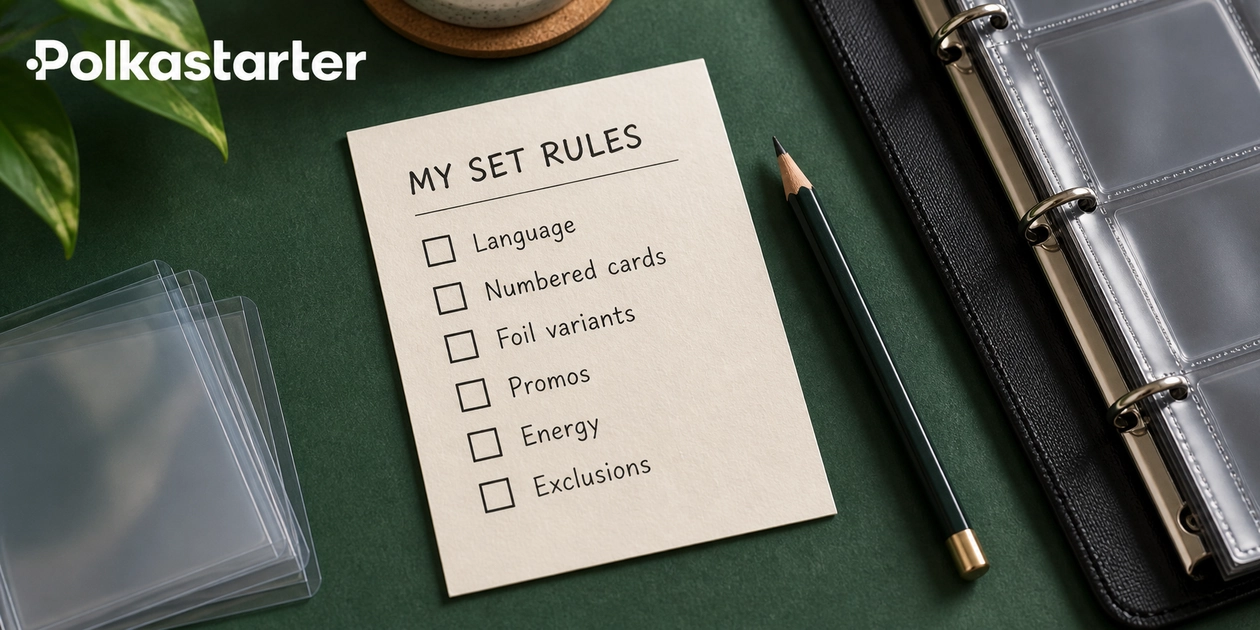
Write Your Set Rules in Six Lines
Before buying the next missing card, save this scope sheet with your inventory.
- Language and expansion: identify one exact release, or state clearly that languages will be mixed.
- Numbered entries: specify whether the full numbered checklist, including cards beyond the denominator, is required.
- Foil variants: name the standard and parallel finishes you intend to include, only where those versions exist.
- Promos and stamps: list the individual product or retailer variants included. Avoid the open-ended phrase all promos unless you have an inventory for it.
- Energy and nonstandard items: decide how foil Energy, metal cards and oversized cards are treated.
- Exclusions and condition: record what is deliberately outside the project and the minimum condition you accept.
Date the sheet. If a newly discovered variant changes your plan, update the scope and total together. That creates a visible change rather than making yesterday's completed collection mysteriously incomplete today.
Track Positions, Not the Number of Cards You Own
Build one inventory row per required combination of identity and finish. Record whether you own it, its condition and where it is stored. Keep duplicates in a separate quantity field. Buying a second copy should not advance completion unless your written project specifically requires it.
For a purely hypothetical project with 400 required positions, filling 340 means 85% complete. Owning 500 physical cards does not change that percentage if many are duplicates. This is an illustration of the method, not a claim that any particular Pokémon master set contains 400 cards.
You can keep the record in a notebook or a spreadsheet. The important feature is a stable denominator. If you add 10 newly included variants, the total becomes 410 and the percentage changes for a clear reason. Record the revision instead of comparing percentages calculated under different rules.
Buy a Missing Position, Not an Ambiguous Promise
When comparing a collection advertised as a master set, ask for an itemized checklist and readable photographs. Match them against your own scope. Check whether a pictured card is a different language, a different foil, a promo substitute or a duplicate occupying a gap.
Condition deserves its own pass. A collection can have every required identity while containing copies you would choose to replace. Do not let a completeness percentage stand in for examining corners, surfaces and the seller's description. For graded inclusions, use the graded-card verification checks as well.
The remaining cost also matters more than the completion percentage alone. A collection missing a few expensive cards is not necessarily almost finished in spending terms. Our most valuable Pokémon cards guide is background context, not an appraisal of your checklist. Look up the exact missing editions and conditions rather than borrowing a character's headline price.
Give the Project a Finish Line You Can Enjoy
Set a stopping rule you can afford and leave excluded cards excluded unless you genuinely want to expand. A carefully defined collection is easier to enjoy, explain and eventually trade than a project driven by every new claim that you need one more variant.
For a separate opening experience, the Polkastarter marketplace offers real collectible Lootboxes. Every Lootbox lists its contents, values, and chances before you open. A free mystery pack is available at signup under the current offer's conditions. It is not a guaranteed method of finding the last card on a master-set checklist.
Frequently Asked Questions
What is a Pokémon master set?
It is a collector-defined completion project that usually extends beyond one copy of each numbered card to include specified variants. The term alone is not enough. State the language, finishes, promos and exclusions so another collector can understand exactly what is included.
Does a master set have to include promo cards?
That depends on the stated scope. Some projects include named product promos or stamps, while others track them separately. Ask for an itemized list instead of assuming that complete includes every related promo.
How many cards are in a Pokémon 151 master set?
There is no useful universal total without defining variants and extras. The official English 151 checklist runs through 207 numbered entries, but that is not a count of every possible finish, related promo or metal card a collector might include.
Facts and specifications checked September 13, 2026 as cited. Offers, product details and event policies can change. Nothing here is financial or investment advice. Polkastarter is not affiliated with Pokémon, Nintendo, Creatures or the other companies named. Generated visuals are editorial illustrations, not official product photographs or evidence of a specific real event.
Sources
- Pokémon, official English 151 checklist, accessed September 13, 2026
- Pokémon, 151 Ultra-Premium Collection contents, accessed September 13, 2026
- PokéBeach, 151 product and promo release guide, accessed September 13, 2026
.png)


Ilknur Gubel is a social media manager at Polkastarter. Ilknur has spent the past four years working as a project manager, marketing manager, and social media strategist across Web3. She has held marketing and project management positions at several crypto companies, including Polygen, Nitro League, Kaizen.Finance, and ChainPort.
At Polkastarter she has covered trading card releases, collectible market pricing, and how token holders can spend crypto on real cards and videogames.
Based in Istanbul, Ilknur earned a bachelor's degree in sociology from Istanbul Aydın University.
You can connect with her on LinkedIn for more information.