.avif)
.png)
.avif)


Content
Shadowless Pokémon Cards: What They Are, How to Spot One, and 2026 Values

A shadowless Pokémon card is an early 1999 Base Set card printed without the drop shadow behind its artwork, and it is one of the most valuable versions a casual collection can quietly be hiding. Shadowless cards were printed right after 1st Edition and before the common Unlimited run, so they sit in the scarce middle tier. A shadowless Base Set Charizard in top grade has sold for tens of thousands of dollars. This guide shows you how to tell if a card is shadowless in seconds, how it differs from 1st Edition and Unlimited, which cards qualify, what they are worth, and how to spot a fake.
What Is a Shadowless Pokémon Card?
A shadowless Pokémon card is a 1999 Base Set card with no drop shadow along the right and bottom edges of its artwork box, so the picture sits flat against the yellow border. It was the second of three Base Set print runs, after 1st Edition and before Unlimited, which makes it scarcer and worth more than the common Unlimited version.
Here is the full story. When Wizards of the Coast first printed the English Base Set in early 1999, the cards had no shadow under the art window. The very first batch also carried an "Edition 1" stamp, those are the 1st Edition cards. Once the stamp was retired but the shadow had still not been added, the result was the Shadowless print. Partway through the run, Wizards added a grey drop shadow to the right of the artwork to give it a framed, slightly 3D look, and every card printed after that is Unlimited. So the order is 1st Edition, then Shadowless, then Unlimited, and the shadow is the line that separates the last two.
How to Tell If Your Card Is Shadowless
Start with the one tell that settles it in two seconds, then confirm with the rest.
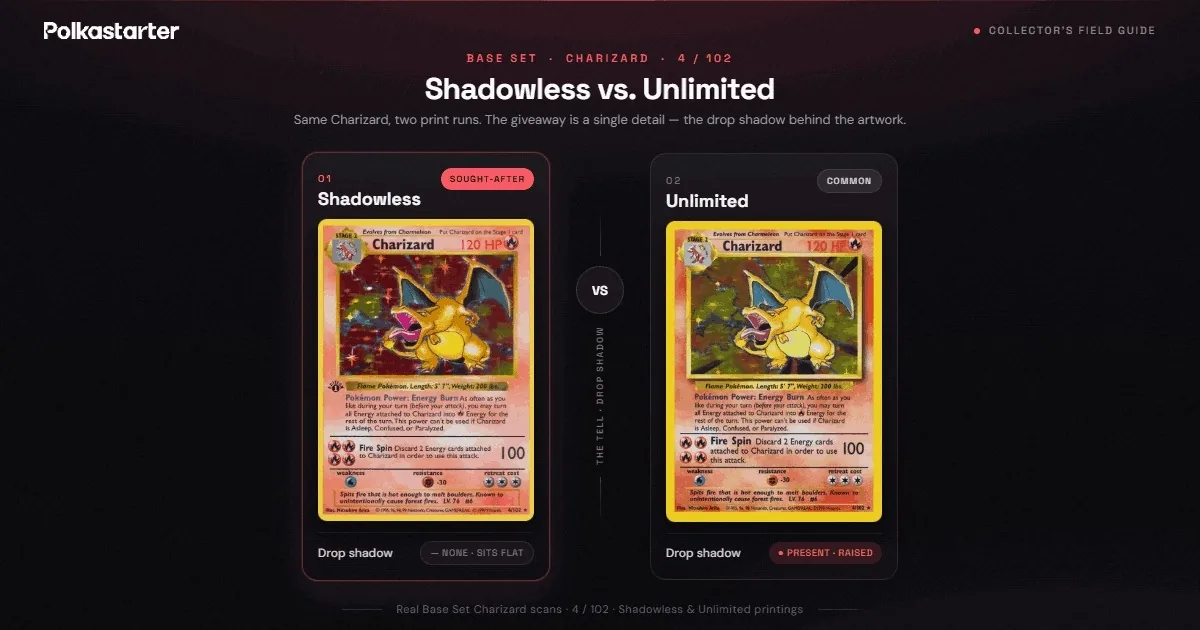
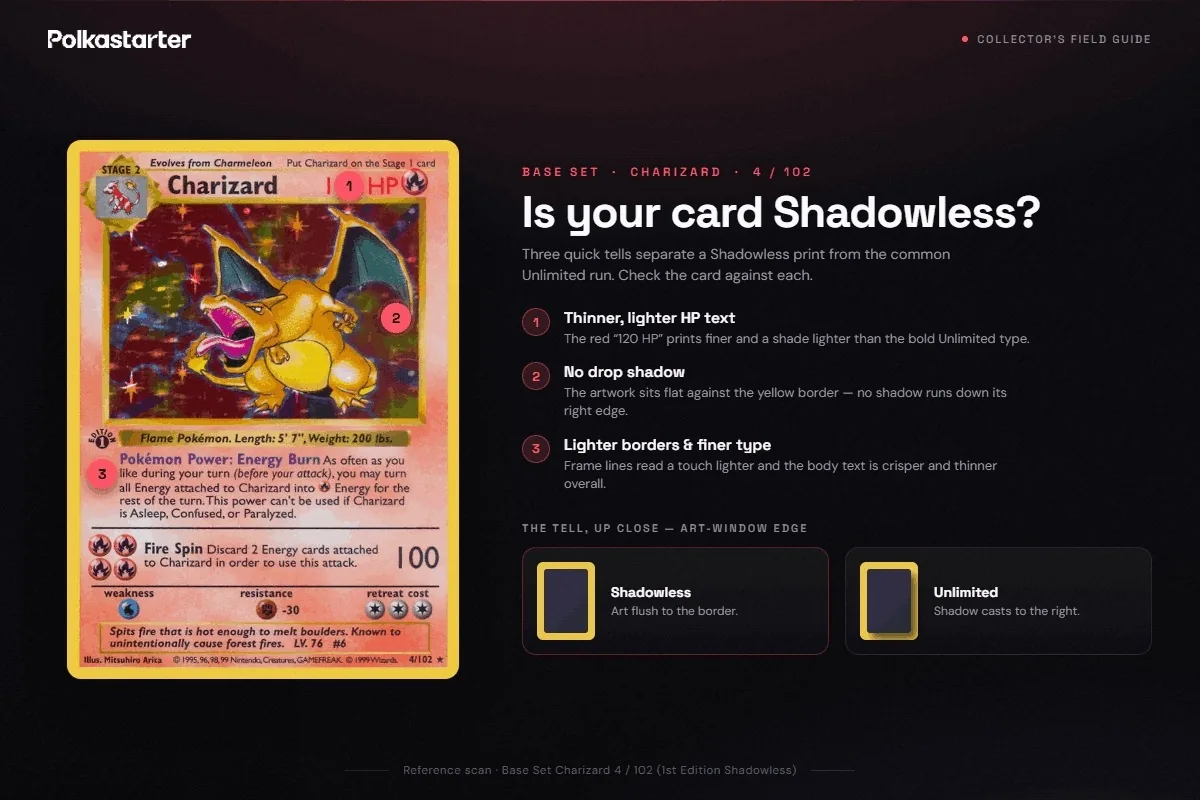
- The drop shadow (the primary tell). Look at the right edge of the artwork box. If the picture sits flat against the yellow border with no grey bar, the card is shadowless. If there is a grey shadow running down the right side, it is the common Unlimited version.
- HP text. Shadowless cards use thinner, lighter red HP text in the top right with tighter spacing. Unlimited prints look bolder and heavier.
- Borders and ink. Shadowless cards have lighter borders and finer type. Unlimited cards print darker and more saturated.
- Attack and Evolution text. On shadowless, the text in the attack and Stage boxes is finer and thinner. Unlimited reads heavier at a glance.
- The copyright line. This is the key test for Trainer and Energy cards, which have no artwork window for the shadow to apply to. A shadowless Base Set card's copyright line still includes the year 99. If the 99 is missing, it is Unlimited. More on this exception below.
- Check for the stamp. If the card also has an "Edition 1" stamp on the lower left of the artwork, it is 1st Edition, which is shadowless and a higher tier still.
No single tell is conclusive on a worn card, so use the shadow first and the text weight to confirm. When in doubt, set your card beside a known reference image of the same card.
Shadow vs Shadowless vs Unlimited
People search "shadow vs shadowless" because the word shadow is what tells the two cheaper versions apart. Here are the three Base Set variants in plain terms.
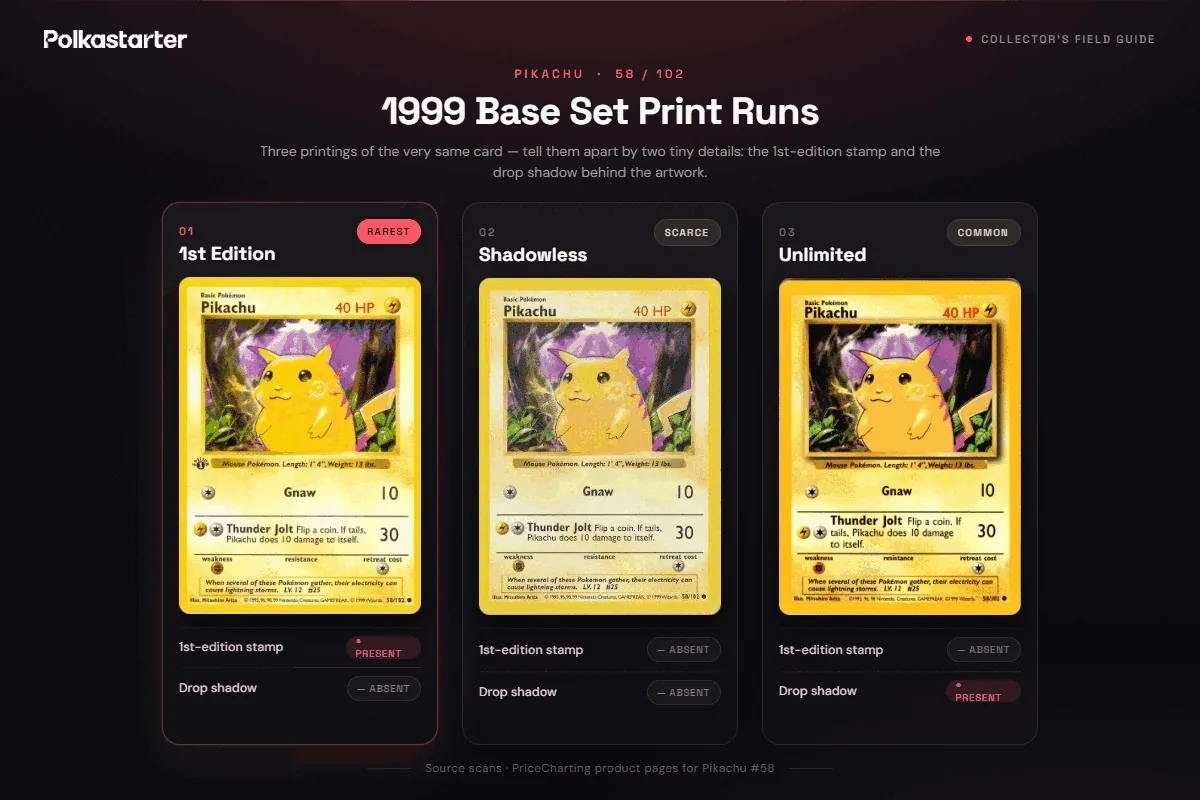
- 1st Edition. Has the "Edition 1" stamp and no shadow. Printed first, rarest, worth the most.
- Shadowless. No stamp and no shadow. The scarce middle tier, worth clearly more than Unlimited.
- Unlimited. No stamp and has the drop shadow. Printed in huge numbers and by far the most common, the version most people pulled as kids.
So "shadow" in collector talk means the Unlimited print, and "shadowless" means the earlier, scarcer one.
Shadowless vs 1st Edition: the Difference
This is the part that confuses almost everyone, so keep it simple. Every 1st Edition card is shadowless, but not every shadowless card is 1st Edition. 1st Edition came first and the shadow had not been invented yet, so those cards are shadowless by definition.
The only visual difference between a 1st Edition card and a plain shadowless card is the "Edition 1" stamp on the lower left of the artwork. Picture the stamp gone and the two are identical. That stamp matters a lot for price, because 1st Edition sells for far more, so the first thing to check on any shadowless card is whether it carries the stamp. No stamp and no shadow means it is shadowless but not 1st Edition.
Which Cards and Sets Are Shadowless
Only the 1999 English Base Set, the original 102-card set, has true shadowless cards. Later sets like Jungle and Fossil were printed with the shadow from the start, so they have 1st Edition and Unlimited versions but no shadowless version. When someone says a card is shadowless, they always mean Base Set.
A few specifics worth knowing.
- Every Base Set card exists in a shadowless print, including all 16 holos (Charizard, Blastoise, Venusaur, and the rest).
- Trainer and Energy cards are the exception to the shadow test. They have no artwork window, so the shadow never applied to them. Tell shadowless from Unlimited on these by the copyright line, a shadowless Trainer or Energy card still shows the year 99.
- A shadowless card can be any condition, and condition is what decides whether it is worth grading or just a nice keeper.
Are Shadowless Cards Worth More?
Yes. Shadowless cards are worth more than the common Unlimited versions, sometimes several times more for the marquee holos, but they sell for far less than 1st Edition. Demand and grade do the rest.
Current as of June 2026, prices move. Approximate ranges, verify live comps before you buy or sell.
- Shadowless Base Set Charizard (#4), PSA 10: roughly $30,000 to $50,000. For comparison, the 1st Edition version reaches into the six figures, with top sales reported in the hundreds of thousands of dollars, while the Unlimited PSA 10 sells for a small fraction of the shadowless price. See our most valuable Pokémon cards guide for where the grails sit.
- Other shadowless holos (Blastoise, Venusaur) in high grade run from the high hundreds into the low thousands of dollars, depending on grade.
- Shadowless commons and uncommons are modest raw, often a few dollars to low double digits, but still carry a premium over the Unlimited equivalent.
The pattern to remember: the shadowless premium and the grade premium stack, so a clean, high-grade shadowless holo is where the real money is, and a worn shadowless common is mostly a collector keepsake. For the value of gold and novelty cards, see our gold Pokémon cards guide.
How to Spot a Fake Shadowless Card
Counterfeiters target shadowless cards precisely because the premium is high, and they fake it two ways: by digitally erasing the shadow from an Unlimited scan, which leaves odd blurring or rough edges around the art box, and by simply passing an Unlimited card off as shadowless in a listing. Use the same method as any card, combined.
- The copyright line. A genuine Base Set card reads "©1995, 96, 98, 99 Nintendo, Creatures, GAMEFREAK." Fakes often get a year or the capitalization wrong. Match it to a real scan of that exact card.
- Edges around the art box. A digitally faked shadowless will show smudging or an unnatural edge where the shadow was painted out. A real shadowless border is clean.
- The light test and card stock. Real Base Set cards have an opaque inner black layer and a genuine 25-year patina. A card that lets too much light through, or looks suspiciously new, is a red flag.
- HP font and the back. Check the HP number's exact shape and the blue shade on the back against a known real card.
The full step-by-step is in our guide on how to tell if a Pokémon card is fake. For anything expensive, buy it already graded by PSA or CGC and the risk is gone.
Should You Grade a Shadowless Card?
Grade it when the upside clears the fee. A shadowless holo or a high-value card in clean condition is a strong candidate, because the shadowless premium and a high grade stack on top of each other. A common shadowless in played condition usually is not worth the cost.
Run the numbers before you send it. Our guides on how PSA grading works and whether PSA Grading is Worth It walk through turnaround, cost, and the break-even, and our CGC vs PSA comparison helps you choose the grader.
Frequently Asked Questions
What does shadowless mean on a Pokémon card?
Shadowless means a 1999 Base Set card printed without the drop shadow that later cards have along the right and bottom of the artwork box, so the picture sits flat against the yellow border. Shadowless was the second Base Set print run, after 1st Edition and before the common Unlimited version, which makes it scarcer and worth more than Unlimited.
How do you tell if a Pokémon card is shadowless?
Look at the right edge of the artwork box. If there is no grey drop shadow and the picture sits flat against the border, it is shadowless. A grey shadow bar means it is the common Unlimited version. Confirm with the lighter, thinner text, and on Trainer and Energy cards use the copyright line, which still includes the year 99 on shadowless prints.
Are all 1st edition Pokémon cards shadowless?
Yes. Every 1st Edition Base Set card is shadowless, because 1st Edition was printed before the shadow was added. The reverse is not true. A shadowless card is only 1st Edition if it also has the Edition 1 stamp on the lower left of the artwork. No stamp and no shadow means it is shadowless but not 1st Edition.
Are shadowless Pokémon cards worth more?
Yes, shadowless cards are worth more than the common Unlimited versions, sometimes several times more for key holos, but they sell for far less than 1st Edition. A shadowless Base Set Charizard in PSA 10 has sold in the range of about $30,000 to $50,000, while the 1st Edition version reaches into the six figures. Condition and grade decide the final price.
How rare are shadowless Pokémon cards?
Shadowless cards are much scarcer than Unlimited but more common than 1st Edition. They were printed only during a short early window of the 1999 Base Set before Wizards of the Coast added the drop shadow, after which the Unlimited run printed in huge numbers. Every Base Set card exists in shadowless, including all 16 holos.
Which Pokémon sets have shadowless cards?
Only the 1999 English Base Set, the original 102-card set, has true shadowless cards. Later sets like Jungle and Fossil were printed with the shadow from the start, so they have 1st Edition and Unlimited versions but no shadowless version. When people say shadowless, they always mean Base Set.
Where to Go From Here
So is your card shadowless? Tilt it to the light, look for a grey shadow on the right of the artwork, and check for the Edition 1 stamp. No shadow and no stamp puts you in the scarce shadowless tier, no shadow plus the stamp is the even rarer 1st Edition, and a shadow means the common Unlimited print. Confirm the card is genuine, weigh the grade, and you will know whether you are holding a few-dollar keepsake or a piece of the most collected set in the hobby.
Educational content only. Collectible prices are volatile, every figure here is an approximate June 2026 snapshot that will change, and nothing here is investment advice.
Sources
- Beckett — What Are Shadowless Cards in the Pokémon TCG
- CGC — How to Tell if a Pokémon Card Is First Edition
- TheGamer — What Are Shadowless Cards in the Pokémon TCG?
- TradingCardSets — 1st Edition, Shadowless, and Unlimited Explained
- PriceCharting — Shadowless Base Set Charizard #4 price history
- TCGplayer — Base Set Shadowless price guide
.png)

Ilknur Gubel is a social media manager at Polkastarter. Ilknur has spent the past four years working as a project manager, marketing manager, and social media strategist across Web3. She has held marketing and project management positions at several crypto companies, including Polygen, Nitro League, Kaizen.Finance, and ChainPort.
At Polkastarter she has covered trading card releases, collectible market pricing, and how token holders can spend crypto on real cards and videogames.
Based in Istanbul, Ilknur earned a bachelor's degree in sociology from Istanbul Aydın University.
You can connect with her on LinkedIn for more information.