.avif)
.png)
.avif)


Content
First Edition Pokémon Cards: How to Tell If Yours Is One (and What It's Worth)

A first edition Pokémon card is one from the very first print run of its set, marked by a small black "Edition 1" stamp, and on a vintage card that little stamp can be the difference between a few dollars and six figures. A 1st Edition Base Set Charizard in top grade has sold for over half a million dollars, while the same card without the stamp sells for a fraction of that. This guide shows you how to tell if a card is first edition in seconds, where the stamp sits on each card type, which sets and years actually had it, how it differs from shadowless and unlimited, and which first edition cards are genuinely worth money.
What Is a First Edition Pokémon Card?
A first edition Pokémon card is a card from the first print run of its set, identified by a small black "Edition 1" stamp, a numeral 1 above the word EDITION, usually inside an oval. The stamp was printed before the larger Unlimited run, so first edition cards are scarcer, and on vintage sets they carry a strong premium over the same card without the stamp.
The stamp is the whole story. Wizards of the Coast, the original English publisher, printed a limited first run of most early sets with the Edition 1 mark, then printed the much larger Unlimited run with no stamp. Fewer first edition cards exist, demand is high, and that is what drives the price. The catch, which we cover below, is that the stamp only carried that meaning during a specific early era, and not every set or every region used it the same way.

How to Tell If Your Card Is First Edition
There is one tell that settles it, the stamp, and then a couple of checks to confirm it is genuine.
- Find the Edition 1 stamp. Look for a small black stamp showing a 1 above the word EDITION. If it is there, you have a first edition card. If there is no stamp, the card is Unlimited or, on early Base Set, Shadowless.
- Know where to look, it moves by card type. This is the part people miss:
- Pokémon and Trainer cards: the stamp sits in the lower left, just below the artwork.
- Energy cards: the stamp sits in the top right instead.
- Confirm it is real with the shadow. Every genuine vintage first edition Base Set card is also shadowless, meaning no drop shadow on the right of the artwork box. So a card that shows the Edition 1 stamp and a drop shadow is automatically fake. More on faked stamps below, and see our guide to shadowless Pokémon cards for that check.
- Check the stamp quality. A real stamp has sharp, cleanly inked edges in the correct position. A blurry, crooked, or oddly placed stamp is a red flag.

The stamp is the fastest positive ID in the hobby. Just make sure it is in the right place for the card type and that the card is otherwise genuine before you celebrate.
Which Sets and Years Had First Edition
First edition is an early-era English feature, not something on modern cards, and this is where a lot of confusion starts.
- English first edition ran from 1999 to about 2002, starting with Base Set and continuing through the Neo era, ending around Neo Destiny.
- Two sets skipped it entirely: Base Set 2 and Legendary Collection were printed in Unlimited only, so no first edition exists for them.
- It stopped for good around 2002 to 2003, when timed releases ended and Nintendo took over the TCG from Wizards of the Coast. By late 2001 the first edition runs were arriving alongside or even after the Unlimited run, which made them far less meaningful, and the practice was dropped.
- Modern English cards do not have first edition. If a card is from the last roughly twenty years of English sets, it will not carry an Edition 1 stamp, so a "first edition" claim on a modern English card is a misunderstanding or a fake.
So a genuine English first edition card is, by definition, a vintage card from 1999 to 2002.
First Edition vs Shadowless vs Unlimited
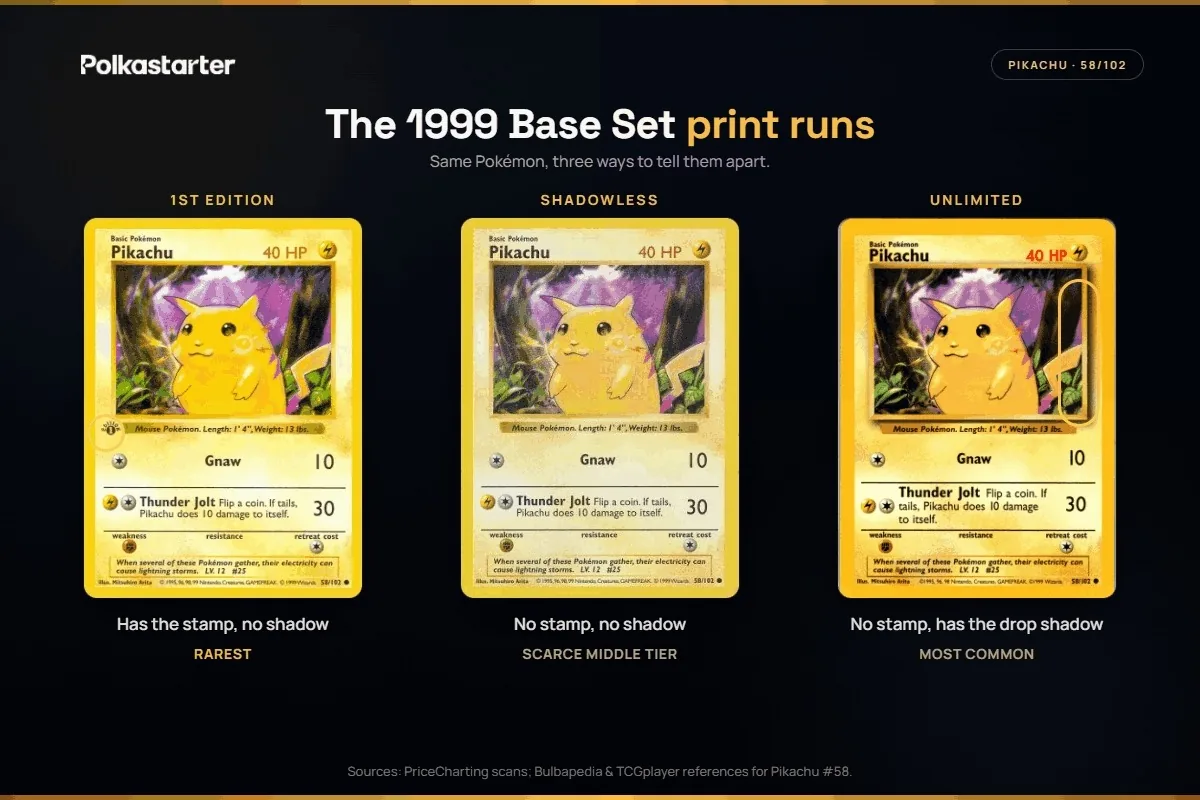
For the 1999 Base Set there are three versions, and people mix them up constantly. Here they are in plain terms.
- 1st Edition. Has the Edition 1 stamp and no drop shadow. The first and rarest run, worth the most.
- Shadowless. No stamp and no drop shadow. The scarce middle tier, printed right after 1st Edition.
- Unlimited. No stamp and has the drop shadow on the right of the artwork box. By far the most common.
The key fact that links them: every 1st Edition card is shadowless, but not every shadowless card is 1st Edition. The stamp is the dividing line. For the full shadow test, see our shadowless Pokémon cards guide.
Do Japanese Cards Have First Edition?
Yes, but it works differently, and this trips up a lot of buyers. Japanese cards did not use a first edition mark at first. The symbol was added to Japanese first print runs starting in 2001 and continued until about 2016. It looks different from the English stamp, a large 1 over the word EDITION between two lines, and it sits in the lower right of Pokémon and Trainer cards, not on Energy cards.
The important difference is value. Japanese first editions are often more common than their Unlimited counterparts, the opposite of the English pattern, so a Japanese first edition mark usually does not carry the big premium an English one does. For more on Japanese values, see our guide on whether Japanese Pokémon cards are worth more.
Are First Edition Pokémon Cards Worth Anything?
Some are worth a fortune, and many are worth very little, so the honest answer is that the stamp adds value only when the card was scarce and is in demand to begin with.
Current as of June 2026, prices move. Approximate ranges, verify live comps before you buy or sell.
- 1st Edition Base Set Charizard #4, PSA 10: a record $550,000 (Heritage, December 2025), with raw near-mint around $3,000 to $6,000 and a PSA 9 around $75,000 to $120,000. This is the top of the whole vintage market. See our most valuable Pokémon cards guide for the full grails list.
- 1st Edition Base Set holos like Blastoise and Venusaur run from thousands into the tens of thousands in high grade.
- 1st Edition commons and uncommons are modest, often a few dollars to low double digits raw, because the card was never scarce, the stamp alone does not make a common card valuable.
What decides it: the specific card, its print scarcity, condition, and grade. A first edition holo in clean, graded condition is where the money is, a first edition common in played shape is mostly a keepsake. For where novelty and gold cards fit, see our gold Pokémon cards guide.
How to Spot a Fake First Edition Stamp
Because the stamp adds so much value, faking it is common, so treat any unverified first edition card with suspicion. Counterfeiters either add a stamp to an Unlimited card or print a sloppy one from scratch.
- The shadow test is the killer tell. Every genuine first edition Base Set card is shadowless. A card with the Edition 1 stamp that also has a drop shadow on the artwork box is fake, no exceptions.
- Stamp quality and position. A real stamp is crisp and correctly placed (lower left on Pokémon and Trainer cards, top right on Energy cards). Blurry, smeared, crooked, or oddly placed stamps, or absurd ones like an "Edition 3," are fakes.
- The usual authentication. Card feel and stock, the light test for the inner black layer, the HP font, and the back color all still apply.
For the full real-versus-fake checklist, see our guide on how to tell if a Pokémon card is fake. For anything expensive, buy it already graded by PSA or CGC and the risk is gone.
Should You Grade a First Edition Card?
Grade it when the upside clears the fee. A first edition holo or a sought-after card in clean condition is a strong candidate, because the first edition premium and a high grade stack. A common first edition in played shape usually is not worth the cost.
Run the numbers before you send it. Our guides on how PSA grading works and whether PSA Grading is Worth It cover the cost and break-even, and our CGC vs PSA comparison helps you choose the grader.
Frequently Asked Questions
How do you tell if a Pokémon card is first edition?
Look for a small black "Edition 1" stamp, a numeral 1 above the word EDITION. On Pokémon and Trainer cards it sits in the lower left below the artwork, and on Energy cards it sits in the top right. If the stamp is there, the card is first edition. Confirm it is genuine, because every real vintage first edition is also shadowless, so a stamped card that has a drop shadow is fake.
What does first edition mean on a Pokémon card?
It means the card came from the first print run of its set, before the larger Unlimited run. Wizards of the Coast printed a limited first batch with the Edition 1 stamp, then printed Unlimited cards with no stamp. Fewer first edition cards exist, which is why, on scarce vintage cards, the stamp can multiply the value.
Are all first edition Pokémon cards shadowless?
Yes, for Base Set. Every genuine first edition Base Set card is shadowless, because first edition was printed before the drop shadow was added. The reverse is not true, a shadowless card is only first edition if it also has the Edition 1 stamp. This is also a fake test, a first edition stamp on a card that has a drop shadow is automatically fake.
Are first edition Pokémon cards worth anything?
Some are worth a fortune and many are not. A 1st Edition Base Set Charizard PSA 10 has sold for $550,000, and first edition holos run into the thousands or tens of thousands, but first edition commons are often only a few dollars. The stamp adds value only when the card was scarce and in demand to begin with. Condition and grade decide the rest.
Do they still make first edition Pokémon cards?
No, not in English. English first edition ran from 1999 to about 2002, from Base Set through the Neo era, and stopped when Nintendo took over the TCG. Modern English cards do not have an Edition 1 stamp, so any "first edition" claim on a recent English card is a misunderstanding or a fake.
Do Japanese Pokémon cards have first edition?
Yes, but differently. Japanese first edition marks appeared from about 2001 to 2016, sit in the lower right of Pokémon and Trainer cards, and look different from the English stamp. They usually do not carry the same premium, because Japanese first editions are often more common than their Unlimited versions, the opposite of the English pattern.
Where to Go From Here
So is your card first edition? Find the stamp, lower left on a Pokémon or Trainer card, top right on an Energy card, then confirm the card is shadowless and genuine. A real stamp on a scarce vintage holo can be worth thousands or more, a stamp on a common is a nice piece of history but not a payday. Identify the exact card, confirm it is real, weigh the grade, and you will know which one you are holding.
Educational content only. Collectible prices are volatile, every figure here is an approximate June 2026 snapshot that will change, and nothing here is investment advice.
- CGC — How to Tell if a Pokémon Card Is First Edition
- Bulbapedia — 1st Edition (TCG), history and regions
- PSA — Collecting the 1999 1st Edition Base Set
- Wargamer — How to Spot First Edition Pokémon Cards
- TheGamer — Most Valuable First Edition Pokémon Cards
- PriceCharting — 1st Edition Base Set Charizard #4 value
.png)

Ilknur Gubel is a social media manager at Polkastarter. Ilknur has spent the past four years working as a project manager, marketing manager, and social media strategist across Web3. She has held marketing and project management positions at several crypto companies, including Polygen, Nitro League, Kaizen.Finance, and ChainPort.
At Polkastarter she has covered trading card releases, collectible market pricing, and how token holders can spend crypto on real cards and videogames.
Based in Istanbul, Ilknur earned a bachelor's degree in sociology from Istanbul Aydın University.
You can connect with her on LinkedIn for more information.