.avif)
.png)
.avif)


Content
Old Pokémon Cards Worth Money: Which 1999 Cards Are Valuable (and How to Check Yours)

Some old Pokémon cards are worth thousands, but most are worth a few dollars, and the difference is not about how old or shiny a card looks. The real money is in the 1999 Base Set holos, especially the 1st Edition and Shadowless prints, while the gold Burger King cards and common cards most people have are worth very little. This guide shows you which old cards are actually valuable, which ones only look valuable, and exactly how to check your own collection.
Are Old Pokémon Cards Worth Money?
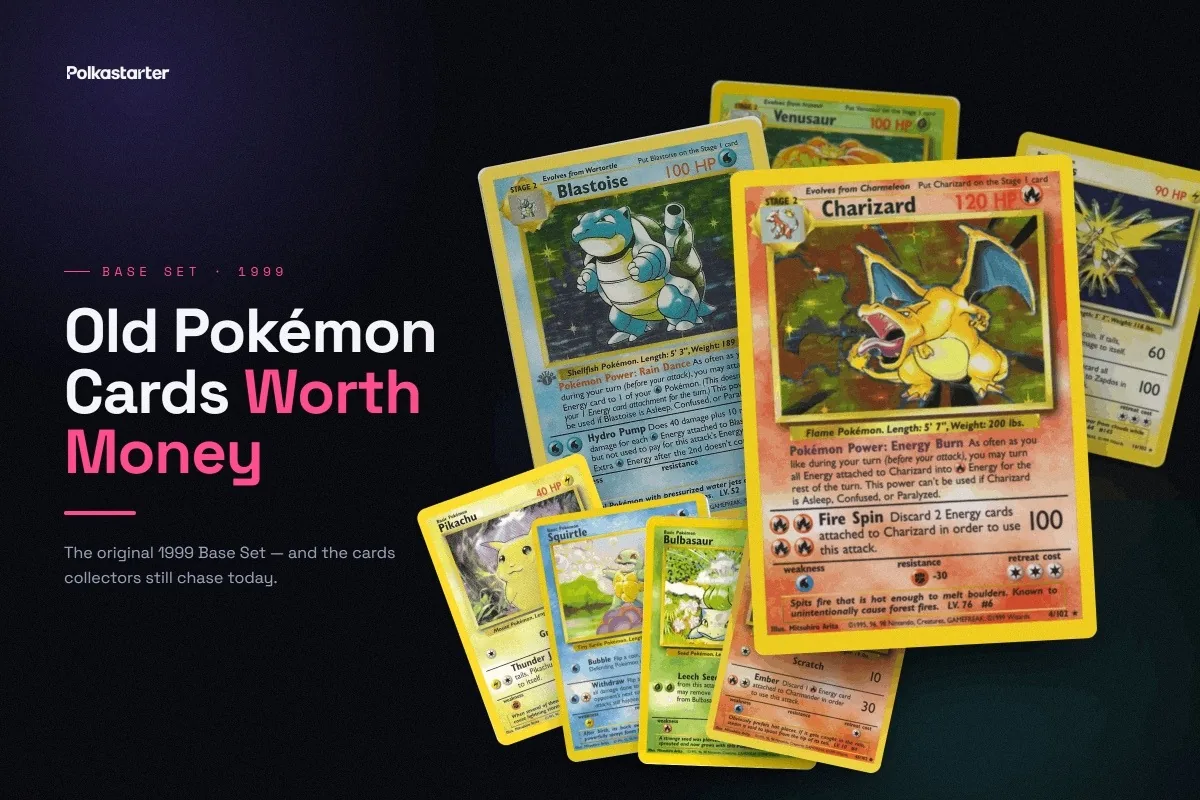
Some are, most are not. The valuable old cards are almost all 1999 Base Set holographic cards, and the biggest money is in the 1st Edition and Shadowless prints of the marquee Pokémon. A 1st Edition Base Set Charizard has sold for over half a million dollars. But the majority of old cards, the commons, the non-holos, the gold Burger King promos, are worth a few dollars, no matter how old they look. Age and shine are not value, the print and the condition are.
Below is the honest version: which old cards are worth real money, which ones are not, and how to tell what you have.
Which Old Pokémon Cards Are Actually Worth Money
The value lives in the 1999 Base Set holos, and it climbs fast with the earlier prints.
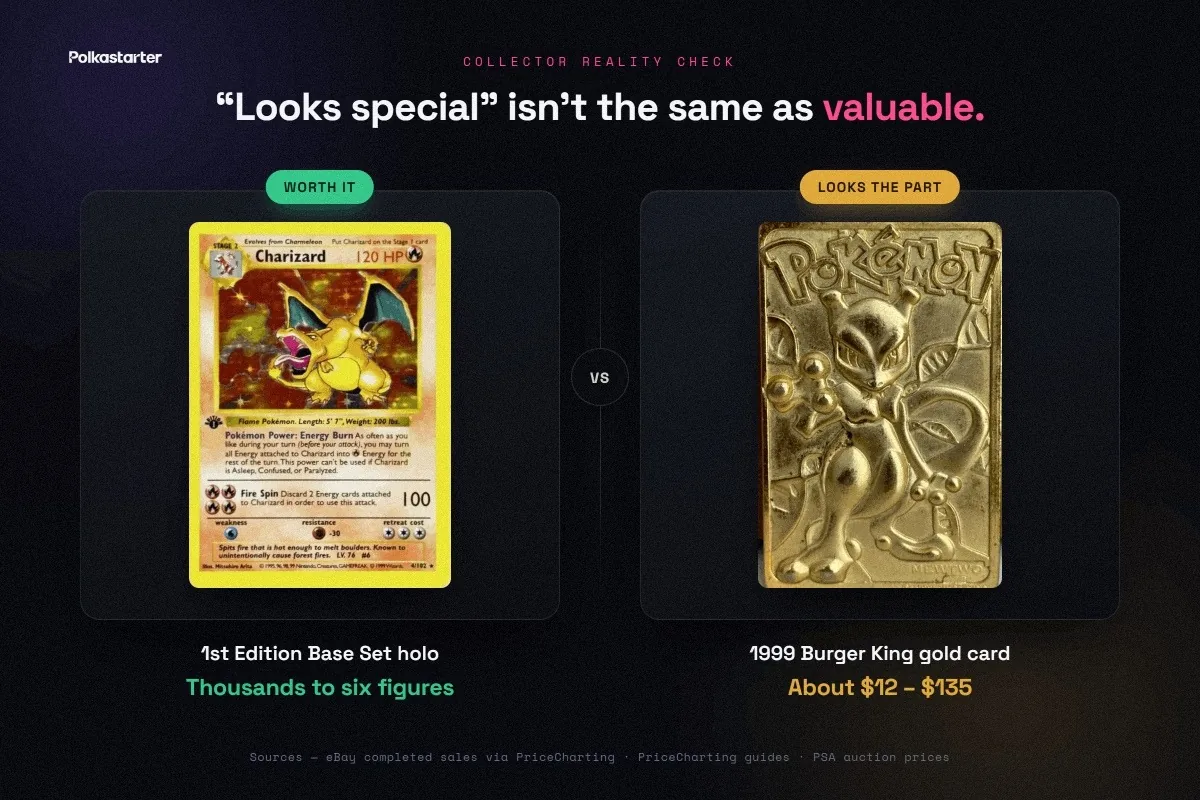
- 1st Edition Base Set Charizard #4. The holy grail. A PSA 10 sold for a record $550,000, raw near-mint runs about $3,000 to $6,000, and a PSA 9 reaches into the tens of thousands. See our most valuable Pokémon cards guide for the full grails list.
- 1st Edition Base Set Blastoise #2 and Venusaur #15. The water and grass halves of the holo big three. A 1st Edition Venusaur PSA 10 runs from about $5,000 into the tens of thousands, and 1st Edition Blastoise reaches similar highs, a top Gem Mint copy has sold near $88,000.
- Shadowless Base Set Charizard. The print between 1st Edition and Unlimited, no stamp and no drop shadow. PSA 10 runs about $40,000 to $60,000. Our shadowless guide shows how to spot it.
- Unlimited Base Set holos, the big three. Even the common Unlimited holos carry real value. A raw Unlimited Blastoise runs about $200 to $250, Venusaur about $150, and Charizard into the hundreds to low thousands, with graded copies worth much more.
- The rest of the Base Set holos (Mewtwo, Gyarados, Zapdos, and so on) run from tens of dollars up, more in high grade.
The pattern to remember: 1st Edition beats Shadowless beats Unlimited, holo beats non-holo, and condition multiplies all of it. Check whether a card is 1st edition first, it is the single biggest value signal.
The Old Cards People Think Are Valuable (But Usually Are Not)
This is where the treasure hunt disappoints most people, so here is the honest version.
- 1999 Burger King gold cards. The gold-plated Charizard, Pikachu, Mewtwo, and others that came in a Poké Ball case for $1.99. They look special, but they are worth about $12 to $135 depending on the character and condition, with complete sets around $200. Too many were made and kept in good shape to ever be rare. See our gold Pokémon cards guide for the full story.
- 1999 Topps Pokémon TV Animation cards. The cards based on the anime, not the actual TCG. They average about $7, with most between $1 and $20, and only the rare holo or graded gems reaching higher.
- Common and non-holo cards. A common 1999 card in played condition is usually worth under a dollar, no matter the year on it.
- "It is old, so it is rare." Age is not rarity. Plenty of vintage commons are worth cents. The value is in the specific card, the print, and the condition, not the date.
None of this means your old cards are worthless, it means you have to identify the actual valuable ones, which is the next step.
How to Check If Your Old Pokémon Cards Are Worth Money
Work top to bottom, because each step changes the value dramatically.
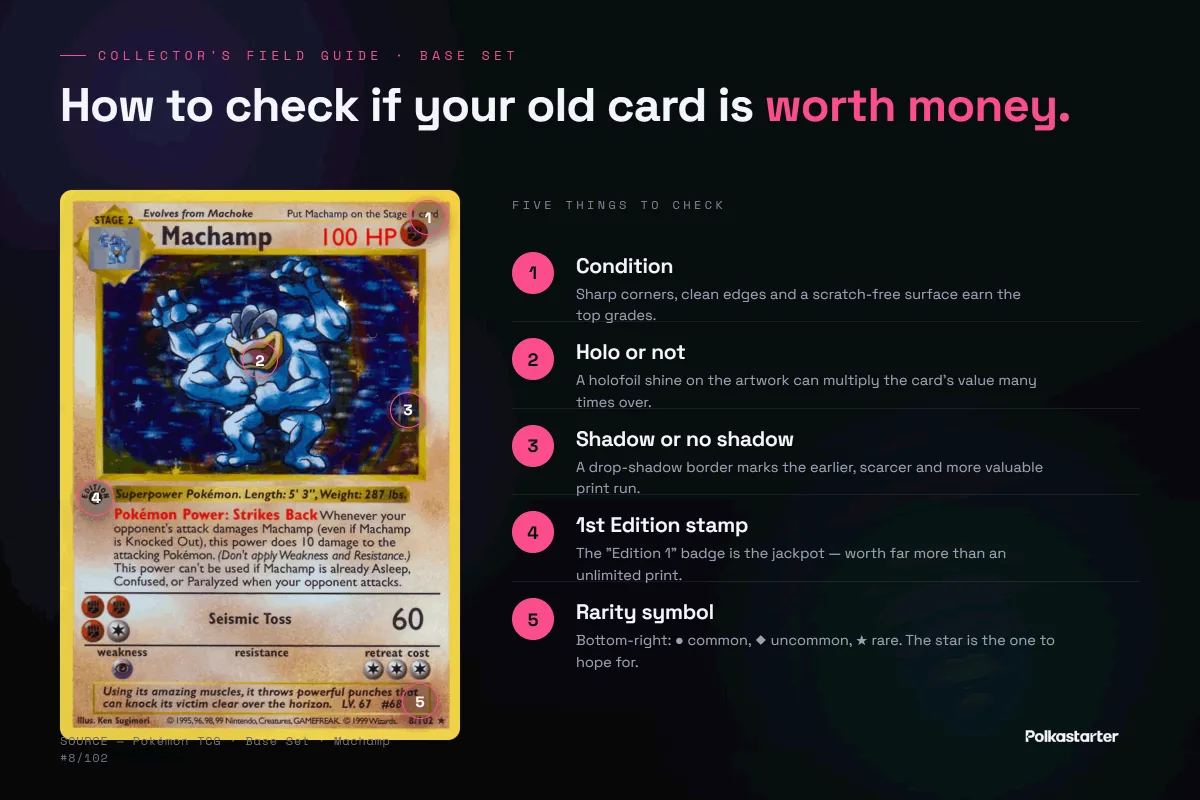
- Check for the 1st Edition stamp. A black "Edition 1" stamp on the lower left of a Base Set card marks the rarest print and can mean six figures on a Charizard. See how to tell if a card is first edition.
- Shadowless or Unlimited. On a Base Set card with no stamp, look at the right edge of the art box. No grey drop shadow means the scarcer Shadowless print, worth several times the Unlimited version.
- Holo or not. A holo card, where the artwork shines, is worth many multiples of a non-holo of the same card.
- Read the rarity symbol. In the bottom corner, a circle is Common, a diamond is Uncommon, and a star is Rare. Our rarity symbols guide decodes the full chart.
- Condition is a multiplier. Under good light, check for edge and corner whitening, surface scratches, off-centering, and creases. A near-mint copy can be worth many times a played one.
How to Look Up What Your Cards Are Worth
Once you have identified the exact card and its condition, price it on real sold data, not asking prices.
- PriceCharting. Splits values by ungraded, graded, and print, ideal for vintage cards.
- eBay, Sold Items filter. Completed sales show what a card in your condition actually sells for, and you can match condition from the photos.
- Average several recent comps of the same print and grade, and treat any single figure as a range, not a guarantee.
- When you are ready to buy or sell, the Polkastarter marketplace covers rare cards and sealed games.
Watch Out for Fakes
Value attracts counterfeits, and the 1999 Base Set Charizard is the single most faked Pokémon card, so a "valuable" old card is worth nothing if it is fake. A quick tell: a card stamped "1st Edition" that has a drop shadow is automatically fake, because every genuine 1st Edition is shadowless. For the full real-versus-fake checklist, the loupe test, the light test, and the slab checks, see how to tell if a Pokémon card is fake. For anything worth about $100 or more, grading verifies authenticity.
Frequently Asked Questions
Are old Pokémon cards worth money?
Some are, most are not. The valuable old cards are almost all 1999 Base Set holos, especially the 1st Edition and Shadowless prints of Charizard, Blastoise, and Venusaur. Commons, non-holos, and the gold Burger King promos are usually worth a few dollars. Age and shine are not value, the print and the condition are.
What old Pokémon cards are worth the most money?
The 1st Edition Base Set Charizard leads, with a PSA 10 selling for a record $550,000. The 1st Edition Blastoise and Venusaur reach into the tens of thousands in top grade, and the Shadowless Charizard runs about $40,000 to $60,000 in PSA 10. Even Unlimited Base Set holos of the big three carry real value, from about $150 up.
How much are 1999 Pokémon cards worth?
It depends entirely on the card, print, and condition. A 1st Edition Base Set holo can be worth thousands to six figures, a Shadowless or Unlimited holo hundreds to thousands, and a common non-holo under a dollar. Check whether it is 1st Edition, Shadowless, or Unlimited, whether it is holo, and its condition, then price it on recent sold comps.
Are 1999 Burger King gold Pokémon cards worth money?
Usually not much. The gold-plated Burger King cards run about $12 to $135 depending on the character and condition, with complete sets around $200. Too many were made and kept in good shape to become rare. They look special, but the real value in old cards sits in the 1999 Base Set holos, not the gold promos.
How can you tell if your old Pokémon cards are valuable?
Check for the 1st Edition stamp on the lower left, then whether a Base Set card is Shadowless (no drop shadow on the art box) or Unlimited, whether it is holo, its rarity symbol, and its condition. Those signals, in that order, decide the value. Then look up recent sold comps on PriceCharting and eBay for that exact card and print.
Are old Topps Pokémon cards worth anything?
Mostly a little. The 1999 Topps Pokémon TV Animation cards average about $7, with most between $1 and $20, and only rare holo or graded copies worth more. They are based on the anime, not the main trading card game, so they do not carry the value of Base Set holos.
Where to Go From Here
The headline is simple: your old cards are worth checking, but the value is concentrated in the 1999 Base Set holos, not the gold cards or the commons. Look for the 1st Edition stamp, check for the shadow, confirm it is holo, judge the condition, and price it on recent sold comps. Do that and you will know in minutes whether your old binder holds a few dollars or a genuine grail.
Educational content only. Collectible prices are volatile, every figure here is an approximate July 2026 snapshot that will change, and nothing here is investment advice.
Sources
.png)


Ilknur Gubel is a social media manager at Polkastarter. Ilknur has spent the past four years working as a project manager, marketing manager, and social media strategist across Web3. She has held marketing and project management positions at several crypto companies, including Polygen, Nitro League, Kaizen.Finance, and ChainPort.
At Polkastarter she has covered trading card releases, collectible market pricing, and how token holders can spend crypto on real cards and videogames.
Based in Istanbul, Ilknur earned a bachelor's degree in sociology from Istanbul Aydın University.
You can connect with her on LinkedIn for more information.